
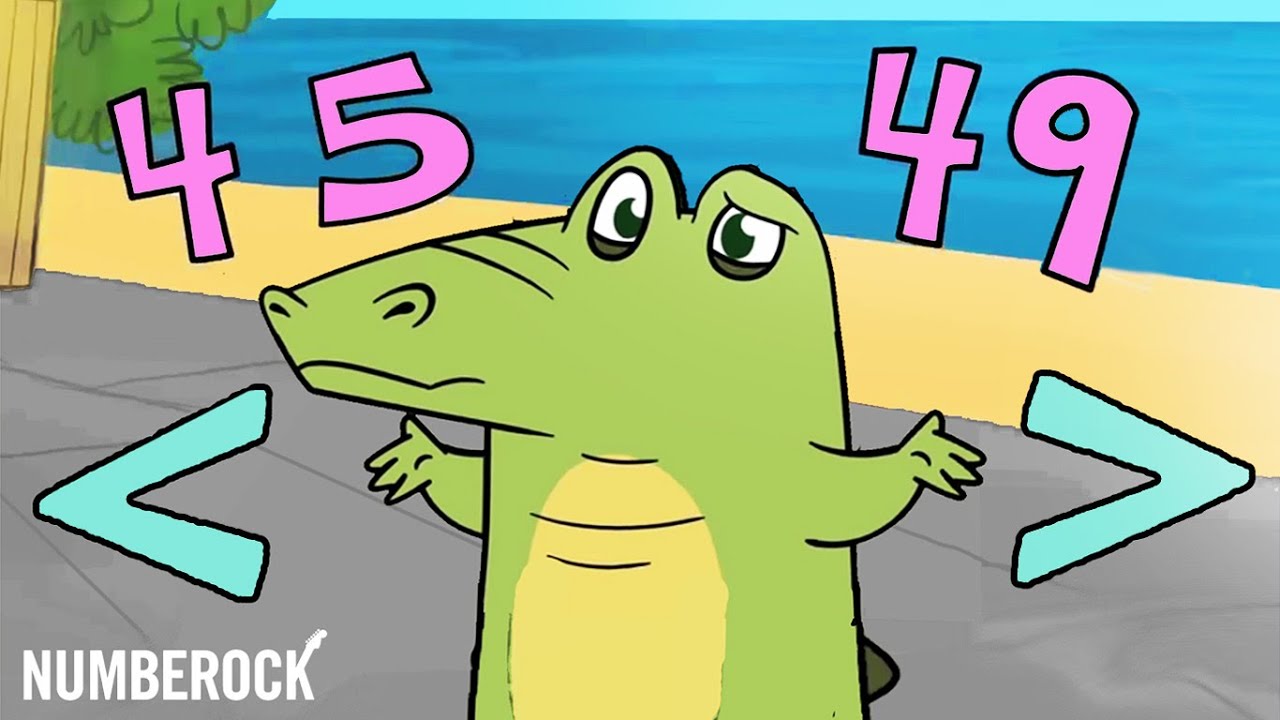
1st Grade teachers, explore Numberock’s equally fun teaching resources with a free month of access available for a limited time at Thank you for watching our Comparing Numbers to 100 Song. Q. What does comparing numbers mean? A. Comparing numbers is to examine the difference between two numbers to decide if one is equal to, greater than or less than the other and to determine by how much. Q. What grade levels do this video target? A. This video targets learning standards in Kindergarten and 1st Grade. This video also targets standards in the UK from KS1 (Year 1 and 2).
Vous aimerez aussi
Year6 Maths
Year4 Maths
3rd Grade Math
How to Play Chess
Year 6 Math
Algebra II | High School Math | Khan Academy
Math for Kids
A savoir faire en mathématiques en Seconde
Year 9 Math
Fractions for Kids
Numberblocks - Number Adventures | Learn to Count | Maths for Kids
Numberblocks Fun! | Learn To Count | @Numberblocks
Numberblocks Special Moments ✨
Kids Songs by CoComelon
Learn English With Disney Movies
Learn Colors with CoComelon!
Year 10 Math
Year3 Maths
CoComelon
Alphabet (ABC) Songs by CoComelon
PrePrimary Maths
Year1 Maths
Year 11 Math
Year2 Maths
Commentaires
10 commentaires
Our mission? Make learning fun, engaging, and oh-so-easy for both you & your students. Our library of lesson materials is not only super-affordable but is also FREE to try out at Thank you for watching our Months of the Year Song. Why are there 12 months in a year? During the reign of Julius Ceasor his astrologers explained the need for 12 months in a year to synchronize with the seasons. Previously there were only 10 months while there were 12 lunar cycles.
Our mission? Make learning fun, engaging, and oh-so-easy for both you & your students. Our library of lesson materials is not only super-affordable but is also FREE to try out at Thank you for watching our Months of the Year Song. Why are there 12 months in a year? During the reign of Julius Ceasor his astrologers explained the need for 12 months in a year to synchronize with the seasons. Previously there were only 10 months while there were 12 lunar cycles.
Our mission? Make math fun, engaging, and oh-so-easy for both you & your students. Our library of lesson materials is not only super-affordable but is also FREE to try out at Video Summary: “3-D shapes! You know, those colorful things that make you feel like a three-dimensional kid again. Let’s explore a few of them, as seen in the video above, and address the burning question: Do these shapes serve any purpose, or can we simply banish them from our lives altogether?” 😄🔍 Cylinders: Picture it: you’re sipping your fizzy drink, and there it is—a cylinder, just hanging out, being all cylindrical. Two circular bases, congruent and parallel faces. It’s like they’re saying, “Hey, I’m practical! Store your soup or your soda in me!” 🥫🥤 Cones: You spot these bad boys in construction zones, right next to the orange cones that scream, “I was born this way!” But wait, there’s more! Cones can be cream holders. 🍦🚧 Wherever you see a circular base which has points that meet at the tippy-top, just lik
Our mission? Make math fun, engaging, and oh-so-easy for both you & your students. Our library of lesson materials is not only super-affordable but is also FREE to try out at Video Summary: “3-D shapes! You know, those colorful things that make you feel like a three-dimensional kid again. Let’s explore a few of them, as seen in the video above, and address the burning question: Do these shapes serve any purpose, or can we simply banish them from our lives altogether?” 😄🔍 Cylinders: Picture it: you’re sipping your fizzy drink, and there it is—a cylinder, just hanging out, being all cylindrical. Two circular bases, congruent and parallel faces. It’s like they’re saying, “Hey, I’m practical! Store your soup or your soda in me!” 🥫🥤 Cones: You spot these bad boys in construction zones, right next to the orange cones that scream, “I was born this way!” But wait, there’s more! Cones can be cream holders. 🍦🚧 Wherever you see a circular base which has points that meet at the tippy-top, just lik
2nd and 3rd Grade teachers, explore Numberock’s equally fun teaching resources with a free month of access available for a limited time at Thank you for watching our subtraction math facts song and learning to subtract with us!
2nd and 3rd Grade teachers, explore Numberock’s equally fun teaching resources with a free month of access available for a limited time at Thank you for watching our subtraction math facts song and learning to subtract with us!
1st and 2nd Grade teachers, explore Numberock’s equally fun teaching resources with a free month of access available for a limited time at Thank you for watching our Skip Counting by 10 Song for Kids | For 1st Grade & 2nd Grade »»-------------¤-------------««»»-------------¤-------------«« We count by 10, again and again! Strap on your snowboarding boots! We are headed to the mountains in this new live action times table song. Learn the 10 times table with a backdrop of majestic mountains along with some pretty gnarly snowboarding skills. Q. What grade levels do this video target? A. This video targets learning standards in 1st Grade to 3rd Grade. This video also targets standards in the UK from KS1 (Year 2) to KS2 (Year 3). Q. Where did you guys come from? A. Numberock is a project that I, Mr. Hehn, began as a 5th Grade math teacher of 7 years. It came together after years of experimenting with my lessons trying to figure out the best way to help my students retain the math concepts t
1st and 2nd Grade teachers, explore Numberock’s equally fun teaching resources with a free month of access available for a limited time at Thank you for watching our Skip Counting by 10 Song for Kids | For 1st Grade & 2nd Grade »»-------------¤-------------««»»-------------¤-------------«« We count by 10, again and again! Strap on your snowboarding boots! We are headed to the mountains in this new live action times table song. Learn the 10 times table with a backdrop of majestic mountains along with some pretty gnarly snowboarding skills. Q. What grade levels do this video target? A. This video targets learning standards in 1st Grade to 3rd Grade. This video also targets standards in the UK from KS1 (Year 2) to KS2 (Year 3). Q. Where did you guys come from? A. Numberock is a project that I, Mr. Hehn, began as a 5th Grade math teacher of 7 years. It came together after years of experimenting with my lessons trying to figure out the best way to help my students retain the math concepts t
1st and 2nd Grade teachers, explore Numberock’s equally fun teaching resources with a free month of access available for a limited time at Did you know there's a quick and easy way for multiplying any number by 5 easily? Well, there is! Simply multiply any number by 10 and then divide by 2! Q. What grade levels do this video target? A. This video targets learning standards in 1st Grade and 2nd Grade, and also touches on the multiplication tables in the 3rd grade standards. This video also targets standards in the UK from KS1 (Year 2) to KS2 (Year 3). Q. I'd like to show my students this video but my school blocks YouTube videos. Where else can I watch this video to work around this problem? A. You can watch this video here; ad-free and child-safe: Q. Where did you guys come from? A. Numberock is a project that I, Mr. Hehn, began as a 5th Grade math teacher of 7 years. It came together after years of experimenting with my lessons trying to figure out the best way to help my students ret
1st and 2nd Grade teachers, explore Numberock’s equally fun teaching resources with a free month of access available for a limited time at Did you know there's a quick and easy way for multiplying any number by 5 easily? Well, there is! Simply multiply any number by 10 and then divide by 2! Q. What grade levels do this video target? A. This video targets learning standards in 1st Grade and 2nd Grade, and also touches on the multiplication tables in the 3rd grade standards. This video also targets standards in the UK from KS1 (Year 2) to KS2 (Year 3). Q. I'd like to show my students this video but my school blocks YouTube videos. Where else can I watch this video to work around this problem? A. You can watch this video here; ad-free and child-safe: Q. Where did you guys come from? A. Numberock is a project that I, Mr. Hehn, began as a 5th Grade math teacher of 7 years. It came together after years of experimenting with my lessons trying to figure out the best way to help my students ret