
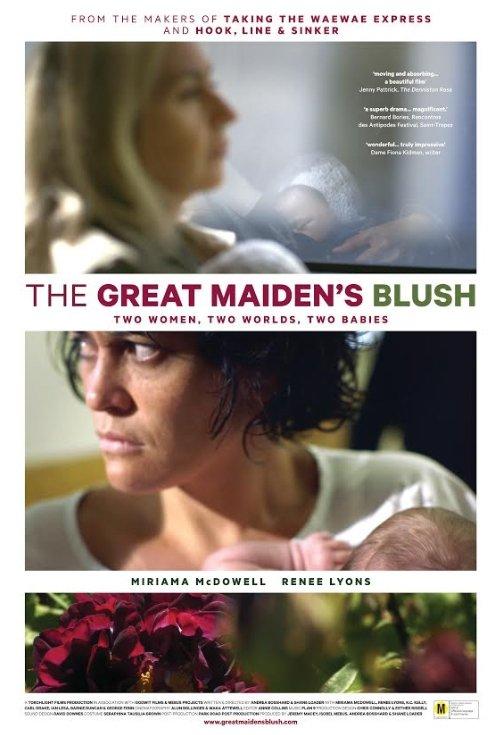
When Bunny and Aila face the challenges of new motherhood, they develop a precarious friendship leading each to confront her past and come to terms with the paternity of her baby.
Trailer
Cast
Renee Lyons
Aila
Miriama McDowell
Bunny
K.C. Kelly
Aleksandar Petrovic
Carl Drake
Henry
Ian Lesa
Noel
Barnie Duncan
Andrej
George Fenn
Luke
Madeline McNamara
Aila's Mother
Carmel McGlone
Social Worker
Gavin Rutherford
Guard
Kerryn Palmer
Charge Nurse
Dra McKay
Midwife
Heather O'Carroll
Maternity Nurse
Isobel Mebus
Beth
Christopher Brougham
Eric
Rangimoana Taylor
Kaumatua
Sabrina Martin
Partner in neo-natal
Alana Henderson
Nurse
Maaari Mo Ring Magustuhan
The Great Maiden's Blush
Orphans & Kingdoms
Holy Days
Sistas
Teen Wolf
The Rookie
Legacies
The Night Agent
XO, Kitty
SEAL Team
Empire
From
Siren
The Wheel of Time
Cobra Kai
Tulsa King
Blood & Water
BMF
Wura
True Beauty
Ithonga
Emily in Paris
All of Us Are Dead
Bon Appétit, Your Majesty
Mga Komento
6 Mga Komento
source: The Great Maiden's Blush
I don't want to discuss the story itself in this review, but rather its structure, as that was the more impressive element of the film, and a very interesting achievement of the writer-directors. It is a cat's cradle of a story, with complex symmetrical and interlocking lines leading between the two characters, Bunni and Aila. It is also a rounded yin-yang of a tale, as the two halves fit together with equal strength and balance, with bits of each seeping into the other's persona and story, inducing odd resonances. One is motherless, the other is fatherless; one bears a baby girl and the other a boy; one is dark and one is fair (one Maori, one Pakeha); one is masculine, skilled with driving and automotives, the other more feminine, a talented pianist with a penchant for gardening. Both have key encounters with father-son pairs who touch them on a very deep level; both have kept secret the identity of their babies' fathers. One rides a bus (passively) and the other drives a taxi (actively). At one point, the vertex of the yin yang is manifested as the two characters actually cross paths in the past. In a less immediate, more echo-y way, the series of symmetries and resonances carries through to the supporting characters. And while their stories remain untold, they are made to come across as fairly complete people. For instance, one seemingly despicable character is given a chance to show his humanity in a 'throwaway' moment, fondly brushing an infant's cheek. On the surface, the elements of the story suggest an old-timey melodrama of the Douglas Sirk ilk, but the narrative is revealed in small, impressionistic dribs and drabs, with multiple key aspects existing in vague outline. One way of looking at this is to acknowledge that, in the tradition of literary fiction, the power of a story comes from what is NOT said. On the other hand, the withholding of clarity and information feels like a bit of a gimmick. I reckon it is intended to keep you hungry. And thinking. The low-key realism of the film-making also belies the melodramatic tradition. The present day scenes in the hospital maternity and neo-natal ward are shot in crisp ultra-realist high def, while the theme of memory and past is intoned, at least for Aila's part, in an impressionistic sunlit palette of Chopin and lush roses, along with speckled super-8 home movies. Bunni's past is largely seen in interior and nighttime shots, lacking color and expansiveness. Her character remains something of a puzzle, but an intriguing one. Still, some of the Sirkian melodrama is maintained, at least in the acting of one secondary character. If you have seen the film, I wonder if you know who I mean. I record these observations as a way of trying to open up the filmmakers' intentions for myself, and maybe for others. After having watched it last night, I woke up dwelling on the work and its structure, which is always a good sign. All in all, a very engaging film, and quite visually stunning. Plus, Chopin.
source: The Great Maiden's Blush
I don't want to discuss the story itself in this review, but rather its structure, as that was the more impressive element of the film, and a very interesting achievement of the writer-directors. It is a cat's cradle of a story, with complex symmetrical and interlocking lines leading between the two characters, Bunni and Aila. It is also a rounded yin-yang of a tale, as the two halves fit together with equal strength and balance, with bits of each seeping into the other's persona and story, inducing odd resonances. One is motherless, the other is fatherless; one bears a baby girl and the other a boy; one is dark and one is fair (one Maori, one Pakeha); one is masculine, skilled with driving and automotives, the other more feminine, a talented pianist with a penchant for gardening. Both have key encounters with father-son pairs who touch them on a very deep level; both have kept secret the identity of their babies' fathers. One rides a bus (passively) and the other drives a taxi (actively). At one point, the vertex of the yin yang is manifested as the two characters actually cross paths in the past. In a less immediate, more echo-y way, the series of symmetries and resonances carries through to the supporting characters. And while their stories remain untold, they are made to come across as fairly complete people. For instance, one seemingly despicable character is given a chance to show his humanity in a 'throwaway' moment, fondly brushing an infant's cheek. On the surface, the elements of the story suggest an old-timey melodrama of the Douglas Sirk ilk, but the narrative is revealed in small, impressionistic dribs and drabs, with multiple key aspects existing in vague outline. One way of looking at this is to acknowledge that, in the tradition of literary fiction, the power of a story comes from what is NOT said. On the other hand, the withholding of clarity and information feels like a bit of a gimmick. I reckon it is intended to keep you hungry. And thinking. The low-key realism of the film-making also belies the melodramatic tradition. The present day scenes in the hospital maternity and neo-natal ward are shot in crisp ultra-realist high def, while the theme of memory and past is intoned, at least for Aila's part, in an impressionistic sunlit palette of Chopin and lush roses, along with speckled super-8 home movies. Bunni's past is largely seen in interior and nighttime shots, lacking color and expansiveness. Her character remains something of a puzzle, but an intriguing one. Still, some of the Sirkian melodrama is maintained, at least in the acting of one secondary character. If you have seen the film, I wonder if you know who I mean. I record these observations as a way of trying to open up the filmmakers' intentions for myself, and maybe for others. After having watched it last night, I woke up dwelling on the work and its structure, which is always a good sign. All in all, a very engaging film, and quite visually stunning. Plus, Chopin.
The Great Maiden's Blush