
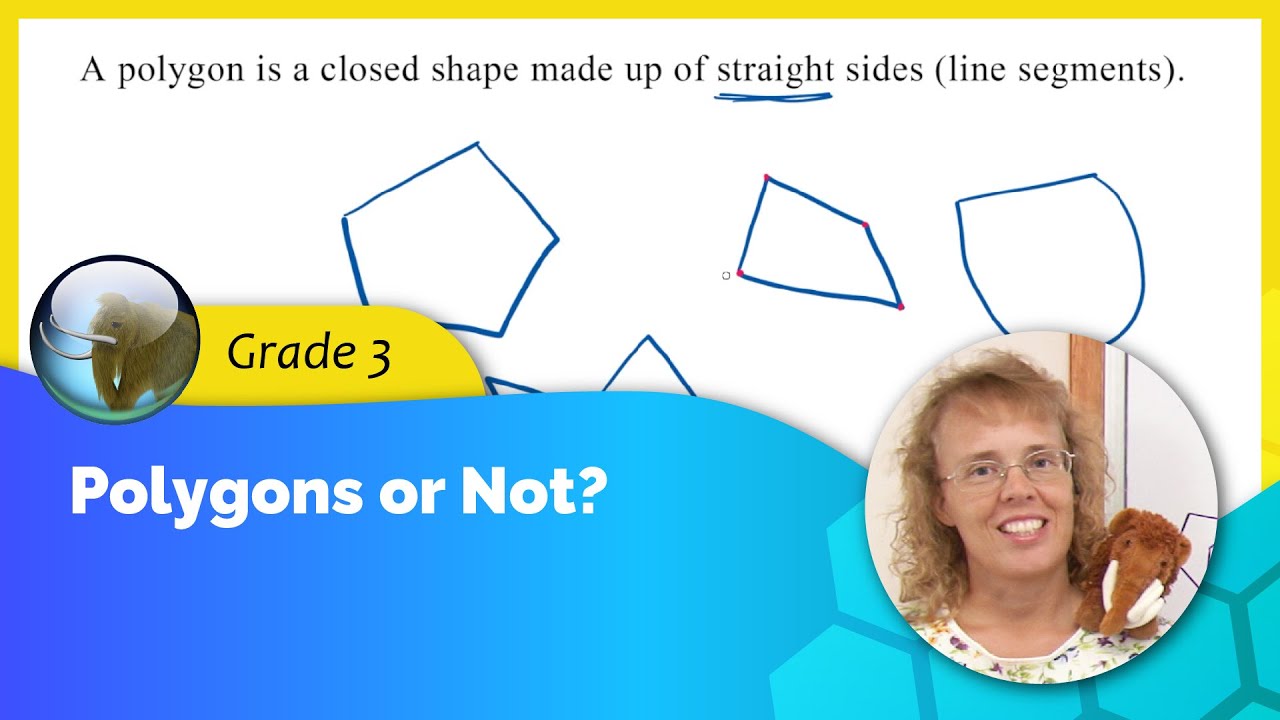
What is a polygon? It is a closed shape made up of line segments (straight sides). I show examples of polygons and non-polygons. Then we'll go on to learn the names for common polygons from triangles to decagons (10-sided shape). And lastly, we investigate dividing a polygon into others by drawing a diagonal into it. Math Mammoth Grade 3 curriculum
آپ کو یہ بھی پسند آ سکتا ہے
Year 11 Math
How to Play Chess
Math Cartoons for Elementary
Grade 3 – Let's Learn
Primary 1 Maths - Number Patterns
Statistics
Science
Matholia Singapore Maths - Circles
Addition Songs | Adventures in Adding
Matholia Singapore Maths - Algebra
Matholia Singapore Maths - Angles and Directions
MATH Unlocked - Strategies for Parents and Teachers (Grades 3-5)
3RD GRADE | Math FSA Bootcamp
Get Ready for 4th Grade Math LIKE A BOSS
Matholia Singapore Maths - Trapezium
McCarthySchoolJams
Matholia Singapore Maths - Parallelogram
Pry6 Math
Grade 12 Mathematics
JSS 2 Junior Mathematics
JSS 1 Junior Mathematics
Pry 5 Primary Mathematics
Video 1: Fraction Addition
JSS2 Mathematics
تبصرے
10 تبصرے
Learn how to find the area of a compound rectangular shape! We divided it into two rectangles, find the area of each separately, and lastly add. Math Mammoth Grade 3 Curriculum Area and Perimeter Builder (online activity)
Learn how to find the area of a compound rectangular shape! We divided it into two rectangles, find the area of each separately, and lastly add. Math Mammoth Grade 3 Curriculum Area and Perimeter Builder (online activity)
We look at rectangles that are divided into two parts. Then, the area of the entire rectangle is the sum of the areas of the two parts. (This is the distributive property in action.) For example, let's say the larger rectangle is 4 by 7 units, and it's divided into parts that are 4 by 2 and 4 by 5 units. Then: 4 x 7 = 4 x 2 + 4 x 5 and also: 4 x (2 + 5) = 4 x 2 + 4 x 5. We practice this concept with several exercises in the video. Math Mammoth Grade 3 Curriculum Area and Perimeter Builder (online activity)
We look at rectangles that are divided into two parts. Then, the area of the entire rectangle is the sum of the areas of the two parts. (This is the distributive property in action.) For example, let's say the larger rectangle is 4 by 7 units, and it's divided into parts that are 4 by 2 and 4 by 5 units. Then: 4 x 7 = 4 x 2 + 4 x 5 and also: 4 x (2 + 5) = 4 x 2 + 4 x 5. We practice this concept with several exercises in the video. Math Mammoth Grade 3 Curriculum Area and Perimeter Builder (online activity)
The basic idea in AREA is that we cover the shape with little squares. The number of those squares is its area. The area of a rectangle can be found by multiplying. In my example, the rectangle is in a grid. We can count the number of columns and rows, and multiply those to get the area. Math Mammoth Grade 3 Curriculum Area & Perimeter Builder - online activity
The basic idea in AREA is that we cover the shape with little squares. The number of those squares is its area. The area of a rectangle can be found by multiplying. In my example, the rectangle is in a grid. We can count the number of columns and rows, and multiply those to get the area. Math Mammoth Grade 3 Curriculum Area & Perimeter Builder - online activity
In this lesson, we draw different rectangles that all have an area of 20 square units, and find the perimeter of those. Area and Perimeter Builder - online activity Math Mammoth Grade curriculum
In this lesson, we draw different rectangles that all have an area of 20 square units, and find the perimeter of those. Area and Perimeter Builder - online activity Math Mammoth Grade curriculum
First I remind viewers of the concepts of area and perimeter and how they differ from each other. Then we find the area and perimeter of a somewhat complex rectilinear figure - not all its side lengths are even given, so we need to figure those out. Lastly, there's a little puzzle to solve: draw a rectangle with the given area and perimeter. Area and Perimeter Builder - online activity Math Mammoth Grade curriculum
First I remind viewers of the concepts of area and perimeter and how they differ from each other. Then we find the area and perimeter of a somewhat complex rectilinear figure - not all its side lengths are even given, so we need to figure those out. Lastly, there's a little puzzle to solve: draw a rectangle with the given area and perimeter. Area and Perimeter Builder - online activity Math Mammoth Grade curriculum