
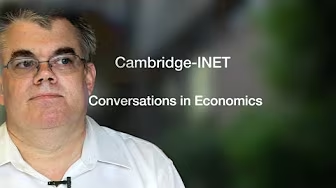
Conversations in Economics is a series of interviews with Cambridge-INET Institute visitors. These distinguished economists explore some of today's most challenging economic questions and introduce viewers to their exciting research.
آپ کو یہ بھی پسند آ سکتا ہے
Kids Songs by CoComelon
Primary 1 English
Alphabet (ABC) Songs by CoComelon
Exams and revision
ABCs Learn the Alphabet
ABC Alphabet for Kids - Read Along with StoryBots! | Netflix Jr
SEAS Videos
Bingo Songs! CoComelon Nursery Rhymes Mix
Letters and Letter Sounds
English Learning Videos!
Princess Power | Netflix Jr
Gabby's Dollhouse | Netflix Jr
BabyBus | Nursery Rhymes Collections
Nastya and papa
Hot Wheels: Let's Race | Netflix Jr
Bebefinn
Larva Funny Cartoon - Comedy Videos for Kids
Diana and Roma (EN)
Diana and Roma ABC stories
Nina and JJ! CoComelon Friends
Zoobees Cartoon Nursery Rhymes for Kids & Videos for Toddlers
Numbers for Kids - Learn to Count with StoryBots! | Netflix Jr
CoComelon Christmas Countdown | Holiday Songs & Winter Fun for Kids!
CoComelon
تبصرے
10 تبصرے
Dr Miguel Morin talks to Professor Coen Teulings about Secular Stagnation
Professor Coen Teulings talks to Professor Jean-Marc Robin about his research into Job Search Theory
Using Networks to Revolutionise Economic Theory and Policy
Research Directions: Networks and their Roles in Economics
Rationality, Learning and Market Selection
High Frequency Trading and Finance
Social Science, Small worlds and Big Data
In combining theory and experiments, we should have two objectives in mind. The first objective is to confront the theory with some data to see whether the theory is at all consistent with the behavior exhibited in the laboratory. Clearly, there is much that can be learned about the theory from the data, quite apart from any notion of "testing" the theory. We hope to learn whether the theory is useful in interpreting the data, of course, but we also expect to find out what extensions of the theory are required to make it compatible with the data. The second objective is to confront the data with the theory. A theoretical framework is needed for two reasons. First, the data set generated by experiments can be extremely rich and the behavior predicted by the theory is sometimes complex and subtle. Any attempt to explain rich datasets in purely "behavioral" terms would require a large number ad hoc assumptions, which would render the "explanation" rather uninformative. The second reason i
Conversations in Economics is a series of interviews with Cambridge-INET Institute visitors. These distinguished economists explore some of today's most challenging economic questions and introduce viewers to their exciting research.
Conversations in Economics is a series of interviews with Cambridge-INET Institute visitors. These distinguished economists explore some of today's most challenging economic questions and introduce viewers to their exciting research.