
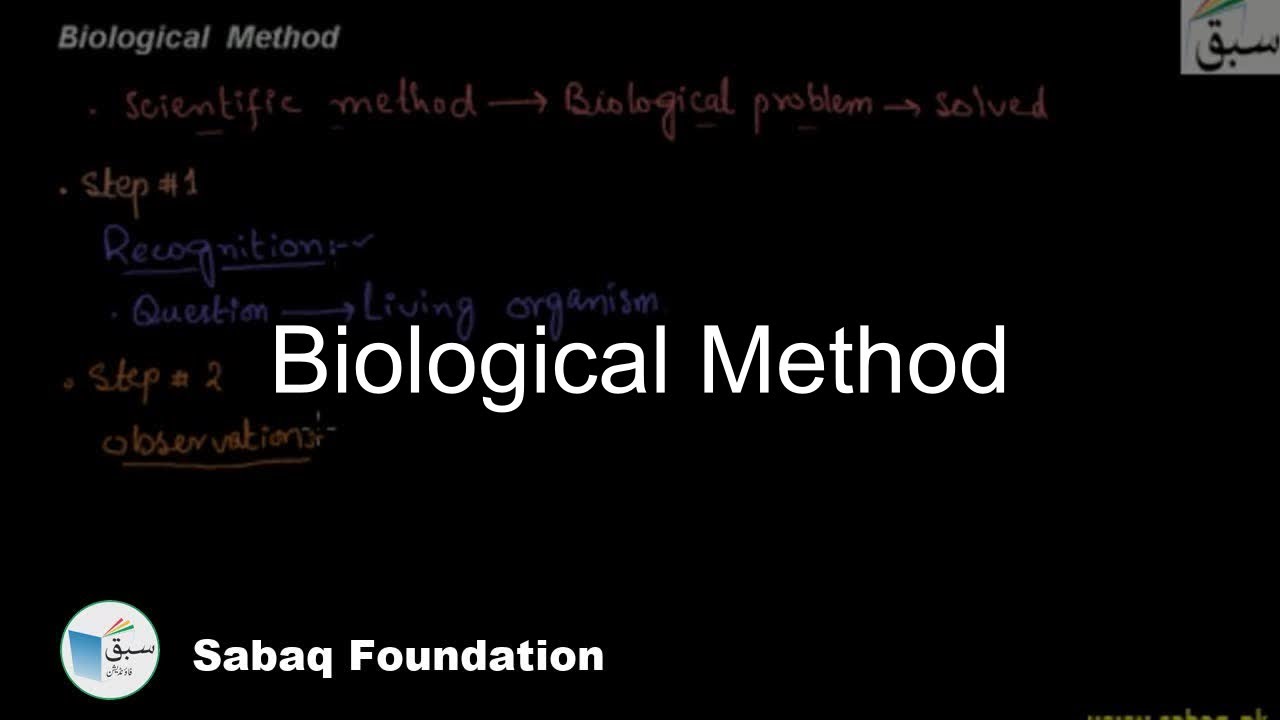
Here’s a playlist of Class 9 Chapter: Solving a Biological Problem Sabaq.pk’s Lectures which help you get started with your online education. Sabaq.pk offers free video lectures and practice tests for Physics, Chemistry, Biology, Maths, Computer Science, English & more subjects for class k-14. So, subscribe to Sabaq.pk/Sabaq Foundation now and get high marks in your exams. This Sabaq.pk Class 9 Chapter: Solving a Biological Problem Playlist has the following topics: -Biological Method -More one Biological Method -Law Principles -Study of Malaria -More Study of Malaria -Data Organization and Analysis -Mathematics: As introegral Part of Scientific Process ABOUT US: Sabaq.pk or Sabaq Foundation is a non-profit trust providing free online video lectures for students from classes K - 14 for all education boards of Pakistan including FBISE, Punjab Board Sindh Board, KP Board, Baluchistan Board as well as for Cambridge. We have a team of qualified teachers working their best to create easy to understand videos for students providing 14,000 + free lectures for subjects including Physics, Chemistry, Mathematics, Biology, English, General Science, Computer Science, General Math, Statistics and Accounting. Sabaq.pk also provides study material for MCAT and ECAT in the form of video lectures. GET CONNECTED WITH US: • Website: http://sabaq.pk/ • Facebook: https://www.facebook.com/sabaq.pk/ • Twitter: https://twitter.com/sabaqpk • Instagram: https://www.instagram.com/sabaq.pk/ • YouTube: https://www.youtube.com/user/sabaqpk • LinkedIn: https://www.linkedin.com/company/sabaq-foundation/ • Contact #: 051-2356303 (10:00 AM To 6:00 PM)
آپ کو یہ بھی پسند آ سکتا ہے
SS 3 Biology
High School Biology | Khan Academy
🌿 Amazing Animals: Wildlife Facts for Kids 🐘
Learning Animals With Blippi
11th Class Biology Chapter 5 - 1st Year Biology Chapter 5 Variety of Life - FSc Part 1 Biology Chapter 5
Class 9 Balochistan Biology Textbook
11th Class Biology Chapter 1 - New Book 2025
Class 6 balochistan General Science Textbook
Old MacDonald Thief in Old MacDonald’s Farm 😱 | Every Animal Is Gone! 🐄 Super COCO Save the Animals
Grade 1 Urdu
Grade 4 Urdu
4 Urdu
Class 12 Kpk Biology Textbook
9th Class Biology Chapter 4 Cell and Tissues
Class 12 Federal Biology Textbook
10th Class Biology Chapter 14 - Class 10 Biology Chapter 5 Reproduction - Biology Class 10 Chapter 14
SS 1 Biology
SS 2 Biology
SSS10 Biology
Sex Ed
11th Class Biology Chapter 6 - 1st Year Biology Chapter 6 Kingdom Prokaryotae (Monera) - FSc Part 1 Biology Chapter 6
11th Class Biology Chapter 3 - 1st Year Biology Chapter 3 Enzymes - FSc Part 1 Biology Chapter 3
9th Class Biology Chapter 9 Transport
Class 11 KPK Biology Textbook
تبصرے
10 تبصرے
Malaria: An Example of Biological Method of Study (Continued) Building on earlier observations, further work by Afa King and Ronald Ross significantly advanced the understanding of malaria. Afa King: In his research, Afa King proposed the hypothesis that the mosquito plays a crucial role in the spread of malaria. He suggested that mosquitoes in marshy areas were responsible for transmitting the Plasmodium parasite to humans. Ronald Ross: Ronald Ross furthered this hypothesis by conducting experiments and making the important deduction that female Anopheles mosquitoes were the vectors that carried and transmitted Plasmodium from one human to another. His groundbreaking work, involving dissection of malaria-infected mosquitoes, confirmed that the Plasmodium parasite develops inside the mosquito before being transmitted to humans through bites. 00:00 Malaria An Example of Biological Method of Study (Continued) 1:10 Problem and observation 4:37 Hypothesis 6:46 Ronald Ross work Subscri
Malaria: An Example of Biological Method of Study (Continued) Building on earlier observations, further work by Afa King and Ronald Ross significantly advanced the understanding of malaria. Afa King: In his research, Afa King proposed the hypothesis that the mosquito plays a crucial role in the spread of malaria. He suggested that mosquitoes in marshy areas were responsible for transmitting the Plasmodium parasite to humans. Ronald Ross: Ronald Ross furthered this hypothesis by conducting experiments and making the important deduction that female Anopheles mosquitoes were the vectors that carried and transmitted Plasmodium from one human to another. His groundbreaking work, involving dissection of malaria-infected mosquitoes, confirmed that the Plasmodium parasite develops inside the mosquito before being transmitted to humans through bites. 00:00 Malaria An Example of Biological Method of Study (Continued) 1:10 Problem and observation 4:37 Hypothesis 6:46 Ronald Ross work Subscri
Malaria: An Example of Biological Method of Study (Continued) Building on earlier observations, further work by Afa King and Ronald Ross significantly advanced the understanding of malaria. Afa King: In his research, Afa King proposed the hypothesis that the mosquito plays a crucial role in the spread of malaria. He suggested that mosquitoes in marshy areas were responsible for transmitting the Plasmodium parasite to humans. Ronald Ross: Ronald Ross furthered this hypothesis by conducting experiments and making the important deduction that female Anopheles mosquitoes were the vectors that carried and transmitted Plasmodium from one human to another. His groundbreaking work, involving dissection of malaria-infected mosquitoes, confirmed that the Plasmodium parasite develops inside the mosquito before being transmitted to humans through bites. 00:00 Malaria An Example of Biological Method of Study (Continued) 1:10 Problem and observation 4:37 Hypothesis 6:46 Ronald Ross work Subscri
Malaria: An Example of Biological Method of Study (Continued) Building on earlier observations, further work by Afa King and Ronald Ross significantly advanced the understanding of malaria. Afa King: In his research, Afa King proposed the hypothesis that the mosquito plays a crucial role in the spread of malaria. He suggested that mosquitoes in marshy areas were responsible for transmitting the Plasmodium parasite to humans. Ronald Ross: Ronald Ross furthered this hypothesis by conducting experiments and making the important deduction that female Anopheles mosquitoes were the vectors that carried and transmitted Plasmodium from one human to another. His groundbreaking work, involving dissection of malaria-infected mosquitoes, confirmed that the Plasmodium parasite develops inside the mosquito before being transmitted to humans through bites. 00:00 Malaria An Example of Biological Method of Study (Continued) 1:10 Problem and observation 4:37 Hypothesis 6:46 Ronald Ross work Subscri
Malaria is a classic example of how the biological method is used to understand and address a biological problem. This disease, caused by the Plasmodium parasite, has been studied extensively through the steps of the scientific method. Biological Problem: The biological problem is understanding malaria, a disease that causes fever and chills in humans. It was originally believed to be caused by mala, or bad air, which was linked to stagnant water and poisoned air in marshy areas. This theory was based on observations of the disease's prevalence in areas with such conditions. Observation: Early observations, such as those made by Laveran, who discovered the presence of tiny living organisms in the blood of infected individuals, led scientists to reconsider the old theory. Laveran observed that the Plasmodium parasite was present in the blood cells of malarial patients, which was a crucial observation that sparked further investigation into the disease's true cause. Hypothesis: Based
Malaria is a classic example of how the biological method is used to understand and address a biological problem. This disease, caused by the Plasmodium parasite, has been studied extensively through the steps of the scientific method. Biological Problem: The biological problem is understanding malaria, a disease that causes fever and chills in humans. It was originally believed to be caused by mala, or bad air, which was linked to stagnant water and poisoned air in marshy areas. This theory was based on observations of the disease's prevalence in areas with such conditions. Observation: Early observations, such as those made by Laveran, who discovered the presence of tiny living organisms in the blood of infected individuals, led scientists to reconsider the old theory. Laveran observed that the Plasmodium parasite was present in the blood cells of malarial patients, which was a crucial observation that sparked further investigation into the disease's true cause. Hypothesis: Based
Malaria is a classic example of how the biological method is used to understand and address a biological problem. This disease, caused by the Plasmodium parasite, has been studied extensively through the steps of the scientific method. Biological Problem: The biological problem is understanding malaria, a disease that causes fever and chills in humans. It was originally believed to be caused by mala, or bad air, which was linked to stagnant water and poisoned air in marshy areas. This theory was based on observations of the disease's prevalence in areas with such conditions. Observation: Early observations, such as those made by Laveran, who discovered the presence of tiny living organisms in the blood of infected individuals, led scientists to reconsider the old theory. Laveran observed that the Plasmodium parasite was present in the blood cells of malarial patients, which was a crucial observation that sparked further investigation into the disease's true cause. Hypothesis: Based
Malaria is a classic example of how the biological method is used to understand and address a biological problem. This disease, caused by the Plasmodium parasite, has been studied extensively through the steps of the scientific method. Biological Problem: The biological problem is understanding malaria, a disease that causes fever and chills in humans. It was originally believed to be caused by mala, or bad air, which was linked to stagnant water and poisoned air in marshy areas. This theory was based on observations of the disease's prevalence in areas with such conditions. Observation: Early observations, such as those made by Laveran, who discovered the presence of tiny living organisms in the blood of infected individuals, led scientists to reconsider the old theory. Laveran observed that the Plasmodium parasite was present in the blood cells of malarial patients, which was a crucial observation that sparked further investigation into the disease's true cause. Hypothesis: Based
In the biological method, concepts such as theory, law, and principle play a critical role in explaining biological phenomena based on observations, experiments, and data analysis. Theory: A theory is a well-substantiated explanation for a biological phenomenon that is supported by a wide body of evidence. It is developed after repeated testing and validation of a hypothesis through experiments and observations. For example, the cell theory is a widely accepted theory in biology that states that all living organisms are made of cells, and the cell is the basic unit of life. This theory was developed through the work of several scientists and has been supported by countless experiments. Law: A law is a statement that describes a consistent and universal phenomenon observed in nature, often under specific conditions. It is based on repeated experimental observations and typically does not offer an explanation, but rather describes a fundamental aspect of biology. For example, Mendel's
In the biological method, concepts such as theory, law, and principle play a critical role in explaining biological phenomena based on observations, experiments, and data analysis. Theory: A theory is a well-substantiated explanation for a biological phenomenon that is supported by a wide body of evidence. It is developed after repeated testing and validation of a hypothesis through experiments and observations. For example, the cell theory is a widely accepted theory in biology that states that all living organisms are made of cells, and the cell is the basic unit of life. This theory was developed through the work of several scientists and has been supported by countless experiments. Law: A law is a statement that describes a consistent and universal phenomenon observed in nature, often under specific conditions. It is based on repeated experimental observations and typically does not offer an explanation, but rather describes a fundamental aspect of biology. For example, Mendel's