
Mungkin Anda Juga Suka
Organic Chemistry
Electricity and magnetism | Physics | Khan Academy
Kids Songs by CoComelon
Primary 1 English
Alphabet (ABC) Songs by CoComelon
CoComelon & Friends Holiday and Christmas Videos for Kids | Little Baby Bum | Go Buster and More!
Baby Learning with CoComelon - Colors, Shapes and Numbers!
Let's learn about.... English Vocabulary for Kids
BEST SONGS for TODDLERS 👶🎵 (1 to 3 year olds)
BEST of CoComelon Bath Song + Wheels on the Bus
Masha & the Bear
Shapes, Colors, & Music by CoComelon
Year4 English
SS 1 Government
Family Fun by CoComelon
JJ & Friends by CoComelon
Classic Fairy Tales: Season 1
Baby Learning with CoComelon - Colors, Shapes and Numbers!
ABC Jamboree by StoryBots
Hank's Big Adventure!
CoComelon Lane | NEW Netflix Kids Show
Mighty Little Bheem | Netflix Jr.
Princess Songs and Nursery Rhymes for Babies - CoComelon Kids Songs
Numbers Songs by StoryBots
Komentar
3 Komentar
Want to explore more? Check out the full thermodynamics playlist here: •Thermodynamics|Physics|KhanAcademy If the same amount of heat flows into (or out of) equal masses of different substances, their temperatures may not change by the same amount. Specific heat capacity (c) tells us how much heat energy is required to change one unit mass of a substance by one unit of temperature. Specific heat is related to heat (q), the mass of the sample (m), and the change in temperature (∆T) by the equation q=cm∆T. Sections: 00:00 - Introduction 02:26 - What is specific heat capacity? 04:55 - Specific heat capacity equation 07:30 - Example 1 (Find heat) 09:22 - Example 2 (Find final temperature) 11:42 - Why do substances have different specific heats? ------------------ Khan Academy is a nonprofit organization with the mission of providing a free, world-class education for anyone, anywhere. Khan Academy has been translated into dozens of languages, and 15 million people around the glob
Courses on Khan Academy are always 100% free. Start practicing—and saving your progress—now! https://www.khanacademy.org/science/h... Want to explore more? Check out the full thermodynamics playlist here: •Thermodynamics|Physics|KhanAcademy The first law of thermodynamics states that if a system gains/loses some amount of energy, the surroundings must lose/gain the same amount of energy. The second law of thermodynamics states that entropy does not spontaneously decrease. Entropy is a measure of how spread out energy is. As an example, if two systems at different temperatures are in contact, heat will flow from the warmer system to the cooler system until they reach thermal equilibrium (equal temperatures). Sections: 00:00 - Intro 00:35 - System and surroundings 02:30 - First law of thermodynamics 05:36 - Entropy and second law of thermodynamics 09:35 - Refrigerators ------------------ Khan Academy is a nonprofit organization with the mission of providing a free, world-clas
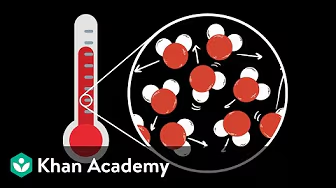
Courses on Khan Academy are always 100% free. Start practicing—and saving your progress—now! https://www.khanacademy.org/science/h... Want to explore more? Check out the full thermodynamics playlist here: •Thermodynamics|Physics|KhanAcademy Thermal energy refers to the kinetic energy of randomly moving particles in a substance. Particles can have translational, rotational, and/or vibrational kinetic energy, depending on the state of matter. Temperature is a measure of the average kinetic energy of the particles in a substance. Heat is thermal energy that transfers into or out of a system. Heat can transfer by conduction, convection, or radiation. Sections: 00:00 - Intro 00:39 - What is thermal energy? 02:50 - What is temperature? 05:13 - What is heat? 06:04 - Modes of heat transfer 08:40 - Heating a vessel of water ------------------ Khan Academy is a nonprofit organization with the mission of providing a free, world-class education for anyone, anywhere. Khan Academy has