
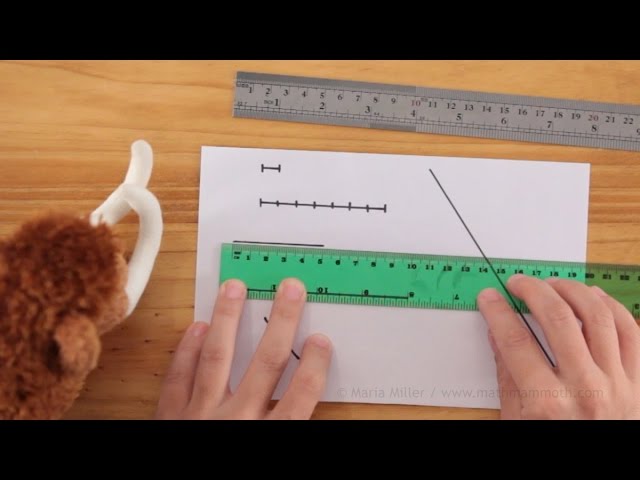
In this lesson, I measure lines and things (marker pen, baby block, Mathy my mammoth mascot) with a centimeter-ruler, in whole centimeters, to keep it simple for 1st grade students. Then I also show how to DRAW lines that measure a certain length. That is actually pretty easy, as long as you remember to hold down the ruler with your other hand. :) Check out also Math Mammoth Grade 1 curriculum - available as a download and as printed books:
आपको ये भी पसंद आ सकते हैं
PrePrimary Maths
Year1 Maths
Year 10 Math
Year6 Maths
Year5 Maths
Year9 Maths
3rd Grade Math
Grade 3 – Let's Learn
Numberblocks - Homeschooling #Stayhome ✏️📘
Numberblocks - How to Count to Ten | Learn to Count
Best Math Courses for Grades 3-5
Numberblocks Fun! | Learn To Count | @Numberblocks
Numberblocks - MI15 Fact Files
Kindergarten
Summer Maths for Kids ☀️
Basic division - 3rd grade
Learn Multiplication
Addition Songs | Adventures in Adding
Celebrating STEM: counting and multiplication
SSS10 Math
SSS12 Math
SSS11 Math
Pry 1 Primary Mathematics
SSS 2 Mathematics
टिप्पणियाँ
10 टिप्पणियाँ
In this lesson, I show how to read a particular bathroom scale that measures in pounds. Then I weigh myself plus some other people on it. I also show the principle for weighing something bulky (a big bag in this case), where you need to use subtraction. Lastly we attempt to weigh Mathy my mascot... Plus he does a surprise in the end! Check out also my workbook Math Mammoth Measuring 1 at
In this lesson, I show how to read a particular bathroom scale that measures in pounds. Then I weigh myself plus some other people on it. I also show the principle for weighing something bulky (a big bag in this case), where you need to use subtraction. Lastly we attempt to weigh Mathy my mascot... Plus he does a surprise in the end! Check out also my workbook Math Mammoth Measuring 1 at
I show and talk about these two basic units for measuring length in the metric system: meters and kilometers. I illustrate the METER with a line on the board, plus I have it drawn on the floor. I jump a one-meter jump, and then walk half-meter steps. Mathy my mascot tries that too! Kilometer is 1000 meters, and children can imagine taking a THOUSAND of those 1-meter steps (or jumps) to visualize this concept. Lastly we figure out which is the most suitable measuring unit to use -- cm, m, or km -- for various things, such as the length of a train, around the Earth, a distance between towns, and so on. Check out also my workbook Math Mammoth Measuring 1 at
I show and talk about these two basic units for measuring length in the metric system: meters and kilometers. I illustrate the METER with a line on the board, plus I have it drawn on the floor. I jump a one-meter jump, and then walk half-meter steps. Mathy my mascot tries that too! Kilometer is 1000 meters, and children can imagine taking a THOUSAND of those 1-meter steps (or jumps) to visualize this concept. Lastly we figure out which is the most suitable measuring unit to use -- cm, m, or km -- for various things, such as the length of a train, around the Earth, a distance between towns, and so on. Check out also my workbook Math Mammoth Measuring 1 at
In this math lesson I measure lines and objects to the nearest half-inch, using a ruler that has a paper taped on it so that it shows only the whole inches and half inches. This makes it easier for young students to use the ruler, which otherwise would have all these confusing lines marking the fractional parts of an inch. Check out also my workbook Math Mammoth Measuring 1 at
In this math lesson I measure lines and objects to the nearest half-inch, using a ruler that has a paper taped on it so that it shows only the whole inches and half inches. This makes it easier for young students to use the ruler, which otherwise would have all these confusing lines marking the fractional parts of an inch. Check out also my workbook Math Mammoth Measuring 1 at
Measuring length to the nearest centimeter means we just give the length as "about 5 cm" or maybe "about 8 1/2 cm" instead of checking the exact millimeters. In this lesson I show how to use a centimeter-ruler to measure how long pencils or lines are. Mathy and I also ESTIMATE the length of some pencils before checking with the ruler how long they are in reality. Lastly we figure out how much taller some chess pieces are than others. :) Check out also my workbook Math Mammoth Measuring 1 at
Measuring length to the nearest centimeter means we just give the length as "about 5 cm" or maybe "about 8 1/2 cm" instead of checking the exact millimeters. In this lesson I show how to use a centimeter-ruler to measure how long pencils or lines are. Mathy and I also ESTIMATE the length of some pencils before checking with the ruler how long they are in reality. Lastly we figure out how much taller some chess pieces are than others. :) Check out also my workbook Math Mammoth Measuring 1 at
In this lesson, I show how to use a ruler to measure lines and other things in whole and half inches. Since this is for 1st grade, I use a special ruler that has a piece of paper taped on top which only shows whole and half inches. That way students don't have to be confused by all those little lines for fractional parts of an inch. We measure the length of a marker pen, toy car, and Mathy my mascot. :) Then I also show how to draw lines that are a specific length. it is easy -- you just need to HOLD DOWN the ruler tightly while you draw. Check out also my workbook Math Mammoth Measuring 1 at
In this lesson, I show how to use a ruler to measure lines and other things in whole and half inches. Since this is for 1st grade, I use a special ruler that has a piece of paper taped on top which only shows whole and half inches. That way students don't have to be confused by all those little lines for fractional parts of an inch. We measure the length of a marker pen, toy car, and Mathy my mascot. :) Then I also show how to draw lines that are a specific length. it is easy -- you just need to HOLD DOWN the ruler tightly while you draw. Check out also my workbook Math Mammoth Measuring 1 at