
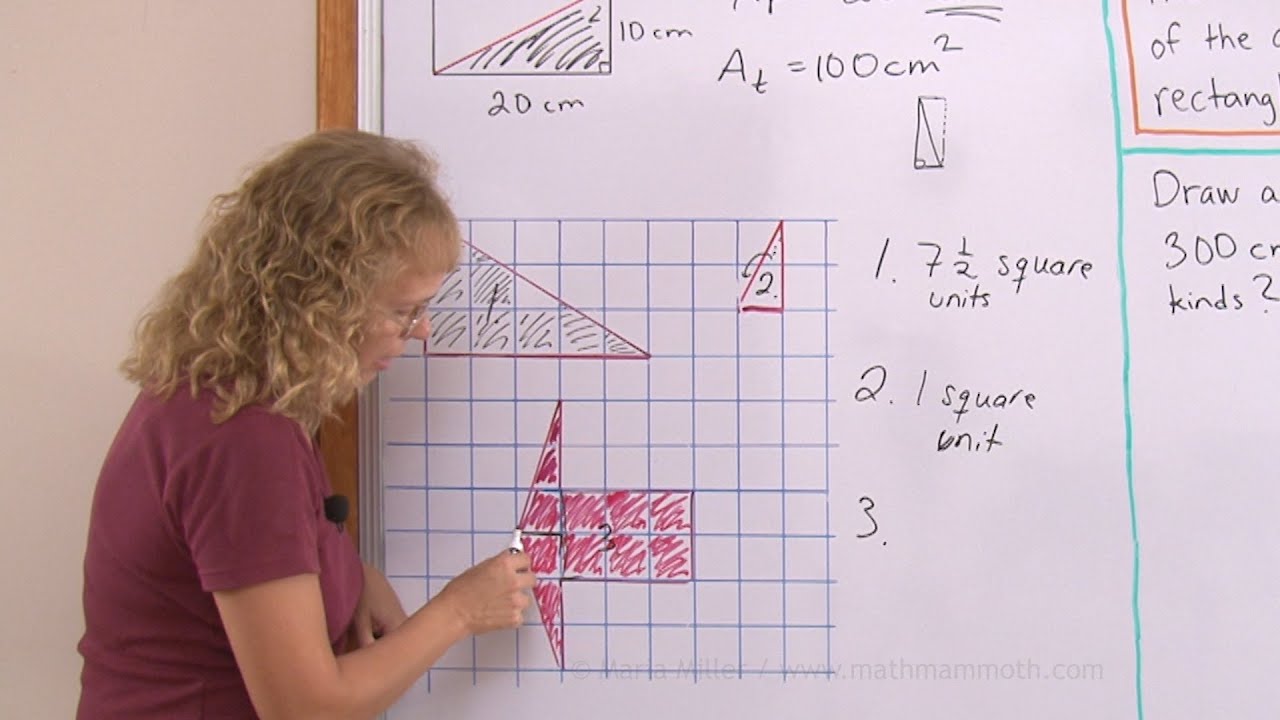
This is a lead-up lesson to the lesson about the area of triangles. In this lesson we only deal with RIGHT triangles. It is easy to see their area is HALF of the area of the rectangle drawn around the triangle. We find the areas of some right triangles and the area of a compound shape. Lastly, the task is to DRAW a right triangle with a given area (300 square centimeters). I show how to find the base and the height for this triangle and draw 2 different ones. In the follow-up lesson we learn how to find the area of any triangle: This lesson is meant for 6th grade math. Check out my free books and worksheets at
आपको ये भी पसंद आ सकते हैं
CoComelon
Alphabet (ABC) Songs by CoComelon
CocoMelon | Little Baby Bum | Blippi - Nursery Rhymes & Kids TV Shows
Learn English With Disney Movies
Year1 Maths
Year 11 Math
Year2 Maths
Year3 Maths
Year 10 Math
Year4 Maths
Year5 Maths
3rd Grade Math
Math for Kids
9th Maths Revision
🍕 Understanding Division in Math: Elementary Math Lessons
دروس الرياضيات للسنة الثانية ثانوي
PrePrimary Maths
Year6 Maths
Year 2 Math
Maths
Kids Songs by CoComelon
Learn Colors with CoComelon!
Year1 English
CoComelon & Friends Holiday and Christmas Videos for Kids | Little Baby Bum | Go Buster and More!
टिप्पणियाँ
10 टिप्पणियाँ
First, I explain the concept of surface area and net using a cube. Then we calculate the surface area of a cube with edge length 2 cm. Lastly, I show how to find the surface area of a rectangular prism (box) when its dimensions are given.
First, I explain the concept of surface area and net using a cube. Then we calculate the surface area of a cube with edge length 2 cm. Lastly, I show how to find the surface area of a rectangular prism (box) when its dimensions are given.
Here in the second part, I show how to calculate the surface area of a square pyramid. It's easy, really... you just add the areas of the different faces together. In the last problem, we're given the volume of a cube and need to find the surface area. Check out also: Math videos for 6th grade: Math Mammoth grade 6 curriculum Math Mammoth Geometry 2 worktext:
Here in the second part, I show how to calculate the surface area of a square pyramid. It's easy, really... you just add the areas of the different faces together. In the last problem, we're given the volume of a cube and need to find the surface area. Check out also: Math videos for 6th grade: Math Mammoth grade 6 curriculum Math Mammoth Geometry 2 worktext:
After reviewing briefly the two formulas for the volume of a rectangular prism, we delve into a real-world problem involving a room with a floor area of 9 1/2 feet by 12 feet, and height of 8 1/2 feet. To find its volume, I first calculate the area of the floor, and then multiply that by the height. Then, the question continues: if the ceiling is dropped so the room is only 8 ft high, how much volume does the room lose? The first part of this lesson deals with the volume of a rectangular prism with fractional edge lengths, and is found at This lesson fits the Common Core Standard 6.G.2.
After reviewing briefly the two formulas for the volume of a rectangular prism, we delve into a real-world problem involving a room with a floor area of 9 1/2 feet by 12 feet, and height of 8 1/2 feet. To find its volume, I first calculate the area of the floor, and then multiply that by the height. Then, the question continues: if the ceiling is dropped so the room is only 8 ft high, how much volume does the room lose? The first part of this lesson deals with the volume of a rectangular prism with fractional edge lengths, and is found at This lesson fits the Common Core Standard 6.G.2.
I show how we can indeed calculate the VOLUME of right rectangular prisms with fractional edge lengths by multiplying the three dimensions length, width, and height. For example, we look at the unit cube (with dimensions 1 cm, 1 cm, and 1 cm), and pack it with little cubes with edge length 1/2 cm. That takes 8 cubes, therefore the volume of each those little cubes is 1/8 of a cubic centimeter. And, you do get the same result if you simply multiply the length, width, and height of the little cube: 1/2 cm x 1/2 cm x 1/2 cm = 1/8 cubic cm. I show another similar example when the edge or side lengths are 1 1/2 in, 1 1/2 in, and 1 in. Lastly we look at another unit cube, this time packed with little cubes with edge lengths of 1/3 unit. Similar reasoning as above shows us that the volume of each little cube is 1/27 of a cubic unit (since 27 little cubes make up the unit cube). And that is the same as 1/3 x 1/3 x 1/3. This lesson is meant for 6th grade, and it specifically matches the common
I show how we can indeed calculate the VOLUME of right rectangular prisms with fractional edge lengths by multiplying the three dimensions length, width, and height. For example, we look at the unit cube (with dimensions 1 cm, 1 cm, and 1 cm), and pack it with little cubes with edge length 1/2 cm. That takes 8 cubes, therefore the volume of each those little cubes is 1/8 of a cubic centimeter. And, you do get the same result if you simply multiply the length, width, and height of the little cube: 1/2 cm x 1/2 cm x 1/2 cm = 1/8 cubic cm. I show another similar example when the edge or side lengths are 1 1/2 in, 1 1/2 in, and 1 in. Lastly we look at another unit cube, this time packed with little cubes with edge lengths of 1/3 unit. Similar reasoning as above shows us that the volume of each little cube is 1/27 of a cubic unit (since 27 little cubes make up the unit cube). And that is the same as 1/3 x 1/3 x 1/3. This lesson is meant for 6th grade, and it specifically matches the common
I show a simple way to get the conversion factor between any two area units. For example, to find how many square inches is 1 square foot, first sketch a square foot (= a square with 1-foot sides). Then think how long the sides are in INCHES -- in this case, they are 12 inches. Then it is simple to find the area of the square by multiplying 12 in x 12 in = 144 sq. in. We use this simple idea to find, for example, the area of a square with 6-ft sides in square inches, or how many square yards are in a square miles. Not forgetting the metric units, I also show how to convert between square centimeters and square millimeters. This way you won't be dependent on having the conversion factors on hand - as long as you can remember the factor between the corresponding units of length.
I show a simple way to get the conversion factor between any two area units. For example, to find how many square inches is 1 square foot, first sketch a square foot (= a square with 1-foot sides). Then think how long the sides are in INCHES -- in this case, they are 12 inches. Then it is simple to find the area of the square by multiplying 12 in x 12 in = 144 sq. in. We use this simple idea to find, for example, the area of a square with 6-ft sides in square inches, or how many square yards are in a square miles. Not forgetting the metric units, I also show how to convert between square centimeters and square millimeters. This way you won't be dependent on having the conversion factors on hand - as long as you can remember the factor between the corresponding units of length.