
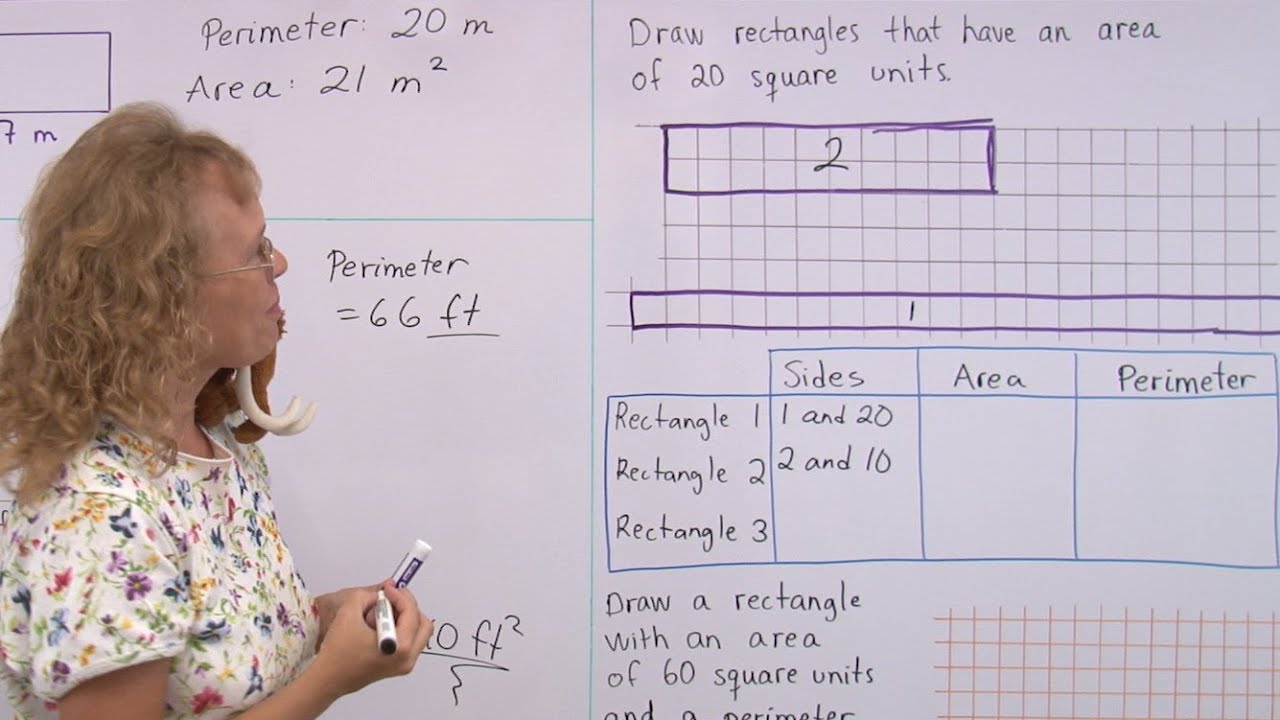
After reminding everyone about what is AREA and what is PERIMETER, we solve several problems involving both area and perimeter of rectangles or rectangular shapes. The first problem involves a shape that we can divide into several rectangles, and then figure its area and perimeter. Some side lengths are missing - but we can find those by subtracting. Then our task is to draw rectangles with an area of 20 square units. There are several, of course. I write in the table their side lengths, and then we also calculate the perimeter of each. We notice how the skinniest rectangle has the largest perimeter, and the rectangle that is closes to a square has the least perimeter (of these three)! Our last problem is almost like a puzzle - draw a rectangle with an area of 60 square units and a perimeter of 34 units. Guess and check helps! Check out also my geometry workbook Math Mammoth Early Geometry at
आपको ये भी पसंद आ सकते हैं
Year 10 Math
Year3 Maths
Kids Songs by CoComelon
CoComelon
PrePrimary Maths
Year1 Maths
Year 11 Math
Year2 Maths
Year6 Maths
Year4 Maths
Maths
3rd Grade Math
Math Videos for Kids
A savoir faire en mathématiques en Seconde
Junoon 2.0 2026 (Class 7th) Mathematics
Интерактивный учебник по математике
Year8 Maths
Year 4 Math
Numberblocks - Learn to Count | Maths for Kids
Numberblocks - Homeschool
English learning videos for kids - Lingokids
CoComelon Lane! Brand New Netflix Kids Show!
Halloween Songs For Kids - CoComelon
Year7 German
टिप्पणियाँ
10 टिप्पणियाँ
This is an introduction to polygons for elementary school - approximately 4th grade. I like to give students the exercises of drawing randomly 4, 5, 6, 7, or 8 points on the paper and connecting them to get a polygon. I also show exercises where we divide polygons into new ones, or put together polygons to get new ones.
This is an introduction to polygons for elementary school - approximately 4th grade. I like to give students the exercises of drawing randomly 4, 5, 6, 7, or 8 points on the paper and connecting them to get a polygon. I also show exercises where we divide polygons into new ones, or put together polygons to get new ones.
What is a circle? It is a figure where the distance from the center point to any point on the outer line (circumference) is the same. So, that is why an oval won't classify as a circle. Students need to practice drawing circles of various sizes using a compass. Drawing concentric circles is a fun exercise for them. I show two other drawing exercises: to draw a circle inside a square and then to copy a simple circle design.
This lesson is a starting point for classifying triangles by their angles. A right triangle has one right angle. (What about the other two angles? We'll find out.) An obtuse triangle has one obtuse angle. (What about the other two angles? We'll find out.) An acute triangle has THREE acute angles.
This lesson is a starting point for classifying triangles by their angles. A right triangle has one right angle. (What about the other two angles? We'll find out.) An obtuse triangle has one obtuse angle. (What about the other two angles? We'll find out.) An acute triangle has THREE acute angles.
What is a parallelogram? The definition says it's a figure enclosed by two sets of parallel lines, and that's where we will start. The DEFINITION does not say a thing about its side lengths or angle measures. Those things students can notice or find out for themselves by drawing and measuring. I also draw a bigger copy of a given rhombus, which is a very good drawing exercises for students, and give ideas for more drawing problems on a basic level.
What is a parallelogram? The definition says it's a figure enclosed by two sets of parallel lines, and that's where we will start. The DEFINITION does not say a thing about its side lengths or angle measures. Those things students can notice or find out for themselves by drawing and measuring. I also draw a bigger copy of a given rhombus, which is a very good drawing exercises for students, and give ideas for more drawing problems on a basic level.
I show how you can draw a right angle (or a perpendicular line to a given line) using either a protractor or a triangular ruler. I also show a line perpendicular to a given line, drawn through a point on the line, or drawn through a point not on the line. Lastly, I draw a rectangle with given side lengths, using a protractor to make right angles, and a regular ruler to measure the sides.
I show how you can draw a right angle (or a perpendicular line to a given line) using either a protractor or a triangular ruler. I also show a line perpendicular to a given line, drawn through a point on the line, or drawn through a point not on the line. Lastly, I draw a rectangle with given side lengths, using a protractor to make right angles, and a regular ruler to measure the sides.
Estimating angle measures is based on comparing them to some ballpark angles, such as the right angle, the 45° angle, and the 30° angle (which is the angle between two consecutive numbers on the clock face). First, I estimate a few angles. Then I draw a few angles by estimating them (not measuring), and check afterwards. Lastly in this video I explain the concept of turning in a specific angle, such has turning in a 30° angle.