
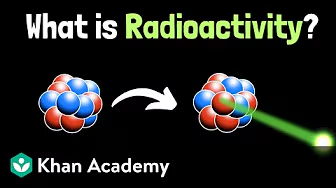
When nuclei change, elements turn into different elements. Large amounts of energy are involved. Learn about radioactive decay, nuclear fusion, and nuclear fission. Discover important applications of these fascinating nuclear processes. Check your understanding with free practice on Khan Academy: https://www.khanacademy.org/science/highschool-physics/x6679aa2c65c01e53:nuclear-physics
Vous aimerez aussi
ChuChu & Friends in Storytime Adventures - ChuChu TV
Popular Compilations by CoComelon
ABCs Learn the Alphabet
Halloween Songs For Kids - CoComelon
Kids Songs by CoComelon
CoComelon
Alphabet (ABC) Songs by CoComelon
CocoMelon | Little Baby Bum | Blippi - Nursery Rhymes & Kids TV Shows
Primary 1 Mathematics
JS 1 Mathematics
JS 2 Mathematics
SS 2 Physical
Organic Chemistry
Electricity and magnetism | Physics | Khan Academy
شرح علوم الصف الخامس الابتدائي المنهج الجديد 2024 الترم الاول بعد التعديل
علوم اولي اعدادي الترم التاني مستر محمد ابراهيم
Learn English Alphabet for Kids
Alphabet ABC Phonics Series (From A to Z) in HD
Nastya and papa
ABC Songs
Hot Wheels: Let's Race | Netflix Jr
Diana and Roma ABC stories
Fast Phonics
Nastya and Dad - best family stories
Commentaires
7 commentaires
Courses on Khan Academy are always 100% free. Start practicing—and saving your progress—now! https://www.khanacademy.org/science/h... Want to explore more? Check out the full nuclear physics playlist here: •Nuclearphysics|Physics|KhanAcademy During a nuclear fission reaction, a fissile nucleus absorbs a neutron and splits into two smaller nuclei. One or more free neutrons are also released. If enough fissile nuclei are located close enough together, the neutrons released from one fission can induce further fissions, resulting in a chain reaction. Nuclear weapons utilize fast, uncontrolled chain reactions to produce an explosion. Nuclear reactors utilize slower, controlled chain reactions to generate electricity. The release of energy during fission relates to the difference in total mass of the reactants and products by E=mc^2. Sections: 00:00 - Intro 00:22 - What is nuclear fission? 03:50 - Fissile and non-fissile nuclei 05:34 - Fission chain reaction 06:23 - Atomic (nucle
Courses on Khan Academy are always 100% free. Start practicing—and saving your progress—now! https://www.khanacademy.org/science/h... Want to explore more? Check out the full nuclear physics playlist here: •Nuclearphysics|Physics|KhanAcademy During nuclear fusion, two or more nuclei combine to form a different nucleus. When light nuclei fuse to produce a nucleus lighter than iron, energy is released (exothermic). When heavy nuclei fuse to produce a nucleus heavier than iron, energy is absorbed (endothermic). The release or absorption of energy relates to the difference in total mass of the reactants and products by E=mc^2. Nuclear fusion powers the Sun and other stars. Sections: 00:00 - Intro 00:30 - What is nuclear fusion? 03:25 - What powers the sun? 04:58 - Mass defect (E = mc^2) 09:00 - Stellar nucleosynthesis (proton-proton chain) ------------------ Khan Academy is a nonprofit organization with the mission of providing a free, world-class education for anyone, anywher
Courses on Khan Academy are always 100% free. Start practicing—and saving your progress—now! https://www.khanacademy.org/science/h... Want to explore more? Check out the full nuclear physics playlist here: •Nuclearphysics|Physics|KhanAcademy Half-life is the time required for half of a radioactive sample to decay. Half-life cannot be changed—nuclei cannot be forced to decay faster or slower. Additionally, we cannot predict when an individual nucleus will decay. However, when analyzing a large sample containing many nuclei, half-life allows us to predict how much of the sample will remain after a given amount of time. This is useful for radiometric dating. Sections: 00:00 - Intro 00:34 - What is half-life? 03:26 - Coin toss analogy 05:50 - Radioactive decay is spontaneous 06:37 - Why care about half-life? 07:20 - Decay graph 08:30 - Radiometric dating ------------------ Khan Academy is a nonprofit organization with the mission of providing a free, world-class education for
Courses on Khan Academy are always 100% free. Start practicing—and saving your progress—now! https://www.khanacademy.org/science/h... Want to explore more? Check out the full nuclear physics playlist here: •Nuclearphysics|Physics|KhanAcademy During gamma decay, an excited nucleus releases energy in the form of a gamma photon. Gamma radiation is high-energy electromagnetic radiation (light) which has a shorter wavelength and higher frequency than visible light. Gamma rays are ionizing radiation. The number of protons and neutrons in the parent nucleus does not change, so the identity of the daughter nucleus is the same as the parent, but in a lower energy state. Sections: 00:00 - Intro 00:30 - Alpha, beta, and gamma decay 02:52 - Radioactivity does not glow 04:25 - Gamma radiation energy level 06:00 - Gamma decay of nickel-60 07:50 - Gamma radiation penetration power 10:06 - Gamma decay application ------------------ Khan Academy is a nonprofit organization with the mission
Courses on Khan Academy are always 100% free. Start practicing—and saving your progress—now! https://www.khanacademy.org/science/h... Want to explore more? Check out the full nuclear physics playlist here: •Nuclearphysics|Physics|KhanAcademy During beta minus decay, a neutron in an unstable nucleus transforms into a proton, releasing a high energy electron and antineutrino in the process. During beta plus decay, a proton in an unstable nucleus transforms into a neutron, releasing a high energy positron and neutrino in the process. Beta particles carry away energy lost by the nucleus and are ionizing radiation. 00:00 - Intro 00:12 - Alpha and beta decay 01:12 - Beta minus decay of carbon-14 04:44 - Beta plus decay of nitrogen-13 07:47 - Neutrinos and antineutrinos 09:09 - Charge conservation 10:14 - Beta decay penetrating power and application ------------------ Khan Academy is a nonprofit organization with the mission of providing a free, world-class education for anyone,
Courses on Khan Academy are always 100% free. Start practicing—and saving your progress—now! https://www.khanacademy.org/science/h... Want to explore more? Check out the full nuclear physics playlist here: •Nuclearphysics|Physics|KhanAcademy During alpha decay, a large, unstable parent nucleus becomes a smaller daughter nucleus. It does this by emitting an alpha particle, a clump of two protons and two neutrons (a He-4 nucleus). The nucleus's atomic number decreases by two, and its mass number decreases by four. The alpha particle is high-energy ionizing radiation—it travels at high speed because it carries away the majority of the energy lost by the nucleus during the decay. Sections: 00:00 - Intro 00:43 - Why are heavy nuclei unstable? 03:50 - What is alpha decay? 05:44 - Alpha decay examples 08:31 - How smoke detectors work ------------------ Khan Academy is a nonprofit organization with the mission of providing a free, world-class education for anyone, anywhere. Kha
Courses on Khan Academy are always 100% free. Start practicing—and saving your progress—now! https://www.khanacademy.org/science/h... Want to explore more? Check out the full nuclear physics playlist here: •Nuclearphysics|Physics|KhanAcademy During radioactive decay, an unstable nucleus (the "parent") spontaneously changes to become a different nucleus (the "daughter"), emitting radiation in the process. The nuclear radiation emitted during radioactive decay is high energy, ionizing radiation. Nuclear radiation is potentially dangerous to living things but also has many beneficial applications. Types of radioactive decay include alpha, beta, and gamma. Sections: 00:00 - Intro 00:22 - Chemical reactions don't change elements 01:35 - Nuclear composition 02:11 - Isotopes 04:00 - What is radioactivity? 05:38 - Example of radioactive decay 06:40 - Ionizing radiation ------------------ Khan Academy is a nonprofit organization with the mission of providing a free, world-class educ