
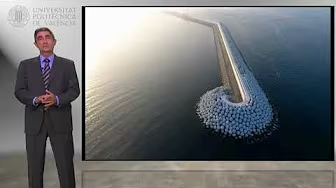
MOOC Cubipod Manual | Universitat Politècnica de Valencia UPV
poliMedia UPV
Vous aimerez aussi
Primary 6 English
SS 3 English
BabyBus Best Nursery Rhymes, Kids Songs, and Cartoon for Kids!
JS 1 Science & Technology
Primary 1 Science & Technology
Learn English with Movies
PrePrimary English
JS 1 English
PrePrimary Maths
SS 1 Government
Programming in Python
SS 1 Literature
Learn With Ms Rachel - Learn To Talk - Baby, Toddler and Preschool Learning
Learn To Talk with Ms Rachel
Learn Christmas English with TV Series and Movies
Learn English with Music
Preschool Videos with Ms Rachel
Learn English with PODCASTS
Animal Videos
Learn Colors, Numbers, Shapes and Letters with Ms Rachel
Learn English with Celebrities
Nursery Rhymes & Kids Songs
Baby Learning with Ms Rachel - Videos for Babies
Español Principiante A1
Commentaires
10 commentaires
Título: Example. Physical tests for validation and optimization. Descripción automática: In this video, the presenter outlines the process of designing a small-scale physical test to validate and optimize the preliminary design of a breakwater, as detailed in Chapter 7 of the manual from 2016. The test aims to reduce costs and uncertainties and is necessary due to differences between standard models and the specific conditions faced by the breakwater, including oblique and depth-limited waves, and structural peculiarities of the breakwater's sections. The presenter discusses the unique challenges posed by the root, trunk, and roundhead sections of the breakwater, and the limitations of formulas used in the preliminary design phase. To address these challenges, the recommendation is to conduct physical tests with a scale model, which should be divided into different sections and possibly tested in separate basins due to uniqueness and complexity. The presenter also stresses the need to
Título: Example. Design of breakwater root. (B) Descripción automática: In this video, the speaker discusses the design considerations for a breakwater root as found in the Cubipod manual 2016. The focus is on structuring the breakwater root to withstand breaking wave conditions with oblique wave attacks. Factors such as the foreshore, water depth at the structure's toe, and seabed slope are critical in determining the largest waves impacting the structure. The presenter details how to calculate the necessary cubepod armor size using the manual's formula, taking into account a safety factor for initiation of destruction and the weight of the units. The stability of the armor against oblique waves compared to perpendicular waves is highlighted, which influences the choice of an 18-tonne single-layer cubepod armor for certain water depths. In estimating the overtopping rate, the EurOtop criterion is applied to determine an obliquity factor, which influences the new crest freeboard calcul
Título: Example. Design of breakwater root. (A) Descripción automática: In this video, the presenter discusses the design of the breakwater root as outlined in the 2016 Cubipod manual. There is a focus on the differences between non-breaking and breaking wave conditions when it comes to breakwater design. With an emphasis on breaking wave scenarios, the presenter covers how to calculate the largest waves impacting the structure by considering various environmental factors such as foreshore, water depth, and seabed slope. The video details how to determine the nominal diameter of a single layer Cubipod armor using a formula which takes into account a defined safety factor and the conditions present at specific water depths. In an example provided, the presenter calculates the necessary unit weight and safety factors when waves attack at a specified angle. Furthermore, the presenter explains how to estimate the overtopping rate by using the EurOtop criterion to determine the obliquity fa
Título: Example. Design of roundhead. Descripción automática: In this video, the presenter delves into the design aspects of the roundhead in a single-layer and a double-layer armor model. The video highlights two alternatives for a 72-tonne armor trunk with stability coefficients and numbers provided for each. The Double Layer Armor Roundhead (Alternative B2) requires a nominal diameter calculation based on the design significant wave height and involves the use of large crawler cranes for placement of the heavy units, potentially substituting high-density concrete to reduce weight. Transitions between varying weights and armor layers are also addressed. Next, the Single Layer Armor Roundhead (Alternative B1) is examined, discussing the slope of the roundhead armor and how it aligns with the trunk section. The stability coefficient is given, and the necessary nominal diameter is calculated based on wave heights and safety factors. This option requires even heavier units, and similar c
Título: Example. Construction costs. Descripción automática: In this video, the presenter discusses the cost estimation process for different breakwater designs with various armor layers, as outlined in the Cubipod manual. The focus is on estimating the construction costs for three alternatives: double layer cube armor, single layer Cubipod armor, and double layer Cubipod armor. The trunk cross-section of the breakwater, which is the most critical part, is presented, along with assumptions made for the length and cost equivalence of the breakwater segments. The costs of concrete based on its compressive strength and the volume needed for the cubic blocks are calculated, with specific figures provided for each alternative. The formula for estimating manufacturing and placement costs is introduced, and the cost of rock needed for construction is factored into the total cost estimation of each design. Comparative analysis of the alternatives is then presented, focusing on five quality ind
Título: Example. Design of the crown wall. Descripción automática: In this video, the presenter discusses the preliminary design of crown walls in hydraulic structures based on the guidelines from the Cubipod manual 2016. The focus is on ensuring stability against hydraulic conditions that are most severe at high water levels, such as overtopping rates and wave forces, with an emphasis on avoiding failure through sliding and overturning. A formula from Molines 2016, which takes into account friction factors, is employed to calculate the necessary dimensions of crown walls using double layer cube, single, and double layer Cubipod armors. The conditions for the design include significant wave heights, wave periods, water depth, and tidal ranges. These factors influence the calculations of forces and moments on the crown wall, which are also dependent on the type of armor's roughness factor. The presenter specifies the dimensions, including height, width, and base elevation of the crown w
Título: Example. Core filter layers and toe berm. Descripción automática: In this video, the presenter discusses coastal protection structures, specifically examining the elements of cores, filter layers, and toe berms as outlined in the Manual from 2016. The presenter refers to vital guidelines for constructing toe berms in non-breaking wave conditions, citing a recommendation that the toe berm be placed below a certain depth relative to the design significant wave height. Key formulas from sources like the Rock Manual are used to estimate the appropriate rock size for toe berms to ensure acceptable levels of damage. The video features an example where the presenter calculates the minimum depth of a toe berm required for a specific water depth and wave height. The importance of using three layers of rocks for stability and the concept of implementing a safety factor in design are also highlighted. Different configurations (single and double layer) of cube armour and toe berms are addr
Título: Example. Design of breakwater crest. Descripción automática: In this video, the speaker explains the process of calculating breakwater crest elevation based on the principles outlined in the 2016 Cubipod manual. They focus on maintaining the mean overtopping rate within safe limits for different return periods, presenting three alternative armor designs: double-layer cube, single-layer cubipod, and double-layer cubipod armors. The limits set for overtopping rates are 1 L/s/m for a two-year return period, 7 L/s/m for a hundred-year return period, and 40 L/s/m for a thousand-year return period, with the view to protect pedestrians, small boats, and structures from damage. A fifteen-year lifecycle scenario anticipates a 50% probability of damage to buildings and small boats and a 5% probability of damage to large yachts and unprotected structures. The video outlines the use of the formula by Smolka et al., 2009, to estimate overtopping discharge, with variations in crest elevation
Título: Preliminary design of a mound breakwater. Example. Descripción automática: In this video, the presenter discusses the preliminary design process for armor layers of a breakwater, as detailed in chapter seven of the Cubipod model, 2016. The initial design stage evaluates hydraulic stability to approximate the necessary size of armor units across different sections, considering various environmental conditions, such as water depth, coast orientation, and wave direction. The video explains that the project assumes easy access to a quarry and the absence of logistical and environmental constraints. The focus is on constructing a breakwater 3.5 kilometers in length, with specific seabed slopes and a tidal range of 4.5 meters. Design storms of varying return periods and their corresponding significant wave heights and peak periods are mentioned, with the initiation of damage and destruction expected at certain thresholds. Furthermore, the presentation addresses the characterization o
Título: Transition. Changes in armor thickness. Descripción automática: In this video, the presenter explains the considerations and techniques involved in managing changes in armor thickness along coastal breakwaters, particularly when transitioning between different armor layers or unit sizes. The focus is on maintaining a smooth external armor profile to prevent steps that could occur when armor with varying thicknesses is placed on the same filter layer. Transition designs, such as a progressive filter thickness increase and inverted wedges, are proposed solutions to address the discontinuities. One transition method described involves a gradual increment in the underlying filter thickness to compensate for the increased armor thickness, using a layered construction strategy including inverted wedges and a subsequent filling with stones. This technique ensures a homogeneous transition from single to double layer armor, exemplified by a detailed description of placing a double-layer