
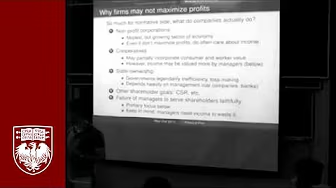
The first part of this course discusses markets with one or a few suppliers. The second part focuses on demand and supply for factors of production and the distribution of income in the economy. This course also includes some elementary general equilibrium theory and welfare economics
Vous aimerez aussi
Vadodara Rashtriya Natya Mahotsav
Primary 1 English
SS 3 Chemistry
Nursery Rhymes & Kids Cartoon (All!!) | Kiki and Miumiu | Baby Shark | Fire Truck | Top Playlist - Nursery Rhymes & Kids Songs by BabyBus
Test Your English with TV Series and Movies
Educational Cartoons for Kids | Learn with Sheriff Labrador
🎮⭐ Play & Watch | Trailers and Gameplays
Learn about Good Habits & Good Manners for Kids
English learning videos for kids - Lingokids
CoComelon Lane! Brand New Netflix Kids Show!
Halloween Songs For Kids - CoComelon
Year7 German
Learn English With Disney Movies
🎃🕯️🧛♀️ HALLOWEEN STORIES 2025 🕷️🧹👻
Sheriff Labrador Popular Live Stream
Funny Cartoons for Kids | Sheriff Labrador
Charlie and Lola Full Episodes
How to Be a Better Human
Numberblocks & Alphablocks - Learn to read and count #readingmonth
Recent videos we think you’ll love
CoComelon #shorts
All New Akili & Me
Sheriff Labrador New Episodes
Sleepytime! 💤 | Learn Words with Yakka Dee |BBC Kids
Commentaires
10 commentaires
ECON 20100: The Elements of Economic Analysis E. Glen Weyl, Assistant Professor of Economics and the College "Regulation," November 3, 2011. The first part of this course discusses markets with one or a few suppliers. The second part focuses on demand and supply for factors of production and the distribution of income in the economy. This course also includes some elementary general equilibrium theory and welfare economics. This lecture discusses the regulation of natural monopolies and industries, such as health insurance, where selection undermines the efficient operation of markets. We discuss the causes of natural monopoly and why the natural solution of marginal cost pricing is so impractical. Then discuss the more common solution of average cost pricing, exploring its advantages and disadvantages. Finally, we discuss how competition in the market place can lead to average cost pricing and the distortions this causes in markets, like insurance, where different consumers bring diff
ECON 20100: The Elements of Economic Analysis E. Glen Weyl, Assistant Professor of Economics and the College "Regulation," November 3, 2011. The first part of this course discusses markets with one or a few suppliers. The second part focuses on demand and supply for factors of production and the distribution of income in the economy. This course also includes some elementary general equilibrium theory and welfare economics. This lecture discusses the regulation of natural monopolies and industries, such as health insurance, where selection undermines the efficient operation of markets. We discuss the causes of natural monopoly and why the natural solution of marginal cost pricing is so impractical. Then discuss the more common solution of average cost pricing, exploring its advantages and disadvantages. Finally, we discuss how competition in the market place can lead to average cost pricing and the distortions this causes in markets, like insurance, where different consumers bring diff
ECON 20100: The Elements of Economic Analysis E. Glen Weyl, Assistant Professor of Economics and the College "Price Discrimination," October 27, 2011. The first part of this course discusses markets with one or a few suppliers. The second part focuses on demand and supply for factors of production and the distribution of income in the economy. This course also includes some elementary general equilibrium theory and welfare economics. This lecture addresses monopolistic firms' attempt to get around their basic trade-off by charging different prices to different consumer or for different units of goods. After exploring why first-degree price discrimination is desirable but unattainable, we consider how various imperfect forms of price discrimination (implicit, explicit and others) operate. We analyze when price discrimination improves and when it harms the efficient operation of markets and how price discriminatory strategies can be used in the design of public policies such as taxation,
ECON 20100: The Elements of Economic Analysis E. Glen Weyl, Assistant Professor of Economics and the College "Price Discrimination," October 27, 2011. The first part of this course discusses markets with one or a few suppliers. The second part focuses on demand and supply for factors of production and the distribution of income in the economy. This course also includes some elementary general equilibrium theory and welfare economics. This lecture addresses monopolistic firms' attempt to get around their basic trade-off by charging different prices to different consumer or for different units of goods. After exploring why first-degree price discrimination is desirable but unattainable, we consider how various imperfect forms of price discrimination (implicit, explicit and others) operate. We analyze when price discrimination improves and when it harms the efficient operation of markets and how price discriminatory strategies can be used in the design of public policies such as taxation,
ECON 20100: The Elements of Economic Analysis E. Glen Weyl, Assistant Professor of Economics and the College "Basic Monopoly Theory," October 25, 2011. The first part of this course discusses markets with one or a few suppliers. The second part focuses on demand and supply for factors of production and the distribution of income in the economy. This course also includes some elementary general equilibrium theory and welfare economics. This lecture begins the second half of the course, which focuses on imperfect competition. We begin by developing the basic incentive of a monopolist to reduce quantity in order to raise price and how to measure the inefficiency this creates. We consider some empirical measurements of these incentives and inefficiencies. We then consider the comparative statics of monopoly and how the rate at which the monopolist passes through cost changes into price changes measures many dimensions of her behavior. For readings associated with this lecture and slides, v
ECON 20100: The Elements of Economic Analysis E. Glen Weyl, Assistant Professor of Economics and the College "Product Design Price Theory" October 20, 2011. The first part of this course discusses markets with one or a few suppliers. The second part focuses on demand and supply for factors of production and the distribution of income in the economy. This course also includes some elementary general equilibrium theory and welfare economics. For readings associated with this lecture and slides, visit: ➡ Subscribe: About #UChicago: Since its founding in 1890, the University of Chicago has been a destination for rigorous inquiry and field-defining research. This transformative academic experience empowers students and scholars to challenge conventional thinking in pursuit of original ideas. #UChicago on the Web: Home: News: Facebook: Twitter: Instagram: University of Chicago on YouTube: /uchicago *** ACCESSIBILITY: If you experience any technical difficulties with this video or would like
ECON 20100: The Elements of Economic Analysis E. Glen Weyl, Assistant Professor of Economics and the College "Assessing Externalities" October 20, 2011 The first part of this course discusses markets with one or a few suppliers. The second part focuses on demand and supply for factors of production and the distribution of income in the economy. This course also includes some elementary general equilibrium theory and welfare economics. This lecture picks up where the last left off: how to gather the information needed to correctly internalize externalities. We analyze three approaches: those based on scientific expertise, surveys and "incentive compatible mechanisms". After developing some basic concepts, we consider the Stern Review of the Economics of Climate Change as an example of the first approach. We then discuss the flaws of surveys and the poor incentives they offer participants. Finally, we discuss how incentive compatible mechanisms, like the Vickrey-Clarke-Groves mechanism,
ECON 20100: The Elements of Economic Analysis E. Glen Weyl, Assistant Professor of Economics and the College "Assessing Externalities," October 20, 2011. The first part of this course discusses markets with one or a few suppliers. The second part focuses on demand and supply for factors of production and the distribution of income in the economy. This course also includes some elementary general equilibrium theory and welfare economics. This lecture picks up where the last left off: how to gather the information needed to correctly internalize externalities. We analyze three approaches: those based on scientific expertise, surveys and "incentive compatible mechanisms". After developing some basic concepts, we consider the Stern Review of the Economics of Climate Change as an example of the first approach. We then discuss the flaws of surveys and the poor incentives they offer participants. Finally, we discuss how incentive compatible mechanisms, like the Vickrey-Clarke-Groves mechanism
ECON 20100: The Elements of Economic Analysis E. Glen Weyl, Assistant Professor of Economics and the College "Payment in Accordance with Product," October 18, 2011. The first part of this course discusses markets with one or a few suppliers. The second part focuses on demand and supply for factors of production and the distribution of income in the economy. This course also includes some elementary general equilibrium theory and welfare economics. This lecture considers the most fundamental market failure: externalities not mediated by the price system. We begin by considering what an externality is and is not, contrasting pecuniary and real externalities and considering some difficult cases. We then consider policy remedies for externalities operating through taxation, regulation or litigation and compare their relative advantages and disadvantages. Finally we consider the Coase-Stigler critique of policies to deal with externalities and why information is crucial to externality polic
ECON 20100: The Elements of Economic Analysis E. Glen Weyl, Assistant Professor of Economics and the College "Industry Supply and Rents." The first part of this course discusses markets with one or a few suppliers. The second part focuses on demand and supply for factors of production and the distribution of income in the economy. This course also includes some elementary general equilibrium theory and welfare economics. This lecture considers the different talents and abilities of individual firms and how they generate an industry supply. We begin by deriving the basic concepts of industry supply from individual firm supply and producer surplus. We then turn to the notion of long-run industry supply, contrasting the traditional view that competition erodes profits to the importance of rare talents and superstars. Finally we discuss prominent empirical regularities about the distribution of talents, such as power laws and particularly Zipf's law. For readings associated with this lectu