
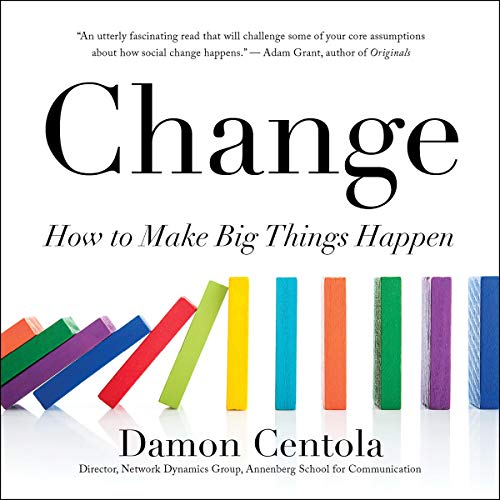
Publisher's Summary How to create the change you want to see in the world using the paradigm-busting ideas in this "utterly fascinating" (Adam Grant) big-idea book. Most of what we know about how ideas spread comes from best-selling authors who give us a compelling picture of a world, in which "influencers" are king, "sticky" ideas "go viral", and good behavior is "nudged" forward. The problem is that the world they describe is a world where information spreads, but beliefs and behaviors stay the same. When it comes to lasting change in what we think or the way we live, the dynamics are different: beliefs and behaviors are not transmitted from person to person in the simple way that a virus is. The real story of social change is more complex. When we are exposed to a new idea, our social networks guide our responses in striking and surprising ways. Drawing on deep-yet-accessible research and fascinating examples from the spread of coronavirus to the success of the Black Lives Matter movement, the failure of Google+, and the rise of political polarization, Change presents groundbreaking and paradigm-shifting new science for understanding what drives change, and how we can change the world around us. ©2021 Damon Centola (P)2021 Hachette Audio
Vous aimerez aussi
Harem Tales of a Reincarnated Elf Prince
The Summer I Turned Pretty
The Hobbit
Grey's Anatomy Uncut
Rich Dad Poor Dad
The Psychology of Money
Think and Grow Rich
I Will Teach You to Be Rich
Dual Cultivation
Motivational and Inspirational
Vampire Academy
A Reincarnated Mage’s Tower Dungeon Management
Chronicles of an Aristocrat Reborn in Another World – the Apostle of the Gods Who Know No Self-Restraint
A Returner’s Magic Should Be Special
Raw
Boy Meets Girl Meets Boy Meets World
Love Island: The Morning After
Close Combat Mage
In Love
The Sideline Eye Podcast
Starship Troopers
Possession
Build
Beyond the Scenes from The Daily Show with Trevor Noah
Commentaires
8 commentaires
I’m already planning to revisit several of the excellent chapters in this book. It really deserves better than a five star rating!
The author is a respected and highly-cited professor of experimental sociology and complex contagions at Penn (formerly at MIT). In this book he discusses, in a way that is very engaging most of the time, his and others' studies in network dynamics, e.g., social networks, biological networks, transportation networks, etc. He also describes interesting results from experiments designed to affect network dynamics in the most effective way. The author makes no attempt at introducing, and then distilling into lay terms, the mathematical rigors I feel are necessary to make the study of network dynamics really pop. But this is still one of the better treatments on the subject I've come across. The narrator was excellent! Not perfect, but excellent. See also Sync, by Steve Strogatz, one of my overall favorites on this subject, which is highly underrated.
Did you love Malcolm Gladwell's Tipping Point? Then you'll like this one a lot too! It's non-overlapping, timely, and includes a fair amount of examples from the Life Sciences. An excellent, enjoyable, and educational read!
The book does a great job at explaining it's point but it is so overly complex that it is hard to follow