
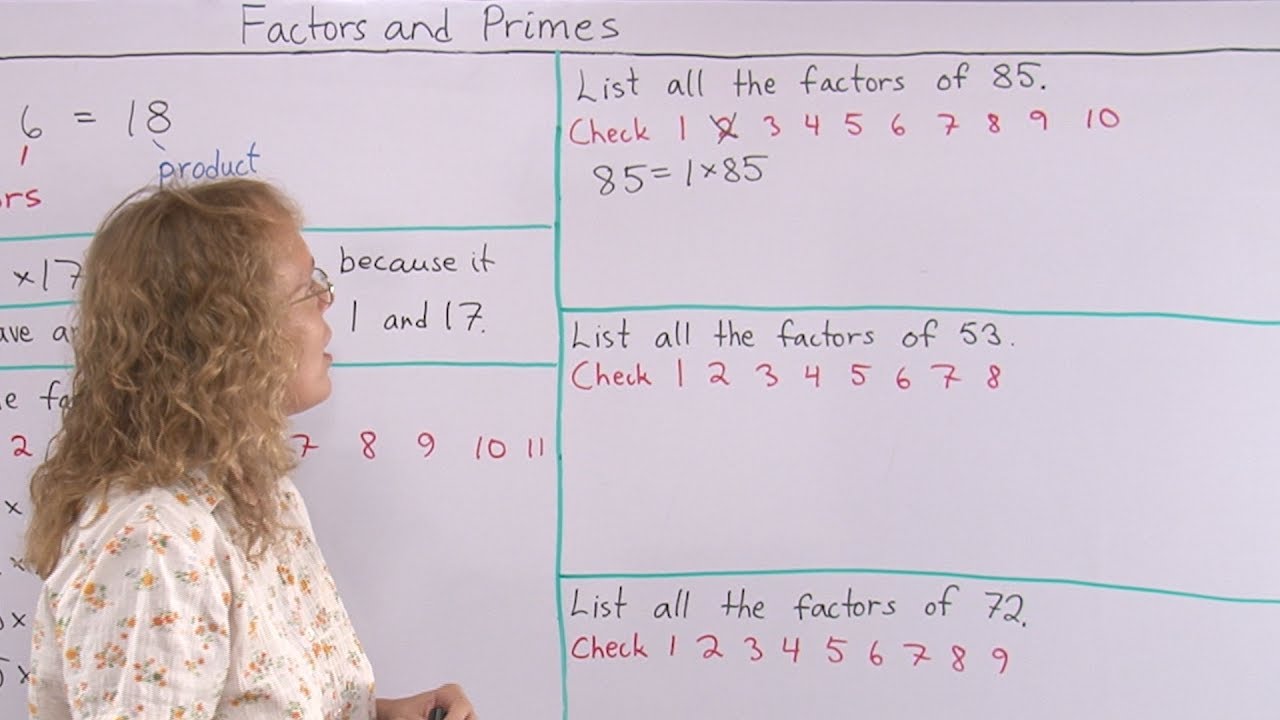
I explain a systematic way of finding all the factors of a given number. Basically, we check whether numbers 2, 3, 4, 5, and so on are factors of the number, and every time we find a factor, we write the multiplication and write down both factors. Going through the counting numbers in order, at some point you will know that you will have found all the factors, because the large factors will "meet" the small factors. It's much easier to understand by an example so please watch the video. This topic is first encountered in 4th grade math (in Common Core) but may be in some other grade/year in other countries/standards.
Maaari Mo Ring Magustuhan
Year6 Maths
Year 7 Math
Numberblocks - Learn to Count | Maths for Kids
Year 3 Math
Yes Yes Songs! CoComelon Nursery Rhymes Mix
Programming with JavaScript
Masha and The Bear. Episodes in English
Alphabet ABC Phonics Series (From A to Z) in HD
Kids Songs by CoComelon
CoComelon
Alphabet (ABC) Songs by CoComelon
CocoMelon | Little Baby Bum | Blippi - Nursery Rhymes & Kids TV Shows
PrePrimary Maths
Year1 Maths
Year 11 Math
Year2 Maths
Year 10 Math
Year4 Maths
Year5 Maths
Maths
Back To School | Counting for Kids | @Numberblocks
Algebra I | High School Math | Khan Academy
Functions and their graphs | Algebra II | Khan Academy
Calcul de probabilités/Dénombrement/2SPCF- 2bacspcf/sciences techniques/Terminale S/dénombrement/Analyse combinatoire/variable aléatoire-loi binomiale
Mga Komento
10 Mga Komento
I show you why we can simplify "criss cross" or cross cancel, when simplifying (reducing) fractions, or when multiplying fractions. It's a neat process and kind of fun, to look for numbers that have common factors, and to simplify them. The first part of the lesson is here: See more 6th grade math videos: Self-teaching worktext to learn about multiplication, division, and factoring: Check out Math Mammoth grade 6 curriculum here:
I show you why we can simplify "criss cross" or cross cancel, when simplifying (reducing) fractions, or when multiplying fractions. It's a neat process and kind of fun, to look for numbers that have common factors, and to simplify them. The first part of the lesson is here: See more 6th grade math videos: Self-teaching worktext to learn about multiplication, division, and factoring: Check out Math Mammoth grade 6 curriculum here:
When simplifying fractions, or when multiplying fractions, you can cross out, or cancel, common factors from the numerator and the denominator. It can help to write the numerator and the denominator as (something times something), in other words to factor them. I show this process using multiple examples, going from simple to more complex. In the 2nd part, we learn how to cross-cancel (simplify criss-cross): See more 6th grade math videos: Self-teaching worktext to learn about multiplication, division, and factoring: Check out Math Mammoth grade 6 curriculum here:
When simplifying fractions, or when multiplying fractions, you can cross out, or cancel, common factors from the numerator and the denominator. It can help to write the numerator and the denominator as (something times something), in other words to factor them. I show this process using multiple examples, going from simple to more complex. In the 2nd part, we learn how to cross-cancel (simplify criss-cross): See more 6th grade math videos: Self-teaching worktext to learn about multiplication, division, and factoring: Check out Math Mammoth grade 6 curriculum here:
Several examples of building a factor tree and finding the prime factorization of various numbers. In this lesson we focus on factoring three-digit numbers. The starting point for factoring is to find a divisor of the number. You can use the basic divisibility tests for starters, and beyond that, test-divide (long division) to check if the number is divisible by another. See more 6th grade math videos at
Several examples of building a factor tree and finding the prime factorization of various numbers. In this lesson we focus on factoring three-digit numbers. The starting point for factoring is to find a divisor of the number. You can use the basic divisibility tests for starters, and beyond that, test-divide (long division) to check if the number is divisible by another. See more 6th grade math videos at
In this lesson we have a chart for numbers 1-30, and I check whether each of them is divisible by 1, 2, 3, 4, 5, 6, 7, 8, and 9. The larger numbers didn't fit, but not to worry, our check is sufficient to find all the primes between 1 and 30: they are numbers that are only divisible by 1 and by themselves. Lastly we check whether 79 and 87 are prime or composite numbers, based on divisibility. This lesson is meant for 4th grade math. The first part of the lesson explains the terms factor, multiple, and divisible, and it is found here:
In this lesson we have a chart for numbers 1-30, and I check whether each of them is divisible by 1, 2, 3, 4, 5, 6, 7, 8, and 9. The larger numbers didn't fit, but not to worry, our check is sufficient to find all the primes between 1 and 30: they are numbers that are only divisible by 1 and by themselves. Lastly we check whether 79 and 87 are prime or composite numbers, based on divisibility. This lesson is meant for 4th grade math. The first part of the lesson explains the terms factor, multiple, and divisible, and it is found here:
Two topics explained here: (1) Using the least common multiple of the denominators when adding fractions; and (2) How to find the least common multiple of two numbers by using the prime factorization of the numbers. This lesson is intended for 6th grade (and onward). The first part of the lesson explains what is the least common multiple and gives examples of how to find it: Check out also the free Math Mammoth books and worksheets you can find here:
Two topics explained here: (1) Using the least common multiple of the denominators when adding fractions; and (2) How to find the least common multiple of two numbers by using the prime factorization of the numbers. This lesson is intended for 6th grade (and onward). The first part of the lesson explains what is the least common multiple and gives examples of how to find it: Check out also the free Math Mammoth books and worksheets you can find here: