
Maaari Mo Ring Magustuhan
Kids Songs by CoComelon
Primary 1 English
Alphabet (ABC) Songs by CoComelon
March 2024 KIDS Songs from LooLoo Kids
Yes Yes Songs! CoComelon Nursery Rhymes Mix
ABC Videos: Write the Letter - Alphabet Writing Lessons for Children
Popular Compilations by CoComelon
Mix - Every CoComelon Wheels on the Bus Ever!
Nick Jr. Mindfulness & Mental Health with PAW Patrol and More 💗
Bengali Kids Cartoon Videos
CoComelon Lane! Brand New Netflix Kids Show!
English learning videos for kids - Lingokids
Alphabet ABC Phonics Series (From A to Z) in HD
ABC Songs for Kids - CoComelon Nursery Rhymes
ABCs, 123s, and MORE with Sesame Street and The Children's Kingdom Nursery Rhymes
Halloween Songs For Kids - CoComelon
Summer Songs for Babies! CoComelon Summertime
IELTS Listening and Speaking Sections Skills Mastery
🎃🕯️🧛♀️ HALLOWEEN STORIES 2025 🕷️🧹👻
Popular Kids Songs & Nursery Rhymes Compilations - by BabyBus
Kids Songs by CoComelon & Blippi - Nursery Rhymes
Exams and revision
ABCs Learn the Alphabet
ABC Alphabet for Kids - Read Along with StoryBots! | Netflix Jr
Mga Komento
10 Mga Komento
In the ancient Mediterranean world, the earliest-known mosaics, which date to the 8th century B.C., were made of large, water-smoothed pebbles arranged in geometric patterns. Over time, they were made of tiny pieces of glass or stone, called tesserae, which were used to create intricate patterns and images on the floors, walls, and ceilings of public and private spaces. By the Roman and Byzantine periods, an empire-wide trade existed for luxurious materials, such as marble and granite, which were used in their creation. Filmed at the Chicago Mosaic School, this video explores the materials used to make mosaics. This video was produced with the generous support of a Long-Range Fund grant provided by the Community Associates of the Art Institute of Chicago. It was created for LaunchPad, a program of digital interpretive materials that supplement the viewing of works of art on display in the Art Institute of Chicago's galleries.
观看完整课程: http://ed.ted.com/lessons/how-art-can... 艺术能救命吗?并不尽然,但一些被认为最有价值的从业人员(医生、护士、警察)能通过学习艺术分析获得实用的技能。 通过学习诸如雷内·马格利特的《凝固的时间》 这样的艺术作品,同时着重于看到了什么和没看到什么,能够加强人的交流和分析技巧。 Amy E. Herman向我们解释了为什么艺术史的训练能为现实生活中的调查研究做准备。 课程讲师:Amy E. Herman, 动画: Flaming Medusa Studios Inc.
全部课程集,请访问: http://ed.ted.com/lessons/is-there-a-... 达·芬奇是个艺术天才吗?当然是!但他也是在正确的时代,生在了正确的地方。文艺复兴兴起之前,西方艺术家们很少因为其作品而获得个人功劳。在西方以外的其他地方,传统的形式长久以来都比创新更受褒奖。我们对于 “艺术” 与 “工艺” 的认识从何而来?Laura Morelli带我们追溯我们对视觉艺术价值认识的历史。 课程: Laura Morelli, 动画制作: Sandro Katamashvili.
In the mid-first century B.C., glass makers around Jerusalem discovered they could inflate glass into a bubble at the end of a tube. This new glassblowing technique revolutionized the glass industry, allowing vessels to be made quickly and more cheaply, and glassware began to replace clay vessels for household use. Watch a demonstration of this ancient method in this video featuring footage from the Corning Museum of Glass. Love Art? Hit Subscribe! (https://www.youtube.com/user/gettymus...) #antiquities #gettyantiquities #glass
看整个视频:http://ed.ted.com/lessons/a-brief-his... 在我们把艺术陈列到博物馆前,艺术是宗教的视觉表达。那些数个世纪前的绘画,雕塑,文字和我们相关么? Jeremiah讲述了艺术是如何进化的和怎样现代人可以将艺术历史看成进行的全球对话。
Learn the difference between tint, shade, and tone with IN THE STUDIO instructor Corey D’Augustine. Explore the techniques of other New York School painters like de Kooning, Rothko, and Pollock in MoMA's new free, online course, "In the Studio: Postwar Abstract Painting." Sign up: http://mo.ma/inthestudio Subscribe for our latest videos: http://mo.ma/subscribe Explore our collection online: http://mo.ma/art Plan your visit in-person: http://mo.ma/visit In painting, a tint is a color plus white, a shade is a color plus black, and a tone is a color plus gray. #art #moma #museum #modernart #nyc #education #artist #tint #shade #tone #painting #howtopaint
A conversation with Dr. Steven Zucker & Dr. Beth Harris In classical architecture, the Orders consist of variations of an assembly of parts made up of a column (usually with a base), a capital, and an entablature. These structural units may be repeated and combined to form the elevation of a building and its architectural vocabulary. There are eight Orders in total: Doric (Greek and Roman versions), Tuscan, Ionic (Greek and Roman), Corinthian (Greek and Roman), and Composite. The simplest is the Tuscan, supposedly derived from the Etruscan-type temple. It has a base and capital and a plain column. The Doric is probably earlier, however, its Greek version having no base, as on the Parthenon. The Ionic Order, with its twin volute capitals, originated in Asia Minor in the mid-6th century B.C.E. The Corinthian Order was an Athenian invention of the 5th century B.C.E. and was later developed by the Romans. The Composite Order is a late Roman combination of elements from the Ionic and Cori
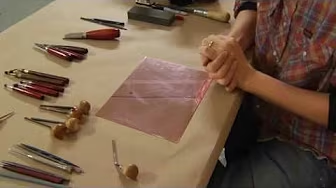
Subscribe for our latest videos: http://mo.ma/subscribe Explore our collection online: http://mo.ma/art Plan your visit in-person: http://mo.ma/visit Produced in conjunction with the exhibition German Expressionism: The Graphic Impulse. Find out more at http://moma.org/germanexpressionism Special thanks to Phil Sanders, Director and Master Printer, Robert Blackburn Printmaking Workshop. A program of The Elizabeth Foundation for the Arts. Created by Plowshares Media PlowsharesMedia.com © 2011 The Museum of Modern Art, New York #art #moma #museum #modernart #nyc #education #artist #expressionism #expressionist #germanexpressionism