
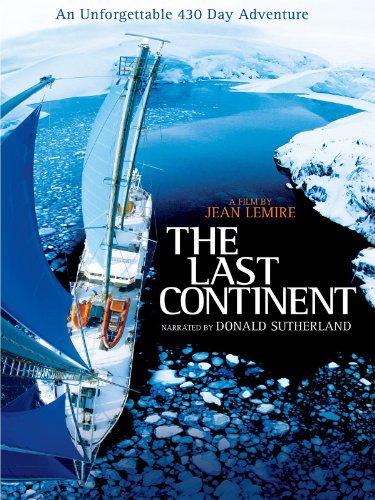
Narrated by Donald Sutherland, this thrilling, feature-length documentary chronicles the brave group of scientists on board the Sedna IV as they explore the Earth's most fascinating and isolated continent.
Trailer
Cast
Jean Lemire
Director
Donald Sutherland
Self - Narrated by
Dominic Champagne
Writer
Robert Blondin
Writer
Jacques Payette
Writer
Jacob Potashnik
Writer
Jean Lemire
Writer
Caroline Underwood
Writer
You Might Also Like
Serviced
Mostly Sunny
Beauty and the Breast
Bigay hilig: Sexual Fetish
I, Hostage
Ice Vikings
Paid in Full: The Battle for Black Music
The Big Dry
History's Greatest Heists
Mourinho
World War II with Tom Hanks
Murder 101
Timber Titans
This Is High School
Secrets in the Jungle
Restoration Garage
Heavy Rescue: 401
Sex Next Door
Sex, Explained
Kingdom
Ashley Madison: Sex, Lies & Scandal
Porn Laid Bare
Serengeti
Trust Me: The False Prophet
Comments
9 Comments
source: The Last Continent
i was disappointed in this documentary.it supposedly details a group of Canadian scientists/filmmakers in their efforts to test and observe the effect that global warming is having in the Antarctic,by spending the winter there under supposed harsh conditions,which would supposedly test them and present them with a great deal of danger.unfortunately,it seems to focus mainly on the crew themselves and their banal,everyday conversations.they didn't really seem to do very much in the way of studying the climate.plus,the were never really in any great deal of peril due to all the modern technology they had.so the film is neither very compelling or interesting.the narration of Donald Sutherland elevates things a bit,and there are few striking scenes showing parts of snow cliffs melting and crashing into the water.and their are few a few scenes showing some of the native life that lives in harsh conditions.but overall,a lacklustre effort,in my opinion.for me,The Last Continent is a 4/10
The "mission" was for group of French Canadian scientists and filmmakers to spend Winter in Antarctica making observations and this documentary, something which (apparently) all previous teams had shunned due to the severity and austerity of the Winter. But the team was largely thwarted in this objective due to the unseasonably high temperatures, a much as 6°C (11°F) above average which prevented the expected pack ice formation and consequent locking in of the research vessel Sedna IV. As month after month passes, and Winter seems almost passed, the team's frustration grows, exacerbated by the increased hours of darkness and its resultant effect of depressing spirits. As narrator Donald Sutherland puts it, it's one thing to clinically study a scientific phenomenon, quite another to find yourself the victim of it. The film is beautifully photographed and the powerful, moving musical score does much to maintain a sense of gravity in the movie. Much is made of the historical comparison with early polar explorer Shackleton and his team and mission, which almost came to grief. However with satellite TV, phone, radar, up to date weather reports,a good supply of varied food, and recreation facilities, there really is no comparison with the hardships of the early explorers. I found myself perhaps cynically wondering if the real "mission" was to make a colorful documentary of the event. Even when Winter finally sets in (in August) there doesn't seem much in the way of scientific study. One can only wonder if either this didn't occur, or was deemed by the film's backers as being too boring, and deliberately kept in the background. So one is treated in the film largely to scenes of the team having a good (eating together, sports, personal pursuits) or worrying time (journal musings, securing the ship's physical safety). During the Winter phase there is a token effort at observing the local fauna, though even this is more like a visit to the zoo or local aquarium than serious scientific research. Nothing wrong with making a doco entertaining, and it seemed that the team was genuinely not expecting the lack of Winter, but meaningful work and a disciplined regimen of tasks and duties can go a long way to assuaging boredom and feelings of helplessness, with which the team was (apparently) so beset. Anyway for someone like myself concerned about climate change, the film was, if only incidentally, an eye-opener. I was previously under the impression that Antarctica had largely escaped global warming and that only the Arctic was being dramatically affected, but it is very apparent that this is not the case. I remain, sadly, quite alarmed.
source: The Last Continent
source: Mission Antarctique
The "mission" was for group of French Canadian scientists and filmmakers to spend Winter in Antarctica making observations and this documentary, something which (apparently) all previous teams had shunned due to the severity and austerity of the Winter. But the team was largely thwarted in this objective due to the unseasonably high temperatures, a much as 6°C (11°F) above average which prevented the expected pack ice formation and consequent locking in of the research vessel Sedna IV. As month after month passes, and Winter seems almost passed, the team's frustration grows, exacerbated by the increased hours of darkness and its resultant effect of depressing spirits. As narrator Donald Sutherland puts it, it's one thing to clinically study a scientific phenomenon, quite another to find yourself the victim of it. The film is beautifully photographed and the powerful, moving musical score does much to maintain a sense of gravity in the movie. Much is made of the historical comparison with early polar explorer Shackleton and his team and mission, which almost came to grief. However with satellite TV, phone, radar, up to date weather reports,a good supply of varied food, and recreation facilities, there really is no comparison with the hardships of the early explorers. I found myself perhaps cynically wondering if the real "mission" was to make a colorful documentary of the event. Even when Winter finally sets in (in August) there doesn't seem much in the way of scientific study. One can only wonder if either this didn't occur, or was deemed by the film's backers as being too boring, and deliberately kept in the background. So one is treated in the film largely to scenes of the team having a good (eating together, sports, personal pursuits) or worrying time (journal musings, securing the ship's physical safety). During the Winter phase there is a token effort at observing the local fauna, though even this is more like a visit to the zoo or local aquarium than serious scientific research. Nothing wrong with making a doco entertaining, and it seemed that the team was genuinely not expecting the lack of Winter, but meaningful work and a disciplined regimen of tasks and duties can go a long way to assuaging boredom and feelings of helplessness, with which the team was (apparently) so beset. Anyway for someone like myself concerned about climate change, the film was, if only incidentally, an eye-opener. I was previously under the impression that Antarctica had largely escaped global warming and that only the Arctic was being dramatically affected, but it is very apparent that this is not the case. I remain, sadly, quite alarmed.
i was disappointed in this documentary.it supposedly details a group of Canadian scientists/filmmakers in their efforts to test and observe the effect that global warming is having in the Antarctic,by spending the winter there under supposed harsh conditions,which would supposedly test them and present them with a great deal of danger.unfortunately,it seems to focus mainly on the crew themselves and their banal,everyday conversations.they didn't really seem to do very much in the way of studying the climate.plus,the were never really in any great deal of peril due to all the modern technology they had.so the film is neither very compelling or interesting.the narration of Donald Sutherland elevates things a bit,and there are few striking scenes showing parts of snow cliffs melting and crashing into the water.and their are few a few scenes showing some of the native life that lives in harsh conditions.but overall,a lacklustre effort,in my opinion.for me,The Last Continent is a 4/10
Mission Antarctique