
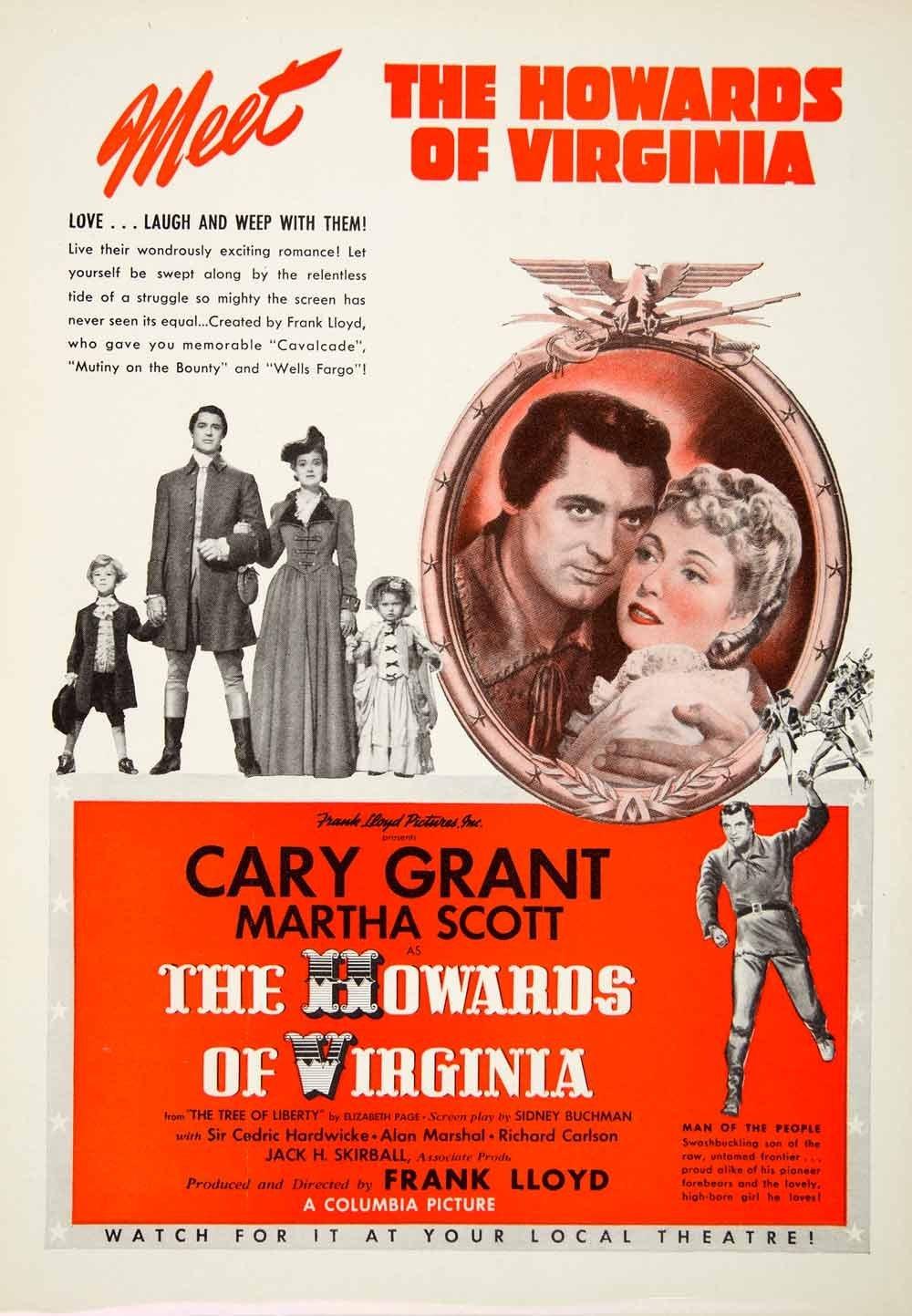
Just prior to the American War of Independence, aristocratic Virginian Jane Peyton marries unsophisticated rustic farmer and surveyor Matt Howard who takes her to his Shenandoah Valley plantation and later goes to war.
Trailer
Cast
Frank Lloyd
Director
Cary Grant
Matt Howard
Martha Scott
Jane Peyton-Howard
Cedric Hardwicke
Fleetwood Peyton
Alan Marshal
Roger Peyton
Richard Carlson
Thomas Jefferson
Paul Kelly
Captain Jabez Allen
Irving Bacon
Tom Norton
Elisabeth Risdon
Aunt Clarissa
Anne Revere
Mrs. Norton
Tom Drake
James Howard at 16
Phil Taylor
Peyton Howard at 18
Rita Quigley
Mary Howard at 17
Libby Taylor
Dicey
Richard Gaines
Patrick Henry
George Houston
George Washington
Ralph Byrd
James Howard
Dickie Jones
Matt Howard at 12
Buster Phelps
Tom Jefferson at 11
Sidney Buchman
Writer
Elizabeth Page
Writer
You Might Also Like
1944
Quo Vadis, Aida?
Natural Light
Deliler
Chief of War
Roots
We Were the Lucky Ones
All the Light We Cannot See
Euphoria
Ambitions
my vampire system
Wild Rose
Manhattan
TURN: Washington's Spies
The Book of Negroes
The Forgotten Army - Azaadi ke liye
Uyanis: Büyük Selcuklu
The Hollow Crown
Legacy
Sanadamaru
1864
Rebellion
Women at War
Gunshi Kanbee
Comments
10 Comments
source: The Howards of Virginia
Cary Grant was terribly miscast in an historical film set in the 18th century. It doesn't help that he looks 40, almost twice as old as his character for much of the film.
When I first started to play this, I was afraid I had erred. The acting seemed second-rate and rather silly. But I realized we hadn't seen the main actors, yet. And even when they came on, they hit their stride later in the movie. The funny thing for me was that the best performances often came from the child actors. Buster Phelps as the young Thomas Jefferson was especially good. The adult Jefferson was good in general, but did not hold a candle to the portrayal in the HBO John Adams series. Cary Grant is fun to watch. His accent never quite sounds as rough as it should, but his gruff mannerisms make him convincing enough, so long as you're willing to suspend disbelief. The best element for me was how Cary Grant's character was developed in relation to his family.
Never realized that Cary Grant appeared in a film which concerned the American Revolution or that he even was willing to give his talents to this type of film. I later found out that Cary Grant did not like this role he was playing in the film and made it a point to never appear in such a film. Many people felt that Cary Grant was not suited for his role in this film and felt he should have turned down this role. There are great supporting actors in this film which are Martha Scott, (Jane Peyton Howard) and Cary Grant, ( Matt Howard) and also Cedric Hardwicke,(Fleetwood Peyton). This film deals with the Boston Tea Party which means that the British were enacting a tax on the people of Boston and the people of Boston were very rebellious against such legislation and made the statement, "No Representation with out Taxitation." You must agree this is not really a Cary Grant film, he was placed in a film which he should never had appear in.
I liked this movie despite the dreadful miscasting of Cary Grant. His performance beggared all description. What were they thinking? Cary looked like he had been on amphetamines, jerky and hyperactive. He sounded like an Englishman trying to speak like he thought an American should sound. Grant realized that his performance was woefully bad and vowed never to do a costume drama again. Unfortunately he must have forgotten that pledge for seventeen years later he starred in The Pride and the Passion with Frank Sinatra and Sophia Loren. While he was bad in this role too, he did not stand out as much as Frank and Sophia were equally inept. Cedric Hardewick, Richard Carlson and Martha Scott were competent in their roles in HOV which contrasted Grant's fiasco.
I was a bit surprised to see so many other reviewers panning this film, since I had seen it once before and thought it was quite good. I watched it again, and I still believe it's a far better-than-average costume drama. Several people thought Cary Grant was miscast, and even criticized his British accent. Well, what accent do you think a British citizen from the 1760s WOULD have? His character was a "low-born" British colonist, for crying out loud! I thought he did well, definitely playing against type, and I thought his actual British origins, hardly high-born, made him an excellent choice for the part. His character's progression over time, in this film, was believable and, I thought, well done. I suspect it parallels, in some ways, Grant's life changes from humble British kid to acclaimed Hollywood star. The film itself, with its use of the colonial Williamsburg settings and attention to detail about frontier life, was refreshing, as of course was the excellent casting overall. I also thought the very realistic historical treatment was commendable, laying out clearly many of the controversies and issues facing the colonies during these times. I'd recommend it for kids, especially, since what they get for American history class about this period of time is truly awful -- what little there is. I'd give it a solid 8, easily.
This premiered yesterday on TCM. In his intro, Robert Osborne said this was one of Cary Grant's least-known films. Ten minutes in, you know why. Matthew was 9 or 10 when he loses his father. A title card then moves us forward 12 years, meaning Matthew should be 21 or 22, but is played by the 36 year old Grant! It doesn't help that Matthew is an a-hole! He rejects his first son because he is crippled. So instead of naming the kid after his dead father, Matthew sticks it to him by naming him after the hated Fleetwood! The irony that Matthew becomes the very kind of man he despises Fleetwood for being - landowner (and slave owner), politician, member of the upper-crust - is completely lost on Z-Grade director Frank Lloyd. As if he knew he was horribly miscast, Grant tears through this like he's on crack! Martha Scott struggles mightily. Only the great Cedric Hardwicke emerges from this unscathed. Fleetwood is a snob, but one with an innate sense of civility who tries to walk a fine line between love of his King and love of his adopted home. He makes you feel Fleetwood's bitterness as his world crumbles around him, betrayed, through no real fault of his own, by the very people he thought of as his own. Did anyone pick up on that Roger was gay? Fleetwood gives Jane the family's necklace because he knows Roger will never marry! And Tom-Cat Jefferson was SO effeminate, I was waiting for him to hook up with Roger! Boy Howdy!
Sad that so many Cary Grant fans had their bubbles burst. It certainly was strange to see him play such a character, but did anyone have any problems with the actors who played the other backwoodsmen? Grant could not have played his dapper persona while being from the Shenandoah Valley, especially in scenes with those crude and embarrassing frontiersmen and women. They must have been extras. I doubt if that kind of acting is taught at UCLA or Princeton. One reviewer was critical of the director because the irony of Matthew Howard turning into a kind of Fleetwood Peyton was not portrayed. But from early on in the movie, Tom Jefferson and Matt Howard thought it would be grand to develop the 1,000 acres in the Shenandoah Valley into a PLANTATION. That was the American Dream, to achieve success through hard work. Then it meant that the most successful planter had slaves and went to Congress. But Matt Howard didn't want to run at first, and when pressed said he would go if only to improve the roads and bridges and repeal the Stamp Act. He had no thoughts of aristocratic power unlike Fleetwood. Anyone see John Wayne in The Searchers? Early in the film he wanted to murder his niece Natalie Wood because she was kidnapped and lived with the Redskins. He too was playing a character from an earlier time when there were other mores. Talk about provincialism! It's thriving even today. Collectivism versus individualism is being played out today on these movie reviews. Am I being too critical to suggest that those who are most critical of this move are doing so on political rather than on artistic grounds? July 4, 2009 I watched the film again this year on TV. It's becoming an Independence Day (don't call it the 4th of July) classic, something like Jimmy Stewart's the 25th of December classic, "It's a Wonderful Life." I can't answer all the other reviewers individually here. Basically, I suspect that the "Cary Grant as Matt Howard" detractors are either in love with the suave Cary Grant or are against the political principles of Matt Howard. His performance in the beginning as a backwoodsman was energetic and realistic. He pulled no punches. The depiction of his friends as toothless and illiterate, and his love and respect for them was outstanding. His speechifying at the conclusion, espousing the distinctly American virtues of freedom, self-reliance and industriousness, sounded heartfelt. I don't know what Cary Grant felt later about the film, but the film is essential now both as a political debate and a period piece. Read the reviews at the Cary Grant web site: some of them written when the film came out in 1940 when we were allied with England in WW II. Think about today's political climate, what with tea-partyers (the original Boston Tea party was referred to in the movie) and the current debate on levels of taxation and government controls (the Stamp Act was also a plot element in the movie). Also, in case there's some doubt, Cary Grant wasn't always perfectly elegant. Early in his career he played a heavy. "In a string of films he had supporting parts, including the heavy who nearly destroys Marlene Dietrich in Blonde Venus 1932) and Mae West's foil in She Done Him Wrong (1933) and I'm No Angel (1933)." Later in his career, after he had established his elegant style, he played in a couple less-than-exemplary roles, costarring with Jayne Mansfield in 1957 in "Kiss Them for Me" and playing a heartless swindler and a Cockney in 1943 in "Mr Lucky." I don't see why he can't play against type in this patriotic film. Maybe he was still trying to establish his bona fides as an actor, or he could have believed in the principles of Matt Howard. In support of the second theory, Cary Grant became an American citizen on June 26th, 1942. Might not he actually believed the lines he was reading because that is what they were teaching our naturalized citizens in those days? July 4, 2010
Simpler than it first appears. This movie tries to be an epic about a frontier man transformed into a civic and military leader - but it doesn't try that hard. Cary Grant doesn't look like he knows quite how to play this guy, and I don't blame him. The material isn't wonderful, although it's a nice story. The wrong elements of the plot are emphasized, and the character of Matthew Howard is less a complicated man than a simple cypher. It's not a bad movie by any means, but it looks like it's trying desperately to copy "A Tale of Two Cities" and "Gone with the Wind" at the same time. It just doesn't have the legs for either one. I give this movie a 6 for Cary's personal magnetism, even in a stifling role like this one.