
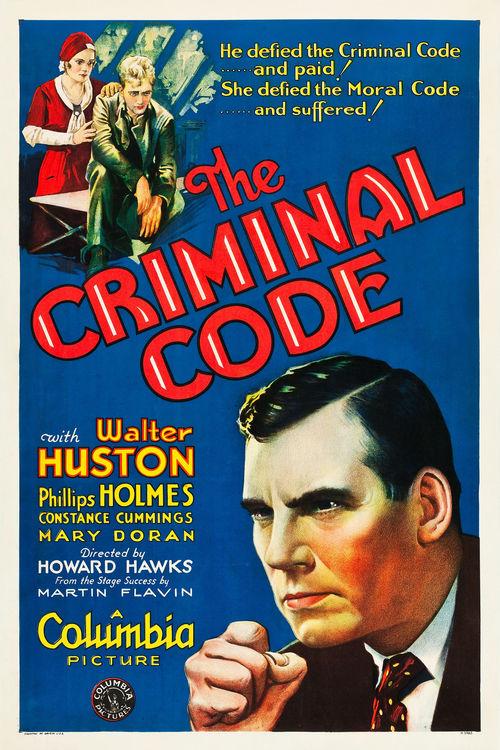
After a failed attempt at running for governor, D.A. Mark Brady is appointed warden of the state prison where many of the criminals he prosecuted are incarcerated.
Trailer
Cast
Howard Hawks
Director
Walter Huston
Mark Brady
Phillips Holmes
Robert Graham
Constance Cummings
Mary Brady
Boris Karloff
Galloway
DeWitt Jennings
Captain Gleason
Mary Doran
Gertrude Williams
Ethel Wales
Katie Ryan
Clark Marshall
Runch
Arthur Hoyt
Leonard Nettleford
John St. Polis
Dr. Rinewulf
Paul Porcasi
Tony Spelvin
Otto Hoffman
Jim Fales
John Sheehan
McManus
Richard Bishop
Minor Role
Andy Devine
Cluck - a Convict with knife
James Guilfoyle
Detective Doran
Frank Hagney
Prison Guard in Yard
Al Hill
Jerry
Martin Flavin
Writer
Fred Niblo Jr.
Writer
Seton I. Miller
Writer
You Might Also Like
Teacher's Pet
Erotic Symphony
Sugar Baby
The Babysitters
All the Queen's Men
Ruthless
You
P-Valley
wolves of blood moon
The Madison
The dawn of Olympus son of apollo
The Elf Prince Is My Baby Daddy
The Catch
You Are My Hero
Halik
My Father's Wife
Pyarey Afzal
Lady of Steel
New Beginnings
Darr Khuda Say
Blocco 181
Stars of Hope
The Half Sisters
False Identity
Comments
8 Comments
criminal code season 1 hindi bhai dalo
source: The Criminal Code
The Criminal Code
"The Criminal Code" is centered around the theme "An Eye for An Eye." This theme is the reason that young Robert Graham is sent to prison, the reason why the prisoners object to the D.A. becoming the Warden of the prison, and the reason why Graham is sent to "the hole" near the end of the film. For 1931, it was one of the first critical looks at this theme. It raises certain questions as to the morals of the law, and the Criminal Code versus the Prisoners Code. Phillips Holmes gives a good enough performance as Robert Graham, and Boris Karloff came off well as the inmate with a bone to pick (months before becoming Frankenstein), but the performance that I liked the most was Walter Huston, who played the D.A.-turned-prison-warden. Huston's character was a wily one, who said "Yeah" and "Yeah?" about a hundred times throughout the film.
The Criminal Code (1931) is often passed over when it comes to discussion of the films of Howard Hawks, but it's actually one of my favorites from him. There are a lot of stagey aspects to be sure and the central love story is pretty boring, but there's just so much to love. The film experiments with sound, overlapping dialogue and using crowd noise as a plot element. The two standout actors are Walter Huston and a pre-stardom Boris Karloff. Anytime either of them walks on screen, everyone else just evaporates. Huston does a great job making the audience love and despise his character. And Karloff is just mesmerizing as Galloway, a convict hell-bent on vengeance. No masterpiece, but it is an early sign of Hawks' genius. And I would take it over Bringing Up Baby (1938) and His Girl Friday (1940) any day of the week.
Sometimes you seem to get into a position where you have to take your medicine for an even unintended actions. That is what happens to poor 20-year-old Bob Graham, and within 10 minutes into the movie, he's in the infinite world of prison, where he must learn yet another set of codes of the criminal sort. Creepy Ned Galloway (Boris Karloff just before his "Frankenstein" turn) takes a rather minor (at least early on) role and fills it with gusto (maybe its that creepy little haircut) in a claustrophobic cell. Later, he does the right thing for rehabilitated and soon-to-be-paroled (maybe) Graham, who does not violate the titular Criminal Code (since he's still a con). James Whale wanted Karloff for his monster after seeing Boris in this flick, and after you see it, you'll know why. BTW, who doesn't love a good prison movie yarn, and with Karloff in it, it rates a "9."
Boris Karloff appeared on the stage of the Belasco Theatre, New York City in the role of Galloway in a Martin Flavin stage play. It was a minor part, however, it was an important one: Galloway, the prison trusty who becomes a killer. On the strength of his performance, he was soon cast in the film version. During 1931-32, twenty-three of his films were released, an average of nearly one a month which included Frankenstein. Criminal Code was the big break Karloff was waiting for and he never gave up acting until the very end.