
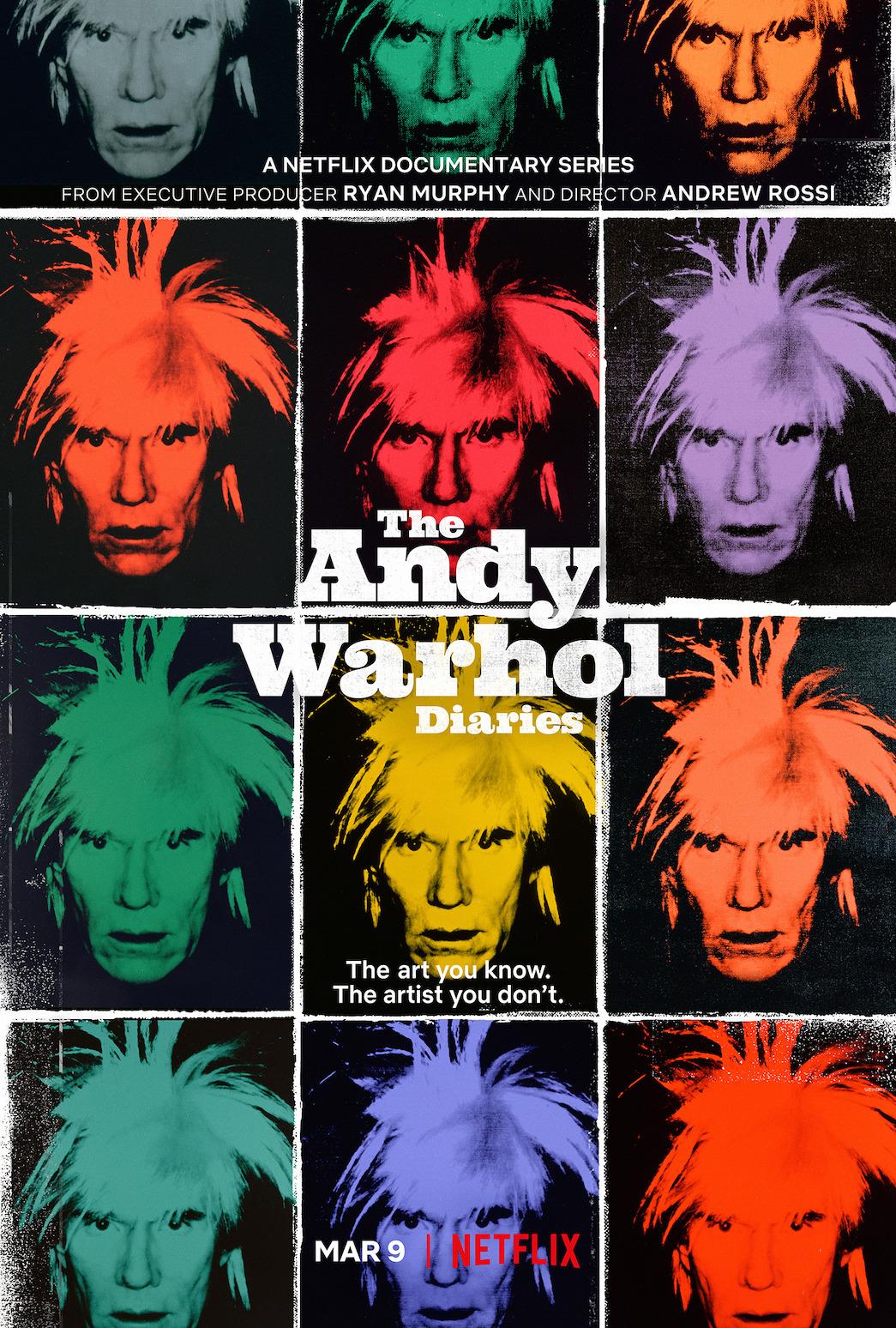
After he's shot in 1968, Andy Warhol begins documenting his life and feelings. Those diaries, and this docuseries, take a peek behind his persona.
Trailer
Cast
Andrew Rossi
Director
Andy Warhol
Self
Bill Irwin
Andy Warhol
Jeffrey Deitch
Self - Art Dealer & Curator
DeVeren Bookwalter
Self
Vincent Fremont
Self - Vice President, Andy Warhol Enterprises
Jessica Beck
Self - Curator, The Andy Warhol Museum
Fab 5 Freddy
Self - Artist
Donna De Salvo
Self - Curator, Andy Warhol From A to B and Back Again
Bob Colacello
Self - Editor, Interview Magazine
Christopher Makos
Self - Photographer & Close Friend
Larry Gagosian
Self - Art Dealer
Daniela Morera
Self - Italian Correspondent, Interview Magazine
Patrick Moore
Self - Director, The Andy Warhol Museum
Lee Quiñones
Self - Artist
Kenny Scharf
Self - Artist
Benjamin Liu
Self - Andy's Assistant
Marc Balet
Self - Creative Director, Interview Magazine
Alan Wanzenberg
Self - Architect
Alan Wanzenberg
Self - Jed's Partner
Andrew Rossi
Writer
Maaari Mo Ring Magustuhan
The Andy Warhol Diaries
Testament: The Story of Moses
Dear Mama
The Long Game: Bigger Than Basketball
Who Killed Tupac?
Pope: The Most Powerful Man in History
Supervillain: The Making of Tekashi 6ix9ine
The New York Times Presents
Hitler
Maradona: Blessed Dream
Pirates: Behind the Legends
The dawn of Olympus son of apollo
The Elf Prince Is My Baby Daddy
Hanna
PORN: A Series
Vladimir
The Business of Drugs
Magic City: An American Fantasy
Hollywood
World's Most Wanted
Halston
Web of Make Believe: Death, Lies and the Internet
History 101
Mga Komento
10 Mga Komento
I enjoyed this series immensely and highly recommend it to anyone interested in Art in general and how Warhol has influenced and presaged the current world we live in. I'm saddened and somewhat shocked by some of the vitriolic reviews here. Even after death Warhol seems to polarize. I would've thought this doc could help provide a bridge to understanding his point of view, as it did for me. I see him as a creative genius, at least fifty years ahead of his time (or perhaps he was creating our future fifty years ago), but he was also a deeply sensitive, insecure human being, desperate for long-term love in a time and with people who could ill-provide it for him. But he wanted it on his terms and these could be extreme. A review here refers to him as not a "nice" person. I take issue with that. Was he aloof? Yes. Arrogant? At times, sure. But I see Warhol's persona mostly as a form of self-protection. A guard against further possible hurt. To me the doc depicts him as truly "nice" in encouraging so many other artists at a time when the very definition of what could be art was being upended. The fact that the mainstream art world only seemed to welcome him after his untimely death is particularly telling and hypocritical. It smelled money and came running, thus proving Andy's point. The use of an Andy AI (and so obviously making a point of it) is a wonderful touch, as though he truly was speaking to us from some unreachable beyond, his voice recognizable, but somewhat distorted. It gives an almost spiritual quality to the piece, which I can only believe he would've appreciated. I also feel it's important for this generation to be aware of just how devastating the AIDS crisis was in the eighties. Of just how many men died far too young and of how our leaders failed us utterly. It's a lesson we clearly haven't learned from, another predictor of the future. This series doesn't shy away from highlighting the importance of that part of history, and how it swept through this group of artists and aesthetes, decimating it and leaving the survivors shell-shocked. Overall, I highly recommend the series for anyone who appreciates art and those who create it (and their motivations for doing so). For Warhol, creating art as a mirror of culture was what he was born to do and in the end the greatest and most lasting piece of art which he created was himself. Who nowadays does not recognize him? But like all great art, what we get out of it depends upon what we bring to it. The experience of art requires an observer. In Warhol's case, he was both the observer and the art itself.
Andy was not a genius, I saw here and there some of his works, never got impressed, never brought me anything loke when we see some real beautiful art, or in clearer words: REAL ART. That is not art, it is just some poor representations of decay. He pick up something famous and put it in another colors, four squares with different shades and that's it. Maybe, and just maybe because that time people did not have tools like photoshop or something like that. But, come on guys, it can be something that time, but we can not worship crazyness like that untill these days. Some art, that is really significant yes, like some beautiful landscapes painting, some absolutly gorgeous paintings, sculptures from michelangelo, Da vinci just naming a few of them. Well, that being said lets move to the documentary. Well, that thing called documentary did not said a single word about you read untill here in this very comment. They make the most boring, slow paced, terribly narrated by a AI with Andy's voice, they focused in his diaries like it is said, but, just that, and, it is not that good, it is more boring than my life is, nothing to be proud of, nothing wonderful, just mediocrity. And the focus on the gay world, that make most of people sick nowadays, because it did not matter, we heard about it, and it's ok, However they are super ultra mega power trying too much to drag our attention on that, which, forgive me, does not matter. We don't care if he was gay, ugly, short, tall, black or white, anything like that. I was alone in my house, and saw that tittle and thought myself: ohhh maybe, just MAYBE I can learn something new from this guy, whom everyone likes, says that is the top os the 80's artists ever. Lets go! And then you start to see, at the very begining that it will not develop anything but "ohhhh god, this again Netflix? Cmon!!" And shut it down.
A wonderful peep behind the curtain of a genius self centered manipulator. His self marketing has never been repeated. Unser the wig was a brilliant mind. All can learn from these diaries. Was Warhol a good human being ? No.
A class act on all fronts. First of all, from the credits on in, it looks sumptuous. The use of digital technology is far more aesthetically sophisticated than pretty much anything I'm seeing from Hollywood and shows, like only one or two other films I'm aware of (the neo Giallo 'Amer' is one) that digital at its best can make a vital, valuable contribution to movie imagery. We even get a sort of implicit origin story for all this in a couple of clips of Warhol trying early computer drawing programmes, once with instruction from Steve Jobs. The leap from that to this doc is something like that from kid's drawing to the high Renaissance. Here, the tech is used to seamlessly weave together an extraordinarily rich array of filmed source material available on Warhol with modern-day interviews and give the whole a lushness at least equal to that of film. The digital finishing touch: with the permission of the Andy Warhol Foundation, Warhol's voice has been computer simulated to read the diaries - and just as the computerised imagery achieves warmth, the voice, the seeming summa of Warhol's stated desire to become a machine, has a surprisingly human quality, its hint of melancholy entirely right for the diaries. This little irony of Warhol finally becoming a machine but the machine achieving feeling is almost a metaphor for the story being told here, for the likely discovery of what being a machine meant to Warhol as a man. In an almost aggressively gleeful flouting of Barthes' 'Death of the Author,' the doc is primarily about Warhol's personal life, especially his long-term love relationships with men. Excellent as Barthes' argument is in many ways, we might note at this point that he was himself a gay man in a homophobic time, who may have had his own reasons for wanting to keep the author's biography in the shadows. This is the question being asked here: how much was Warhol's brilliantly constructed artistic persona - machinelike, detached, asexual - born of a need to hide or at least make palatable his homosexuality? As discussed here, this is not a reductive question. It more than allows for the fact that, as all art is artifice, the need to veil certain messages can actually enrich the work, and also for Warhol's work still to be read through other lenses. Nevertheless, given the way the persona played itself out in the work, I think the series makes an incredibly strong argument that this is a question, and an area of his biography, that Warhol scholarship cannot ignore, that the personal likely mattered to the work even in terms of the way it was hidden by the work. Fortunately, for the filmmakers and the viewers, it also, by its nature, makes for a fascinating, touching human story.
This is the true treasure trove for Warhol fanatics. Much of his early life and 60's life and work is relegated to Episode one - so that we get 5 more episodes that concentrate on his private life, his love life, and his later work - elements that are often underexposed or treated as trivial. Well Warhol's post 70's work is not trivial. It is, in fact, a vibrant, complex, emotional, spiritual and still relevant. And we really get an in-depth look at it here. This series is jam-packed with pictures, videos, film, and art that has rarely seen the light of day. It's a real treat to see actual pictures and video of what the film is describing. Yes, the storyline is somewhat culled from Warhol's Diaries - which were redacted and edited by Pat Hackett - but this is only a device to give the video, pictures, interviews and commentary here a structure. Warhol filmed and photographed and recorded constantly - and we get the feelings that there are boxes and boxes and more boxes of his work to be discovered. But what is here is cool. And its even more cool, because we get to hear Andy's thoughts in Andy's words - but in a nothing-less-than Warholian stroke of inspiration, the words are mouth by a AI Warhol - a computerized version of his voice that sounds just enough like him to feel real - but just computerized enough to remind us that the feeling is an illusion. Warhol's friends and family appear here and there in the film - and most of these are just wonderful to hear and see... but then there is Bob Colacello - one of the most nasty, vile, hateful and grotesque of Warhol's wannabees. Colacello wrote a book about Warhol called "Holy Terror" - but it is Colacello who is unholy - and a true garbage person. Ignore anything he says. Feel free to fast forward through his dialogue as it is trite, ignorant, mindless drivel. He belongs on the ash heap of history and all true Warhol fans will breathe a sigh of relief when he finally disappears from the planet. There will be no mourners. The Warhol Diaries does leave a lot to be desired - but that is because the man was just a wealth of work, thought-provoking ideas, talent and inspiration. One can only hope that this is the start of something that will evolve into numerous new docu-series about the man. Warhol's 60's work, the Happenings, the Superstars and many more related topics deserve to be explored in a series of episodes that, like these, delve deeply into their existence. And the Warhol films - Holy Moley - the films... there are almost a footnote here - but talk about a wealth of complex and unique items that deserve to be revealed more intensely and completely. One waits with baited breath. John Waters - get to work! Yes, The Warhol Diaries explores a lot about the artist, the myth, the lover, the legend... and it leaves so much more to be returned to. We can only hope we live to see it. Warhol will never, can never, die. His influence - not just in art - but in our daily lives - will continue for eons. He is the second half of 20th Century incarnate.