
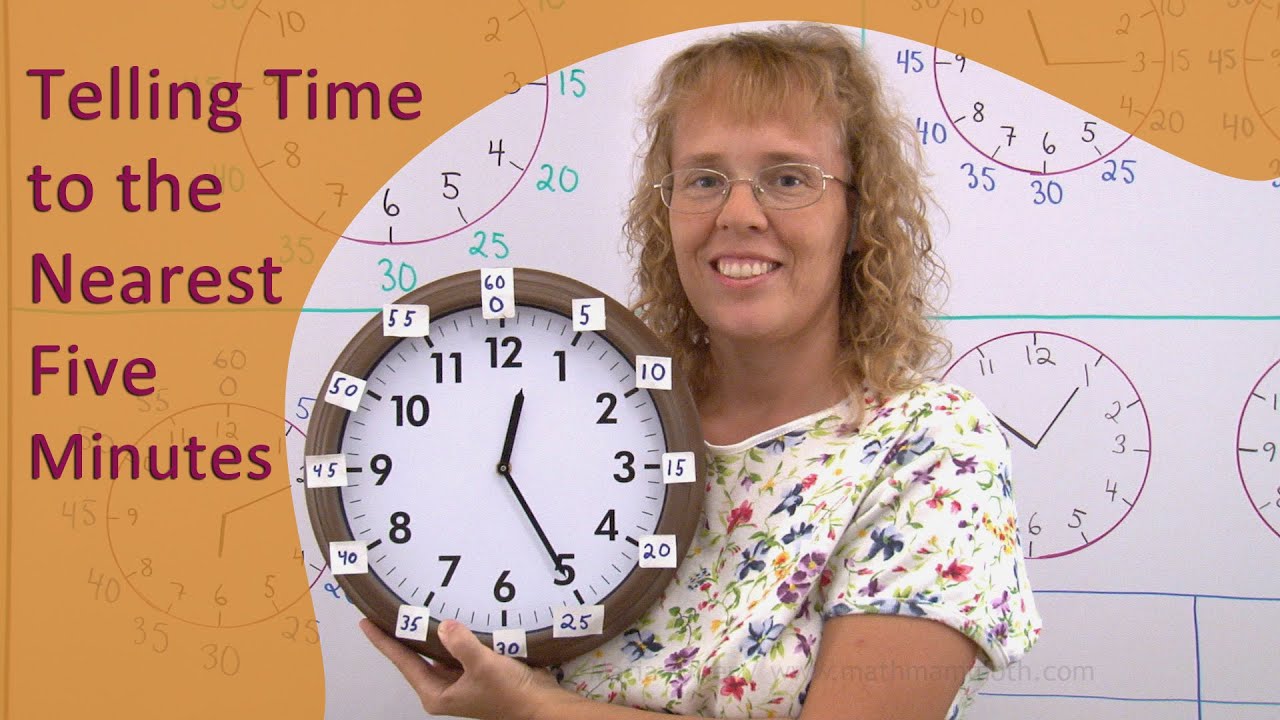
Learn to tell time on an analog clock to five-minute intervals. I use a clock that shows the numbers for the minute hand, written on the outside of the clock rim. Those numbers of course go by fives (you count by fives). So, the students can simply look at the numbers on the clock for the hour hand, and the numbers I wrote outside the clock for the minute hand, to tell the time. The 2nd part of this lesson is at In it, we concentrate on the "tricky times" that are near the next whole hour - times with 45, 50 or 50 minutes, where the hour hand looks like it's already pointing to the next hour. Practice telling time with this free online activity: This video lesson is part of the Math Mammoth Grade 2 Curriculum:
آپ کو یہ بھی پسند آ سکتا ہے
JSS7 Math
JSS8 Math
Quadratic functions
Grade 1 Math
ECZ MATHS GRADE 12
JSS3 Mathematics
Mathematics Grade 12 Term 1
Mathematics class
Grade 2 Math
WAEC 2019 MATHS QUESTIONS THEORY
Video 1: Quadratic
Year4 Maths
Year8 Maths
Maths
Year 7 Math
Year 5 Math
JSS2 Mathematics
Polygon Video 1
Kelas 7 Matematika
Grade 8 Mathematics
Kelas 9 Matematika
GRADE 8 MATHEMATICS
FORM 2 MATHS - TAFA ACADEMY
Video 1: Cube Volume
تبصرے
10 تبصرے
A math lesson for 2nd grade. We use a time line or an "hour line" to figure out how many hours it is from one given time to another. When one of the times is AM and the other PM, we need to figure the elapsed time in two parts. We also solve some word problems involving clock and time. The first one has to do with starting time, when elapsed time and ending time are known. The second one asks how many hours Mathy - my mascot mammoth - slept during the night, when his sleep was broken up into several sections.
A math lesson for 2nd grade. We use a time line or an "hour line" to figure out how many hours it is from one given time to another. When one of the times is AM and the other PM, we need to figure the elapsed time in two parts. We also solve some word problems involving clock and time. The first one has to do with starting time, when elapsed time and ending time are known. The second one asks how many hours Mathy - my mascot mammoth - slept during the night, when his sleep was broken up into several sections.
Learn how to tell time using "till" -- how many minutes it is "to" or "till" the next hour -- such as "20 till 7". The first part of the lesson teaches telling time past the whole hour, and is here: This lesson is part of the Math Mammoth Grade 2 curriculum. Learn more: Practice telling time with "past" and "till" with this online matching game: See more videos for 2nd grade:
Learn how to tell time using "till" -- how many minutes it is "to" or "till" the next hour -- such as "20 till 7". The first part of the lesson teaches telling time past the whole hour, and is here: This lesson is part of the Math Mammoth Grade 2 curriculum. Learn more: Practice telling time with "past" and "till" with this online matching game: See more videos for 2nd grade:
In this video, you will learn to tell the time using "past". We simply say how many minutes past (or after) the whole hour it is, such as "10 past 4". The 2nd part of the lesson teaches how to tell time using "till" (how many minutes unti the next whole hour): This lesson is part of the Math Mammoth Grade 2 curriculum. Learn more: Practice telling time with "past" and "till" with this online matching game: See more videos for 2nd grade:
In this video, you will learn to tell the time using "past". We simply say how many minutes past (or after) the whole hour it is, such as "10 past 4". The 2nd part of the lesson teaches how to tell time using "till" (how many minutes unti the next whole hour): This lesson is part of the Math Mammoth Grade 2 curriculum. Learn more: Practice telling time with "past" and "till" with this online matching game: See more videos for 2nd grade:
Learn to tell the "tricky times" on an analog clock -- those near the next full hour (times with 45, 50 or 55 minutes). I use a clock with numbers for the minute hand to make it easier for students. In this lesson we focus on not getting fooled by the hour hand, when it looks like it's already pointing to the next hour, but in reality, it's not there quite yet. These are times such as 2:55 or 8:50, where the minute hand is close to finishing its full round. The first part of this lesson is at In it, we learn how to tell time to the five-minute intervals in general.
Learn to tell the "tricky times" on an analog clock -- those near the next full hour (times with 45, 50 or 55 minutes). I use a clock with numbers for the minute hand to make it easier for students. In this lesson we focus on not getting fooled by the hour hand, when it looks like it's already pointing to the next hour, but in reality, it's not there quite yet. These are times such as 2:55 or 8:50, where the minute hand is close to finishing its full round. The first part of this lesson is at In it, we learn how to tell time to the five-minute intervals in general.
Learn to tell time on an analog clock to five-minute intervals. I use a clock that shows the numbers for the minute hand, written on the outside of the clock rim. Those numbers of course go by fives (you count by fives). So, the students can simply look at the numbers on the clock for the hour hand, and the numbers I wrote outside the clock for the minute hand, to tell the time. The 2nd part of this lesson is at In it, we concentrate on the "tricky times" that are near the next whole hour - times with 45, 50 or 50 minutes, where the hour hand looks like it's already pointing to the next hour. Practice telling time with this free online activity: This video lesson is part of the Math Mammoth Grade 2 Curriculum:
Learn to tell time on an analog clock to five-minute intervals. I use a clock that shows the numbers for the minute hand, written on the outside of the clock rim. Those numbers of course go by fives (you count by fives). So, the students can simply look at the numbers on the clock for the hour hand, and the numbers I wrote outside the clock for the minute hand, to tell the time. The 2nd part of this lesson is at In it, we concentrate on the "tricky times" that are near the next whole hour - times with 45, 50 or 50 minutes, where the hour hand looks like it's already pointing to the next hour. Practice telling time with this free online activity: This video lesson is part of the Math Mammoth Grade 2 Curriculum: