
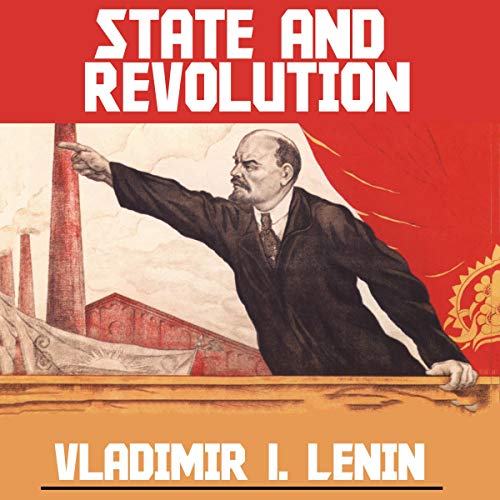
Publisher's Summary State and Revolution (1917) describes the role of the state in society, the necessity of proletarian revolution, and the theoretic inadequacies of social democracy in achieving revolution. It describes the inherent nature of the state as a tool for class oppression, a creation born of one social class' desire to control all other social classes. Whether a dictatorship or a democracy, the state remains in the control of the ruling class. Even in a democratic capitalist republic, the ruling class will never willingly relinquish political power, maintaining it via various strategies. Hence, according to this view, communist revolution is the sole remedy for the abolition of the state. ©2019 BN Publishing (P)2019 BN Publishing
آپ کو یہ بھی پسند آ سکتا ہے
Frozen
The Summer I Turned Pretty
Shadow Hunter
The Hobbit
Rich Dad Poor Dad
The Psychology of Money
Think and Grow Rich
I Will Teach You to Be Rich
Supergirl Radio
Eroge Reincarnation ~Please Don’t Collect Onee-chan’s CGs~
Tell Me Lies
Pastor E.A Adeboye
Business Wars
Queen
Fallout
Starship Troopers
Audiobooks Daily, presented by Public Domain Media
Crypto News Alerts | Daily Bitcoin (BTC) & Cryptocurrency News
Public Health Insight
Rebel
Court
The Girls
WRFI Community Radio News
Life Fellowship with Chris Lindberg (audio)
تبصرے
10 تبصرے
Nearly all the great revolutions of the world have come from this book, and hopefully more to come.
Lenin's writing and prose are clear and easy to understand. Even novice marxists can grasp what he is saying. It is refreshing to re-read this after 10 years.
Essential reading for those who would wish to familiarize themselves with the mature thinking of Vladimir Lenin, particularly those who continue to insist that Lenin’s interpretation of Marxism is compatible with democracy (it isn’t). However, the book’s narration for Audible leaves much to be desired, to say the least. Beyond numerous repetitions and restatements, the narrator mispronounces every name in the book (for example, the French anarchist Proudhon he pronounces “PROWD-hawn”; Bakunin he pronounces “BAWK-uh-nin”). The narrator obviously has no knowledge of German, either, as he renders indistinguishable the numerous German language excerpts (mostly article/book titles) throughout the text. Overall, one would think that any person endeavoring to narrate a text would at least familiarize themselves with the content to the extent that their narration would not create confusion for listeners.
the narrator is just truly terrible. how did he get the job? He pronounces bourgeois as burjwa, so annoying.
One of the most important political works of the 20th century. Lenin's analysis is clearly presented, cutting through popular misconceptions regarding Marxist theory and the role of the state. I would highly recommend it to any and all who desire a deeper understanding of our political system and how to surpass it.