
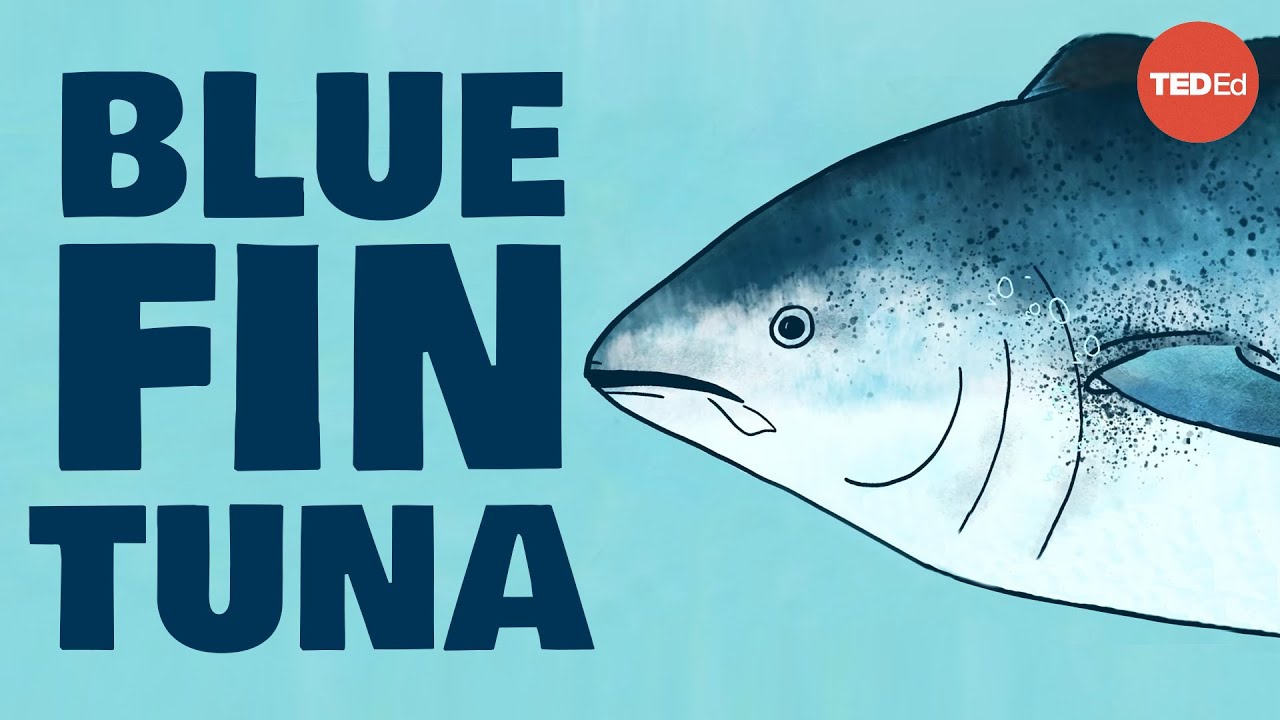
Discover the unique adaptations that make the Atlantic bluefin tuna one of the most dominant predators in the ocean. -- What’s as big as a polar bear, swallows its prey whole, and swims at forty miles an hour? It’s not a shark or a killer whale... it’s the Atlantic bluefin tuna— the largest and longest-lived of the 15 tuna species. Its unique set of adaptations make it one of the most dominant predators in the ocean. Grantly Galland and Raiana McKinney detail how these fish go from tiny hatchling to ocean giant. Lesson by Grantly Galland and Raiana McKinney, directed by Anna Benner. Support Our Non-Profit Mission ---------------------------------------------- Support us on Patreon: Check out our merch: ---------------------------------------------- Connect With Us ---------------------------------------------- Sign up for our newsletter: Follow us on Facebook: Find us on Twitter: Peep us on Instagram: ---------------------------------------------- Keep Learning ---------------------------------------------- View full lesson: Dig deeper with additional resources: Animator's website: Sound design: ---------------------------------------------- Thank you so much to our patrons for your support! Without you this video would not be possible! Amy, Michael Clement, Ghaith Tarawneh, Nathan Milford, Tomas Beckett, Alice Ice, Eric Berman, Kurt Paolo Sevillano, Xavi Ramos, Ron Kakar, Jennifer Heald, flóra lili donáti, Megulo Abebe, TAO7 HORUS, isolwi, Vedasheersh, Michael Chang, Waqar Sheikh, Alexander Gruber, Irene Y., Kate Sem, VPpurplebelt, Ujjwal Dasu, Theunis Groenewald, Minh Quan Dinh, Sylvain, Can Aydogmus, JasonD, Terran Gimpel, Gareth Thomas, Talia Sari, Phan Quang Lam, Katie McDowell, Allen, Sarat Chandra Vegunta, Mahina Bachiller, Bruce Vieira Lopes, Charmaine Hanson, Paul Aldred-Bann, Thawsitt, Jezabel, Abdullah Abdulaziz, Adriano Fontes, Xiao Yu, Melissa Suarez, SpartacusDMR, Brian A. Dunn, Francisco Amaya, Daisuke Goto and Matt Switzler.
You Might Also Like
English learning videos for kids - Lingokids
CoComelon Lane! Brand New Netflix Kids Show!
Halloween Songs For Kids - CoComelon
Year7 German
CoComelon
CocoMelon | Little Baby Bum | Blippi - Nursery Rhymes & Kids TV Shows
Learn English With Disney Movies
SS 2 Mathematics
The Demon of Reason
Understanding genetics
The wonders of Earth
Exploring the senses
KS1 Drama
Kids Songs by CoComelon
Alphabet (ABC) Songs by CoComelon
SS 1 Physics
Hidden Figures: Black History
Let's talk about sex
More money more problems
Cool new tech
Learn English Alphabet for Kids
Bingo Songs! CoComelon Nursery Rhymes Mix
Nina and JJ! CoComelon Friends
Numbers for Kids - Learn to Count with StoryBots! | Netflix Jr
Comments
10 Comments
Discover the quirky creature known as the parrotfish, and the key role it plays in keeping coral reefs healthy and thriving. -- As the sun rises over a quiet coral reef, one animal breaks the morning silence. Named for its vibrant scales and beak-like teeth, the parrotfish devours a particularly crunchy breakfast: rocks. Why would any creature take bites out of the seafloor? Mike Gil explores how these quirky and flashy foragers play a key role in defending the essential coral reef ecosystem. Lesson by Mike Gil, directed by Franz Palomares. Sign up for our newsletter: http://bit.ly/TEDEdNewsletter Support us on Patreon: http://bit.ly/TEDEdPatreon Follow us on Facebook: http://bit.ly/TEDEdFacebook Find us on Twitter: http://bit.ly/TEDEdTwitter Peep us on Instagram: http://bit.ly/TEDEdInstagram View full lesson: https://ed.ted.com/lessons/the-big-beaked-rock-munching-fish-that-protect-coral-reefs-mike-gil Thank you so much to our patrons for your support! Without you this video wou
Discover the quirky creature known as the parrotfish, and the key role it plays in keeping coral reefs healthy and thriving. -- As the sun rises over a quiet coral reef, one animal breaks the morning silence. Named for its vibrant scales and beak-like teeth, the parrotfish devours a particularly crunchy breakfast: rocks. Why would any creature take bites out of the seafloor? Mike Gil explores how these quirky and flashy foragers play a key role in defending the essential coral reef ecosystem. Lesson by Mike Gil, directed by Franz Palomares. Sign up for our newsletter: http://bit.ly/TEDEdNewsletter Support us on Patreon: http://bit.ly/TEDEdPatreon Follow us on Facebook: http://bit.ly/TEDEdFacebook Find us on Twitter: http://bit.ly/TEDEdTwitter Peep us on Instagram: http://bit.ly/TEDEdInstagram View full lesson: https://ed.ted.com/lessons/the-big-beaked-rock-munching-fish-that-protect-coral-reefs-mike-gil Thank you so much to our patrons for your support! Without you this video wou
Discover the extraordinary capabilities of hagfish, the slime-producing fish that has survived on Earth for over 300 million years. -- In 2017, a truck screeched to a halt. One of its containers slid off, hit a car, and spilled its contents— thousands of kilograms of hagfish. The result of this accident was an absolute mess: the highway was coated in a thick slime that took the fire department 7 hours to clear. How did these creatures create this stupendous supply of slime? Noah R. Bressman and Douglas Fudge investigate. Lesson by Noah R. Bressman and Douglas Fudge, directed by Denys Spolitak. Support Our Non-Profit Mission ---------------------------------------------- Support us on Patreon: http://bit.ly/TEDEdPatreon Check out our merch: http://bit.ly/TEDEDShop ---------------------------------------------- Connect With Us ---------------------------------------------- Sign up for our newsletter: http://bit.ly/TEDEdNewsletter Follow us on Facebook: http://bit.ly/TEDEdFacebook Fi
Discover the extraordinary capabilities of hagfish, the slime-producing fish that has survived on Earth for over 300 million years. -- In 2017, a truck screeched to a halt. One of its containers slid off, hit a car, and spilled its contents— thousands of kilograms of hagfish. The result of this accident was an absolute mess: the highway was coated in a thick slime that took the fire department 7 hours to clear. How did these creatures create this stupendous supply of slime? Noah R. Bressman and Douglas Fudge investigate. Lesson by Noah R. Bressman and Douglas Fudge, directed by Denys Spolitak. Support Our Non-Profit Mission ---------------------------------------------- Support us on Patreon: http://bit.ly/TEDEdPatreon Check out our merch: http://bit.ly/TEDEDShop ---------------------------------------------- Connect With Us ---------------------------------------------- Sign up for our newsletter: http://bit.ly/TEDEdNewsletter Follow us on Facebook: http://bit.ly/TEDEdFacebook Fi
View full lesson: http://ed.ted.com/lessons/the-secret-lives-of-baby-fish-amy-mcdermott Coral reef fish, like the yellow tang surgeonfish, begin life in a fascinating and weird way – as tiny floating larvae! These babies are capable of drifting thousands of miles on ocean currents, far from the reefs where they were born. Amy McDermott describes how these tiny trekkers travel across vast oceans, searching for the far-flung reefs they will one day call home. Lesson by Amy McDermott, animation by Reflective Films.
Take a peek beneath the ocean’s covers to discover the surprisingly inventive ways marine animals have sex. -- On a reef in the Pacific Ocean, 17,000 camouflage groupers dart about in the cloudy water. It is, in fact, an underwater orgy— turned feeding frenzy. An orgy might seem like a rather flamboyant way to breed, but sex in the sea is a surprisingly inventive affair. So what other sneaky escapades are happening under the sea? Luka Seamus Wright offers a peek beneath the ocean’s covers. Lesson by Luka Seamus Wright, directed by Michelle O'Connell and Lisa Vertudaches. Music and sound by Phil Brookes Support Our Non-Profit Mission ---------------------------------------------- Support us on Patreon: http://bit.ly/TEDEdPatreon Check out our merch: http://bit.ly/TEDEDShop ---------------------------------------------- Connect With Us ---------------------------------------------- Sign up for our newsletter: http://bit.ly/TEDEdNewsletter Follow us on Facebook: http://bit.ly/TEDEdFa
Take a peek beneath the ocean’s covers to discover the surprisingly inventive ways marine animals have sex. -- On a reef in the Pacific Ocean, 17,000 camouflage groupers dart about in the cloudy water. It is, in fact, an underwater orgy— turned feeding frenzy. An orgy might seem like a rather flamboyant way to breed, but sex in the sea is a surprisingly inventive affair. So what other sneaky escapades are happening under the sea? Luka Seamus Wright offers a peek beneath the ocean’s covers. Lesson by Luka Seamus Wright, directed by Michelle O'Connell and Lisa Vertudaches. Music and sound by Phil Brookes Support Our Non-Profit Mission ---------------------------------------------- Support us on Patreon: http://bit.ly/TEDEdPatreon Check out our merch: http://bit.ly/TEDEDShop ---------------------------------------------- Connect With Us ---------------------------------------------- Sign up for our newsletter: http://bit.ly/TEDEdNewsletter Follow us on Facebook: http://bit.ly/TEDEdFa
View full lesson: http://ed.ted.com/lessons/why-are-sharks-so-awesome-tierney-thys Sharks have been celebrated as powerful gods by some native cultures. And today, sharks are recognized as apex predators of the world’s ocean. What is it that makes these fish worthy of our ancient legends and so successful in the seas? Tierney Thys takes us into the ocean to find out. Lesson by Tierney Thys, animation by TED-Ed.
View full lesson: http://ed.ted.com/lessons/why-are-sharks-so-awesome-tierney-thys Sharks have been celebrated as powerful gods by some native cultures. And today, sharks are recognized as apex predators of the world’s ocean. What is it that makes these fish worthy of our ancient legends and so successful in the seas? Tierney Thys takes us into the ocean to find out. Lesson by Tierney Thys, animation by TED-Ed.
Find out how a hatchetfish survives its daily journey from the depths of the ocean’s Twilight Zone to the resource-rich surface. -- You’re traveling deep beneath the ocean’s surface, where faint lights flicker and toothy grins flash. Your mission is to survive these depths and journey to the surface after sundown to feed. And as a hatchetfish, almost every other deep-sea creature is trying to eat you. Can you complete the quest? Philip Renaud and Kenneth Kostel share how to survive the ocean's Twilight Zone. Lesson by Philip Renaud and Kenneth Kostel, directed by Cris Wiegandt. Designed by Bárbara Fonseca Sound design by Claudia Ioana Vasiliu Narrated by Addison Anderson Script Editing by Alex Gendler Support Our Non-Profit Mission ---------------------------------------------- Support us on Patreon: http://bit.ly/TEDEdPatreon Check out our merch: http://bit.ly/TEDEDShop ---------------------------------------------- Connect With Us ----------------------------------------------