
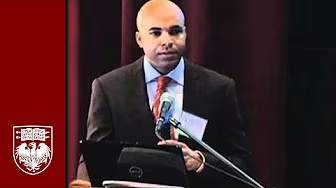
Rethinking Urban Poverty for the 21st Century: Institutional and Organizational Perspectives As we enter the second decade of the 21st century, the prospects for U.S. cities remain uncertain. The promised reinvention of many former manufacturing centers has been halted in its tracks, as record budget deficits, limited growth prospects, and stubbornly high unemployment rates undermine urban recovery. The urban poor continue to bear most heavily the burden of a continuing housing crisis, chronically underperforming schools at a time of increasing returns to education, persistently high births to unmarried mothers, unprecedented rates of obesity and other health problems, and an expansion of the criminal justice system that insists on breaking imprisonment records. Understanding these conditions calls for scholarly perspectives the focus not only on individuals or neighborhoods but also on the institutions and organizations that structure their daily lives, mediate their relation to the state, and facilitate or constrain their ability to acquire resources. The papers either adopt or examine the role of institutional and organizational perspectives to the study of housing, health, criminal justice, education, and immigration in urban contexts.
आपको ये भी पसंद आ सकते हैं
Test Your English with TV Series and Movies
Go Figure
Kids Songs by CoComelon
Learn Colors with CoComelon!
Alphabet (ABC) Songs by CoComelon
CocoMelon | Little Baby Bum | Blippi - Nursery Rhymes & Kids TV Shows
SS 2 Mathematics
CoComelon - Happy Holidays
Learn English With Disney Movies
CoComelon #shorts
All New Akili & Me
Educational Cartoons for Kids | Learn with Sheriff Labrador
English with TV Series (Kids Appropriate)
Understanding the World
Year5 Music
African
5.4 РЕНТГЕНОВСКОЕ И ГАММА-ИЗЛУЧЕНИЕ
KS2 Drama
CoComelon
Sheriff Labrador - Kids Cartoon | Safety Cartoon for Kids
🎃🕯️🧛♀️ HALLOWEEN STORIES 2025 🕷️🧹👻
Charlie and Lola Full Episodes
Learn about Good Habits & Good Manners for Kids
Sheriff Labrador Popular Live Stream
टिप्पणियाँ
6 टिप्पणियाँ
Part of the Rethinking Urban Poverty Forum at the University of Chicago Panelists: Bruce Fuller, University of California, Berkeley Bessie Wilkerson, Harlem Children's Zone Joseph Galaskiewicz, University of Arizona March 10 and 11, 2011 Rethinking Urban Poverty for the 21st Century: Institutional and Organizational Perspectives As we enter the second decade of the 21st century, the prospects for U.S. cities remain uncertain. The promised reinvention of many former manufacturing centers has been halted in its tracks, as record budget deficits, limited growth prospects, and stubbornly high unemployment rates undermine urban recovery. The urban poor continue to bear most heavily the burden of a continuing housing crisis, chronically underperforming schools at a time of increasing returns to education, persistently high births to unmarried mothers, unprecedented rates of obesity and other health problems, and an expansion of the criminal justice system that insists on breaking imprisonmen
Part of the Rethinking Urban Poverty Forum at the University of Chicago Panelists: Nicole Marwell, Baruch College, and Michael McQuarrie, University of California, Davis Moderator: Mario Small, University of Chicago March 10 and 11, 2011 Rethinking Urban Poverty for the 21st Century: Institutional and Organizational Perspectives As we enter the second decade of the 21st century, the prospects for U.S. cities remain uncertain. The promised reinvention of many former manufacturing centers has been halted in its tracks, as record budget deficits, limited growth prospects, and stubbornly high unemployment rates undermine urban recovery. The urban poor continue to bear most heavily the burden of a continuing housing crisis, chronically underperforming schools at a time of increasing returns to education, persistently high births to unmarried mothers, unprecedented rates of obesity and other health problems, and an expansion of the criminal justice system that insists on breaking imprisonmen
Part of the Rethinking Urban Poverty Forum at the University of Chicago Panelists: David Meltzer, University of Chicago Stacy Lindau, University of Chicago Celeste Watkins-Hayes, Northwestern University Discussant: Kate Cagney, University of Chicago March 10 and 11, 2011 Rethinking Urban Poverty for the 21st Century: Institutional and Organizational Perspectives As we enter the second decade of the 21st century, the prospects for U.S. cities remain uncertain. The promised reinvention of many former manufacturing centers has been halted in its tracks, as record budget deficits, limited growth prospects, and stubbornly high unemployment rates undermine urban recovery. The urban poor continue to bear most heavily the burden of a continuing housing crisis, chronically underperforming schools at a time of increasing returns to education, persistently high births to unmarried mothers, unprecedented rates of obesity and other health problems, and an expansion of the criminal justice system th
Part of the Rethinking Urban Poverty Forum at the University of Chicago Panelists: David Harding and Jeffery Morenoff, University of Michigan Harold Pollack, University of Chicago Discussant: Stephen Raudenbush, University of Chicago March 10 and 11, 2011 Rethinking Urban Poverty for the 21st Century: Institutional and Organizational Perspectives As we enter the second decade of the 21st century, the prospects for U.S. cities remain uncertain. The promised reinvention of many former manufacturing centers has been halted in its tracks, as record budget deficits, limited growth prospects, and stubbornly high unemployment rates undermine urban recovery. The urban poor continue to bear most heavily the burden of a continuing housing crisis, chronically underperforming schools at a time of increasing returns to education, persistently high births to unmarried mothers, unprecedented rates of obesity and other health problems, and an expansion of the criminal justice system that insists on br
Part of the Rethinking Urban Poverty Forum at the University of Chicago Panelists: Stefanie DeLuca, Johns Hopkins Stephen Raudenbush and Julia Burdick-Will, University of Chicago Robert Chaskin, University of Chicago Discussant: Mary Pattillo, Northwestern University March 10 and 11, 2011 Rethinking Urban Poverty for the 21st Century: Institutional and Organizational Perspectives As we enter the second decade of the 21st century, the prospects for U.S. cities remain uncertain. The promised reinvention of many former manufacturing centers has been halted in its tracks, as record budget deficits, limited growth prospects, and stubbornly high unemployment rates undermine urban recovery. The urban poor continue to bear most heavily the burden of a continuing housing crisis, chronically underperforming schools at a time of increasing returns to education, persistently high births to unmarried mothers, unprecedented rates of obesity and other health problems, and an expansion of the criminal
Introduction to the Rethinking Urban Poverty Forum at the University of Chicago March 10 and 11, 2011 Rethinking Urban Poverty for the 21st Century: Institutional and Organizational Perspectives As we enter the second decade of the 21st century, the prospects for U.S. cities remain uncertain. The promised reinvention of many former manufacturing centers has been halted in its tracks, as record budget deficits, limited growth prospects, and stubbornly high unemployment rates undermine urban recovery. The urban poor continue to bear most heavily the burden of a continuing housing crisis, chronically underperforming schools at a time of increasing returns to education, persistently high births to unmarried mothers, unprecedented rates of obesity and other health problems, and an expansion of the criminal justice system that insists on breaking imprisonment records. Understanding these conditions calls for scholarly perspectives the focus not only on individuals or neighborhoods but also o