
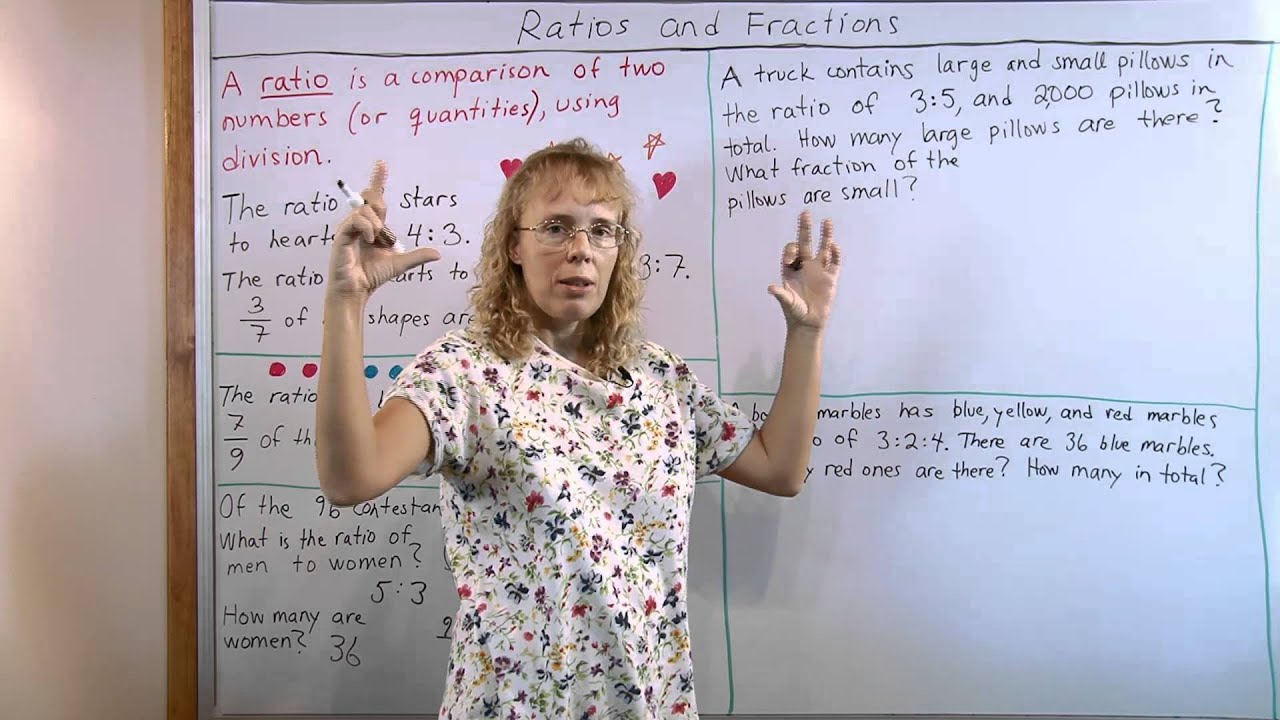
A ratio is a comparison of two numbers (or quantities) using division. For example, if I have 4 hearts and 3 stars, then the ratio of hearts to stars is 4:3 (four to three). We can often "translate" between ratio language and fraction language. Lastly I work several word problems that involve ratios and fractions, using a bar (or block) model, a powerful visual aid that helps students from grade 4 onward solve problems that would otherwise require algebra.
آپ کو یہ بھی پسند آ سکتا ہے
Kids Songs by CoComelon
Learn Colors with CoComelon!
Year1 English
CoComelon & Friends Holiday and Christmas Videos for Kids | Little Baby Bum | Go Buster and More!
CoComelon
Alphabet (ABC) Songs by CoComelon
CocoMelon | Little Baby Bum | Blippi - Nursery Rhymes & Kids TV Shows
Learn English With Disney Movies
PrePrimary Maths
Year1 Maths
Year 11 Math
Year2 Maths
Year 10 Math
Maths
3rd Grade Math
How to Play Chess
Functions and their graphs | Algebra II | Khan Academy
Kindergarten Curriculum
Calcul de probabilités/Dénombrement/2SPCF- 2bacspcf/sciences techniques/Terminale S/dénombrement/Analyse combinatoire/variable aléatoire-loi binomiale
Grade 3 Math Q1 Episode 2: Place Value and Value of Numbers Up to Ten Thousand 10,000
Year 9 Math
Numberblocks - Learn to Count | Maths for Kids
Numberblocks - Homeschooling #Stayhome ✏️📘
Pry2 Math
تبصرے
10 تبصرے
In this problem, we're given the aspect ratio of a rectangle as being 5:3, and its perimeter as 4 inches. The task is to find the side lengths and the area. This involves fraction division and multiplication.
In this problem, we're given the aspect ratio of a rectangle as being 5:3, and its perimeter as 4 inches. The task is to find the side lengths and the area. This involves fraction division and multiplication.
The aspect ratio is simply the ratio of a rectangle's width to height (or length to height). In this lesson, I solve several word problems involving aspect ratio. I use the bar model, visual models, and simple equations to help. This video is part of Math Mammoth 6th grade curriculum - learn more and download samples here: Find more 6th grade math videos:
The aspect ratio is simply the ratio of a rectangle's width to height (or length to height). In this lesson, I solve several word problems involving aspect ratio. I use the bar model, visual models, and simple equations to help. This video is part of Math Mammoth 6th grade curriculum - learn more and download samples here: Find more 6th grade math videos:
In this second part, we tackle two word problems more. The first one involves a ratio and a difference between two quantities. The second one involves fractional parts, a change in the situation, and a given ratio. The first part of the lesson can be found here:
In this second part, we tackle two word problems more. The first one involves a ratio and a difference between two quantities. The second one involves fractional parts, a change in the situation, and a given ratio. The first part of the lesson can be found here:
I solve two word problems that involve ratios, each time with the help of a bar model or diagram - Singapore Math style. The bar or block model is incredibly helpful for these situations and makes the problem solving a breeze.
I solve two word problems that involve ratios, each time with the help of a bar model or diagram - Singapore Math style. The bar or block model is incredibly helpful for these situations and makes the problem solving a breeze.
A set of equivalent rates, such as a set of times & distances when someone goes with a constant speed, gives us a set of NUMBER PAIRS which we can then plot as points on the coordinate plane. We end up with points that look like they're on a LINE... (line - LINEAR - it's a linear relationship).In this video, we first plot a set of equivalent rates having to do a boy riding a bicycle with constant speed. Then we plot TWO sets of equivalent rates - prices per kg - and compare them. (CCSS 6.RP.A.3.a) See the first part of this lesson (about equivalent rates) at This video corresponds to Math Mammoth Grade 6 curriculum; see
A set of equivalent rates, such as a set of times & distances when someone goes with a constant speed, gives us a set of NUMBER PAIRS which we can then plot as points on the coordinate plane. We end up with points that look like they're on a LINE... (line - LINEAR - it's a linear relationship).In this video, we first plot a set of equivalent rates having to do a boy riding a bicycle with constant speed. Then we plot TWO sets of equivalent rates - prices per kg - and compare them. (CCSS 6.RP.A.3.a) See the first part of this lesson (about equivalent rates) at This video corresponds to Math Mammoth Grade 6 curriculum; see