
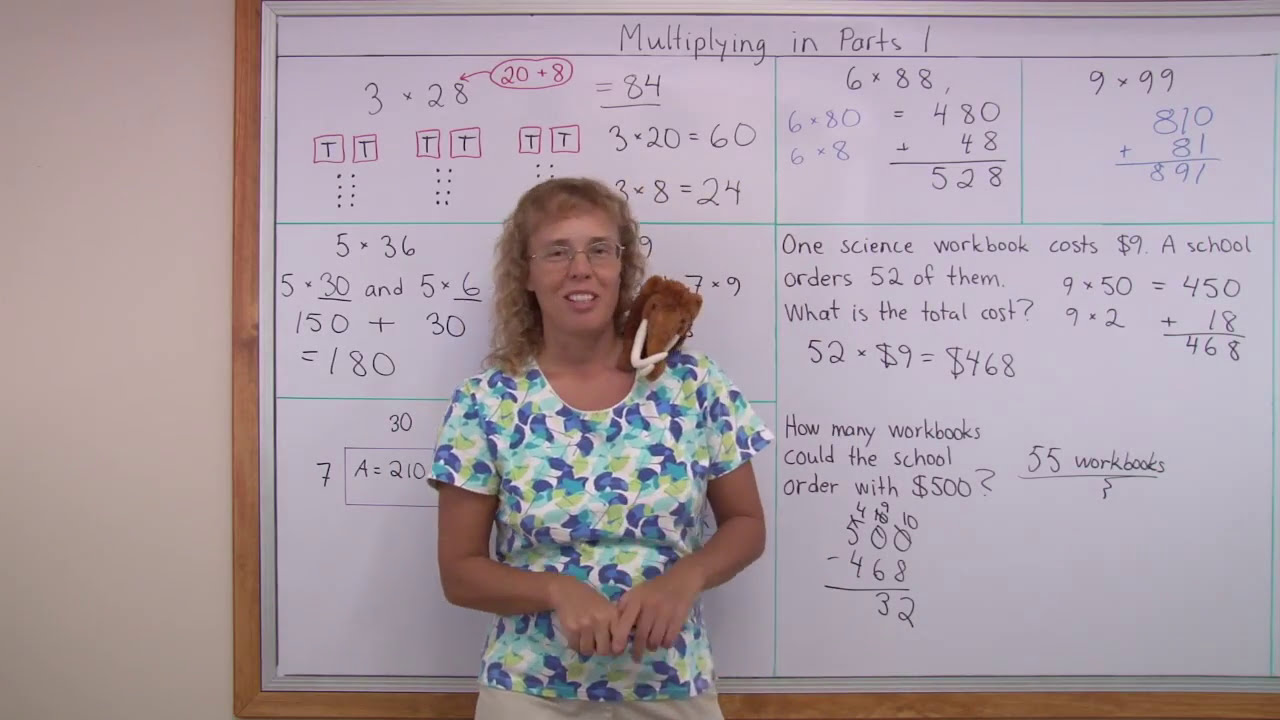
Partial products means we multiply numbers part-by-part. For example, 5 x 36 is done as 5 x 30 and 5 x 6, and those two parts are added. You can quite easily do these in your head when one number has two digits and the other has one. This concept is very important, as it is the basis for the regular multi-digit multiplication algorithm studied in 4th grade. I also teach it in my book Math Mammoth Multiplication 2 at - available both as an inexpensive download ($5.10) and as a printed copy.
Maaari Mo Ring Magustuhan
Year6 Maths
Year4 Maths
Maths
3rd Grade Math
Mathematika KS3 - S1E90
Algebra I | High School Math | Khan Academy
Fonctions exponentielles 2SPC/Terminale S/cours et exercices corrigés fonctions exponentielles/étude fonction exponentielle/examens nationaux /Astuces
Calcul de probabilités/Dénombrement/2SPCF- 2bacspcf/sciences techniques/Terminale S/dénombrement/Analyse combinatoire/variable aléatoire-loi binomiale
Year 4 Math
Compilations ⭐
Quadratic functions
JSS 1 Junior Mathematics
Numberblocks Special Moments ✨
English learning videos for kids - Lingokids
CoComelon Lane! Brand New Netflix Kids Show!
Halloween Songs For Kids - CoComelon
Year 10 Math
Year3 Maths
Kids Songs by CoComelon
CoComelon
PrePrimary Maths
Year1 Maths
Year 11 Math
Year2 Maths
Mga Komento
10 Mga Komento
We can think of 8 x 7 (for example) as 5 groups of 7 plus 2 groups of 7. In other words, we break down the product 8 x 7 into parts, into "partial products". This is easily illustrated with an array. Using partial products, or multiplying by parts, allows us to do multiplications such as 15 x 7 using mental math. It goes like this: 15 x 7 is 10 x 7 plus 5 x 7, which equals 70 + 35 = 105. There are other ways, too! Math Mammoth Grade 3 curriculum Multiplying with the Area Model (online activity)
We can think of 8 x 7 (for example) as 5 groups of 7 plus 2 groups of 7. In other words, we break down the product 8 x 7 into parts, into "partial products". This is easily illustrated with an array. Using partial products, or multiplying by parts, allows us to do multiplications such as 15 x 7 using mental math. It goes like this: 15 x 7 is 10 x 7 plus 5 x 7, which equals 70 + 35 = 105. There are other ways, too! Math Mammoth Grade 3 curriculum Multiplying with the Area Model (online activity)
We can also divide in parts (not only multiply). Simply think of the quotient as consisting of a sum or difference, and divide each part separately. For example, 824 / 4 can be done as (800/4) + (24/4), and that can easily be done in your head. The reason we can do so boils down to the distributive property, and the fact that each division can be written as a multiplication. This lesson is part of the Math Mammoth Grade 6 curriculum. Find out more: See more 6th grade math videos:
We can also divide in parts (not only multiply). Simply think of the quotient as consisting of a sum or difference, and divide each part separately. For example, 824 / 4 can be done as (800/4) + (24/4), and that can easily be done in your head. The reason we can do so boils down to the distributive property, and the fact that each division can be written as a multiplication. This lesson is part of the Math Mammoth Grade 6 curriculum. Find out more: See more 6th grade math videos:
I show how to solve a 2-digit by 2-digit multiplication problem with the partial products algorithm. You can see the same multiplication illustrated with an area model here: This lesson is part of the Math Mammoth Grade 6 curriculum. Learn more: See more 6th grade math videos:
I show how to solve a 2-digit by 2-digit multiplication problem with the partial products algorithm. You can see the same multiplication illustrated with an area model here: This lesson is part of the Math Mammoth Grade 6 curriculum. Learn more: See more 6th grade math videos:
The partial products algorithm allows anyone (even students who are "bad" at math) to learn how to multiply 2- and 3-digit numbers! It is also easy to see why it works. You don't have to be a math whiz! Partial products means that we multiply in part-by-part. For example, 7 x 534 is done as 7 x 500, 7 x 30, and 7 x 4, and lastly those parts are added. This topic is also explained (along with practice problems) in my book Math Mammoth Multiplication 2 at - available both as an inexpensive download ($5.10) and as a printed copy.
The partial products algorithm allows anyone (even students who are "bad" at math) to learn how to multiply 2- and 3-digit numbers! It is also easy to see why it works. You don't have to be a math whiz! Partial products means that we multiply in part-by-part. For example, 7 x 534 is done as 7 x 500, 7 x 30, and 7 x 4, and lastly those parts are added. This topic is also explained (along with practice problems) in my book Math Mammoth Multiplication 2 at - available both as an inexpensive download ($5.10) and as a printed copy.
The area of a two-part rectangle gives us a simple visual model to illustrate partial products (the distributive property), here called "multiplying in parts". This video belongs to a lesson from the Math Mammoth Grade 6 curriculum. See more math videos for 6th grade:
The area of a two-part rectangle gives us a simple visual model to illustrate partial products (the distributive property), here called "multiplying in parts". This video belongs to a lesson from the Math Mammoth Grade 6 curriculum. See more math videos for 6th grade: