
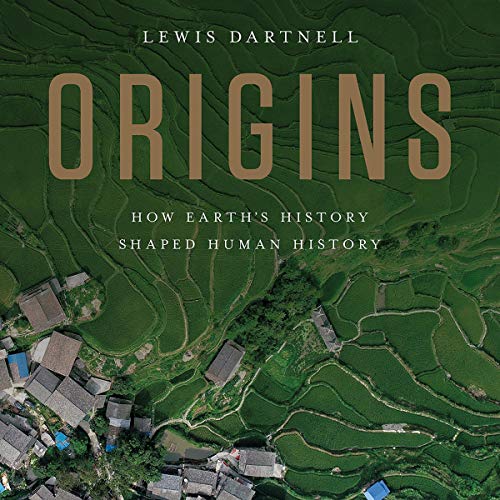
Publisher's Summary A New York Times best-selling author explains how the physical world shaped the history of our species When we talk about human history, we often focus on great leaders, population forces, and decisive wars. But how has the earth itself determined our destiny? Our planet wobbles, driving changes in climate that forced the transition from nomadism to farming. Mountainous terrain led to the development of democracy in Greece. Atmospheric circulation patterns later on shaped the progression of global exploration, colonization, and trade. Even today, voting behavior in the southeast United States ultimately follows the underlying pattern of 75 million-year-old sediments from an ancient sea. Everywhere is the deep imprint of the planetary on the human. From the cultivation of the first crops to the founding of modern states, Origins reveals the breathtaking impact of the earth beneath our feet on the shape of our human civilizations. ©2019 Lewis Dartnell (P)2019 Hachette Audio
Mungkin Anda Juga Suka
The beginning after the end
Wylde In Bed: Erotic Audio Stories at Bedtime
Fifty Shades Darker
Seinfeld XXX
Overheard at National Geographic
The Science of Self
Farming Today
New Books in Psychology
Shadow Hunter
Dual Cultivation
King of Gods
A Reincarnated Mage’s Tower Dungeon Management
The Green Mile
You
Boy Meets Girl Meets Boy Meets World
DJ Dholi Deep
Crazy Leveling System
Boyfriend Material
Hunger
Starship Troopers
Relationship Transformers
Ancient Strengthening Technique
My Story
Church of The Redeemer - Sermons
Komentar
10 Komentar
A bit eurocentric. His info about migration to the America's is a little outdated and the first instance of migration via land bridge 13-15000 years ago has been under scrutiny for quite a while. Seems like the author doesn't know much about non "western" culture.
the author takes an interesting journey from the formation of the planet all the way through the current day by linking long lines of cause and effect. The nature of some of the maximal extrapolations I would debate as insufficient for a determinate causality as it is presented. I've read and listened to numerous attempts to explain the present by the distant past (and geologically so in this case), and Origins deserves recognition in the top handful. The narration is equal to the story and I commend Mr. Sackville there.
This book puts a good perspective on where we are now, where we came from, and and how the Earth and it's climate have shaped Humans from billions of years before their existence.