
Mental math strategies for adding and subtracting 2-digit numbers
This neat and easy "trick" allows you to add 9 or 8 to any number with ease! For example, to solve 9 + 7, imagine that 9 wants to be 10, so it gets "one" from the seven, leaving seven to become only six. So the addition 9 + 7 is changed to the sum 10 + 6 which is super easy to solve. We can also use a similar strategy in sums with 8. For example to solve 8 + 5, imagine that 8 wants to be 10, so it gets two from the 5, which then becomes only 3. So the sum 8 + 5 becomes 10 + 3, which is an easy sum to solve. First and second graders can use these mental math techniques to help their load of memorization of addition facts. This same "trick" or thought pattern also works with two-digit numbers ending in 9, three-digit numbers ending in 99, and so on. Check out my other videos at First grade students
قد يعجبك أيضًا
Kids Songs by CoComelon
Learn Colors with CoComelon!
Year1 English
CoComelon & Friends Holiday and Christmas Videos for Kids | Little Baby Bum | Go Buster and More!
CoComelon
Alphabet (ABC) Songs by CoComelon
Learn English With Disney Movies
CoComelon - Happy Holidays
PrePrimary Maths
Year1 Maths
Year 11 Math
Year2 Maths
Year 10 Math
Maths
3rd Grade Math
How to Play Chess
Third Grade
Functions and their graphs | Algebra II | Khan Academy
Statistiques 3ème collège Apic
Divisibility Rules for 2: Lesson for Kids
Year3 Maths
Year 7 Math
Fresh Starts with Numberblocks! ❄️ | Learn to Count for Kids
Numberblocks Fun! | Learn To Count | @Numberblocks
التعليقات
10 تعليق
Instead of subtracting 29 from 66, we can subtract 30. It makes for a much easier problem to solve! Lastly, we adjust the answer, because in subtracting 30 instead of 29, we subtracted one too much. This is a really neat strategy and works for many kinds of problems, such as 99 + 87 or 4031 - 999. Practice two-digit mental math with these free online exercises: Play Hidden Picture Game and practice mental subtraction: This lesson is part of the Math Mammoth Grade 3 Curriculum:
Instead of subtracting 29 from 66, we can subtract 30. It makes for a much easier problem to solve! Lastly, we adjust the answer, because in subtracting 30 instead of 29, we subtracted one too much. This is a really neat strategy and works for many kinds of problems, such as 99 + 87 or 4031 - 999. Practice two-digit mental math with these free online exercises: Play Hidden Picture Game and practice mental subtraction: This lesson is part of the Math Mammoth Grade 3 Curriculum:
I show two simple examples of subtracting 3-digit numbers mentally. We can use our knowledge of place value to do these subtractions. For example, to subtract 652 - 30, notice that we're subtracting three tens. So, we look at the TENS digit in 652 and subtract 5 - 3 (in the tens). If a child understands place value, subtractions such as 478 - 20 or 783 - 200 are easy. If a child has difficulty with them, it typically indicates the child has not understood the concept of place value (hundreds, tens, ones). Practice mental math with three-digit numbers with this fun game (Mathy's Berry Picking Adventure): Another game to practice mental subtraction: This lesson is part of the Math Mammoth Grade 3 curriculum:
I show two simple examples of subtracting 3-digit numbers mentally. We can use our knowledge of place value to do these subtractions. For example, to subtract 652 - 30, notice that we're subtracting three tens. So, we look at the TENS digit in 652 and subtract 5 - 3 (in the tens). If a child understands place value, subtractions such as 478 - 20 or 783 - 200 are easy. If a child has difficulty with them, it typically indicates the child has not understood the concept of place value (hundreds, tens, ones). Practice mental math with three-digit numbers with this fun game (Mathy's Berry Picking Adventure): Another game to practice mental subtraction: This lesson is part of the Math Mammoth Grade 3 curriculum:
We look at several subtraction problems (2-digit and 3-digit) where the most effective strategy is to think of the difference between the numbers. This strategy works best when the numbers to be subtracted are close to each other. The last example we look at is the two-digit subtraction 72 - 37. I solve it by finding the difference between 37 and 72 -- essentially "adding up" from 37 to 72, in three different parts. I show arrows with jumps -- like using a number line without tick marks. Practice two-digit mental math with these free online exercises: Play Hidden Picture Game and practice mental subtraction: This lesson is part of the Math Mammoth Grade 3 Curriculum:
We look at several subtraction problems (2-digit and 3-digit) where the most effective strategy is to think of the difference between the numbers. This strategy works best when the numbers to be subtracted are close to each other. The last example we look at is the two-digit subtraction 72 - 37. I solve it by finding the difference between 37 and 72 -- essentially "adding up" from 37 to 72, in three different parts. I show arrows with jumps -- like using a number line without tick marks. Practice two-digit mental math with these free online exercises: Play Hidden Picture Game and practice mental subtraction: This lesson is part of the Math Mammoth Grade 3 Curriculum:
Besides using the basic subtraction facts, here is another strategy for subtracting a single-digit or two-digit number from a two-digit number: subtract in parts. For example, to subtract 52 - 5, first subtract enough that you go "down" to the previous ten, or to 50. That means we subtract 52 - 2. Then we still need to subtract 3 more. So, we go 50 - 3 = 47. The next strategy we study is thinking of the DIFFERENCE between the numbers: Practice two-digit mental math with these free online exercises: Play Hidden Picture Game and practice mental subtraction: This lesson is part of the Math Mammoth Grade 3 Curriculum:
Besides using the basic subtraction facts, here is another strategy for subtracting a single-digit or two-digit number from a two-digit number: subtract in parts. For example, to subtract 52 - 5, first subtract enough that you go "down" to the previous ten, or to 50. That means we subtract 52 - 2. Then we still need to subtract 3 more. So, we go 50 - 3 = 47. The next strategy we study is thinking of the DIFFERENCE between the numbers: Practice two-digit mental math with these free online exercises: Play Hidden Picture Game and practice mental subtraction: This lesson is part of the Math Mammoth Grade 3 Curriculum:
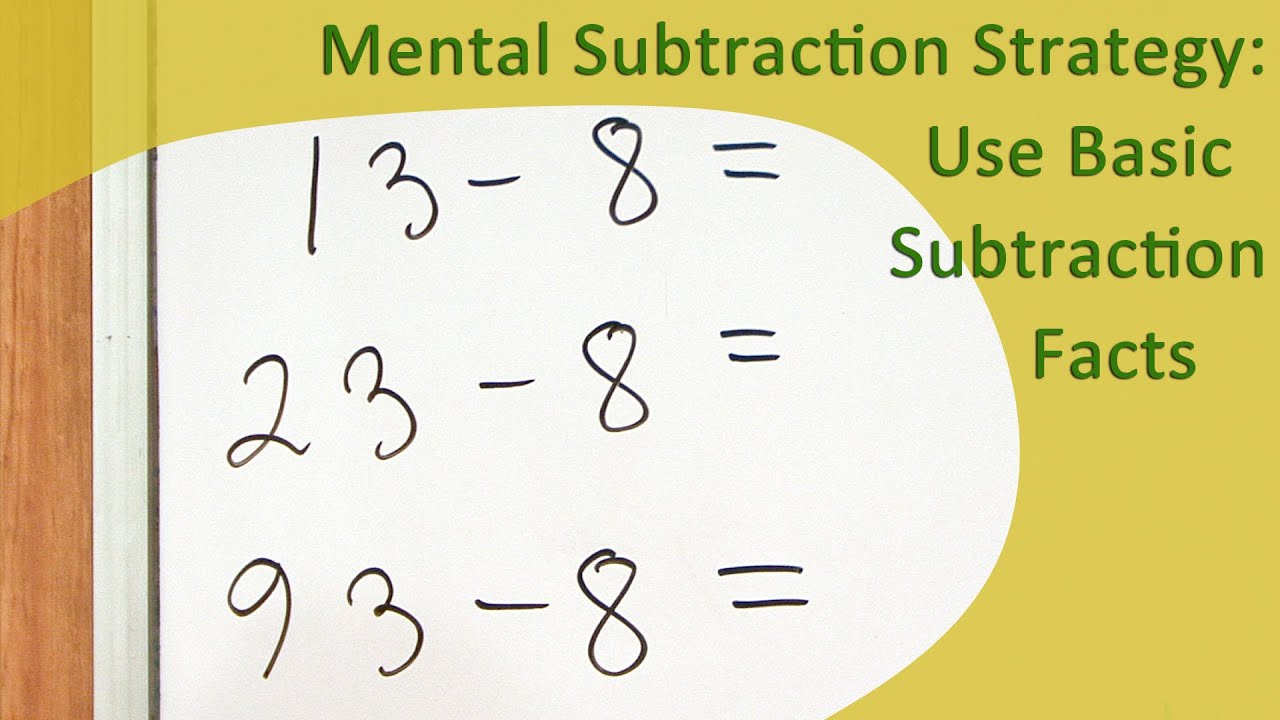
We can solve 23 - 8 and 93 - 8 (and 63 - 8 etc.) by our knowledge of the basic subtraction fact that 13 - 8 = 5. Think of it this way: in 13 - 8, the answer goes "down" to the previous ten, and ends in 5. It works the same way for 63 - 8, for example: the answer is in the previous ten (in the 50s) and ends in 5. The next part of this lesson is here (Subtract in parts): Practice two-digit mental math with these free online exercises: Play Hidden Picture Game and practice mental subtraction: This lesson is part of the Math Mammoth Grade 3 Curriculum:
We can solve 23 - 8 and 93 - 8 (and 63 - 8 etc.) by our knowledge of the basic subtraction fact that 13 - 8 = 5. Think of it this way: in 13 - 8, the answer goes "down" to the previous ten, and ends in 5. It works the same way for 63 - 8, for example: the answer is in the previous ten (in the 50s) and ends in 5. The next part of this lesson is here (Subtract in parts): Practice two-digit mental math with these free online exercises: Play Hidden Picture Game and practice mental subtraction: This lesson is part of the Math Mammoth Grade 3 Curriculum: