
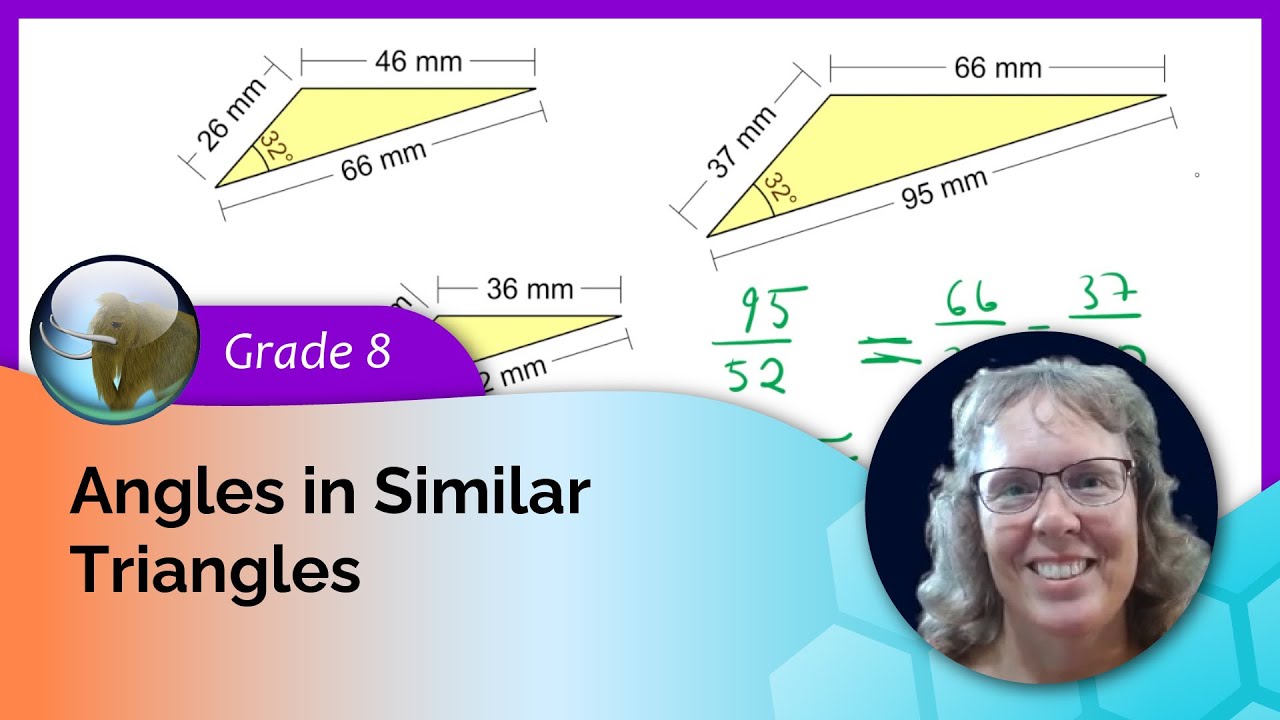
What is kind of amazing about similar triangles is that to show that two triangles are similar, it is sufficient to show that TWO (only two) of their angles are congruent. You don't need to check anything about the sides! And, in similar triangles (as in all similar figures), the corresponding sides are in the same ratio (or proportional). Once we have explored this principle, we solve an exercise that asks whether two triangles are similar or not. The latter half of the video is spent solving another exercise where we need to use a proportion to find an unknown side length of a triangle. Math Mammoth Grade 8 Curriculum
Maaari Mo Ring Magustuhan
Numberblocks Special Moments ✨
English learning videos for kids - Lingokids
CoComelon Lane! Brand New Netflix Kids Show!
Halloween Songs For Kids - CoComelon
Year 10 Math
Year3 Maths
Kids Songs by CoComelon
CoComelon
Year 11 Math
Year2 Maths
Year5 Maths
Year 2 Math
3rd Grade Math
How to Play Chess
6th Grade Math
Numberblocks - Number Adventures | Learn to Count | Maths for Kids
Math Videos for Kids
Punjab Board 9th General Mathematics Ch. 4 Financial Mathematics Financial Mathematics
Paglutas ng mga Salitang Problema | Math para sa 1st Grade | Kids Academy
مقاطع الرياضيات لغات | الصف الخامس الابتدائي | الترم الأول 2025 - 2026
PrePrimary Maths
Year1 Maths
Year6 Maths
Year4 Maths
Mga Komento
10 Mga Komento
First, we look at the definition of a prism and of a cylinder. The volume of both prisms and cylinders is calculated the same way: multiply the area of the base times the height. Next, we calculate the volume of a cylinder that looks like a pipe (it's not "standing up"). The final answer needs rounded according to the rules for significant digits. Then we do the same for a triangular prism. Math Mammoth Grade 8 curriculum
First, we look at the definition of a prism and of a cylinder. The volume of both prisms and cylinders is calculated the same way: multiply the area of the base times the height. Next, we calculate the volume of a cylinder that looks like a pipe (it's not "standing up"). The final answer needs rounded according to the rules for significant digits. Then we do the same for a triangular prism. Math Mammoth Grade 8 curriculum
The volume of a sphere is 4/3 times Pi times radius cubed. We apply this formula in two word problems. The first one asks us to find how many tennis balls have a volume that exceeds one liter. The second one has to do with the volume of a pond that is 90% full of water, in shape of a half-sphere. Math Mammoth Grade 8 curriculum
The volume of a sphere is 4/3 times Pi times radius cubed. We apply this formula in two word problems. The first one asks us to find how many tennis balls have a volume that exceeds one liter. The second one has to do with the volume of a pond that is 90% full of water, in shape of a half-sphere. Math Mammoth Grade 8 curriculum
The formula for the volume of both pyramids and cones is V = (area of the base) x (height) / 3. We calculate the volume of a circular cone, keeping in mind that the diagram gives us the diameter, not the radius, but we need the radius for the area of the circle. Then in the second example, the task is to find the height of a square pyramid when its volume and the side of the base are known. Math Mammoth Grade 8 curriculum
The formula for the volume of both pyramids and cones is V = (area of the base) x (height) / 3. We calculate the volume of a circular cone, keeping in mind that the diagram gives us the diameter, not the radius, but we need the radius for the area of the circle. Then in the second example, the task is to find the height of a square pyramid when its volume and the side of the base are known. Math Mammoth Grade 8 curriculum
In simple terms, two figures are similar figures if they have the same basic shape (but are not necessarily the same size). Mathematically speaking, two figures are similar if there is a sequence of transformations mapping one to the other (reflections, translations, rotations, and dilations are allowed). We also look at an exercise where a triangle is mapped to another, using a sequence of transformations, proving they are similar. Then in another exercise, we're given the coordinates of the vertices for two distinct transformations, and the task is to figure out what transformations they were. Math Mammoth Grade 8 curriculum Practice geometric transformations online
When two geometric figures are similar, they have the same basic shape but are not necessarily the same size. We multiply the side lengths of one by the scale factor to get the side lengths of the other. One can also use a scale ratio. I explain how to get the scale ratio from the scale factor. To calculate unknown side lengths, we can use the scale factor, or set up a proportion. Math Mammoth Grade 8 curriculum
When two geometric figures are similar, they have the same basic shape but are not necessarily the same size. We multiply the side lengths of one by the scale factor to get the side lengths of the other. One can also use a scale ratio. I explain how to get the scale ratio from the scale factor. To calculate unknown side lengths, we can use the scale factor, or set up a proportion. Math Mammoth Grade 8 curriculum
This video is intended for review in 8th grade, before embarking on the study of further angle relationships. In this lesson we review these basic angle relationships from 7th grade: concept of an angle, acute, right, obtuse, and reflex angles, adjacent angles, complementary angles, supplementary angles, and vertical angles. Then we have two exercises with unknown angles to solve. :) Math Mammoth Grade 8 curriculum