
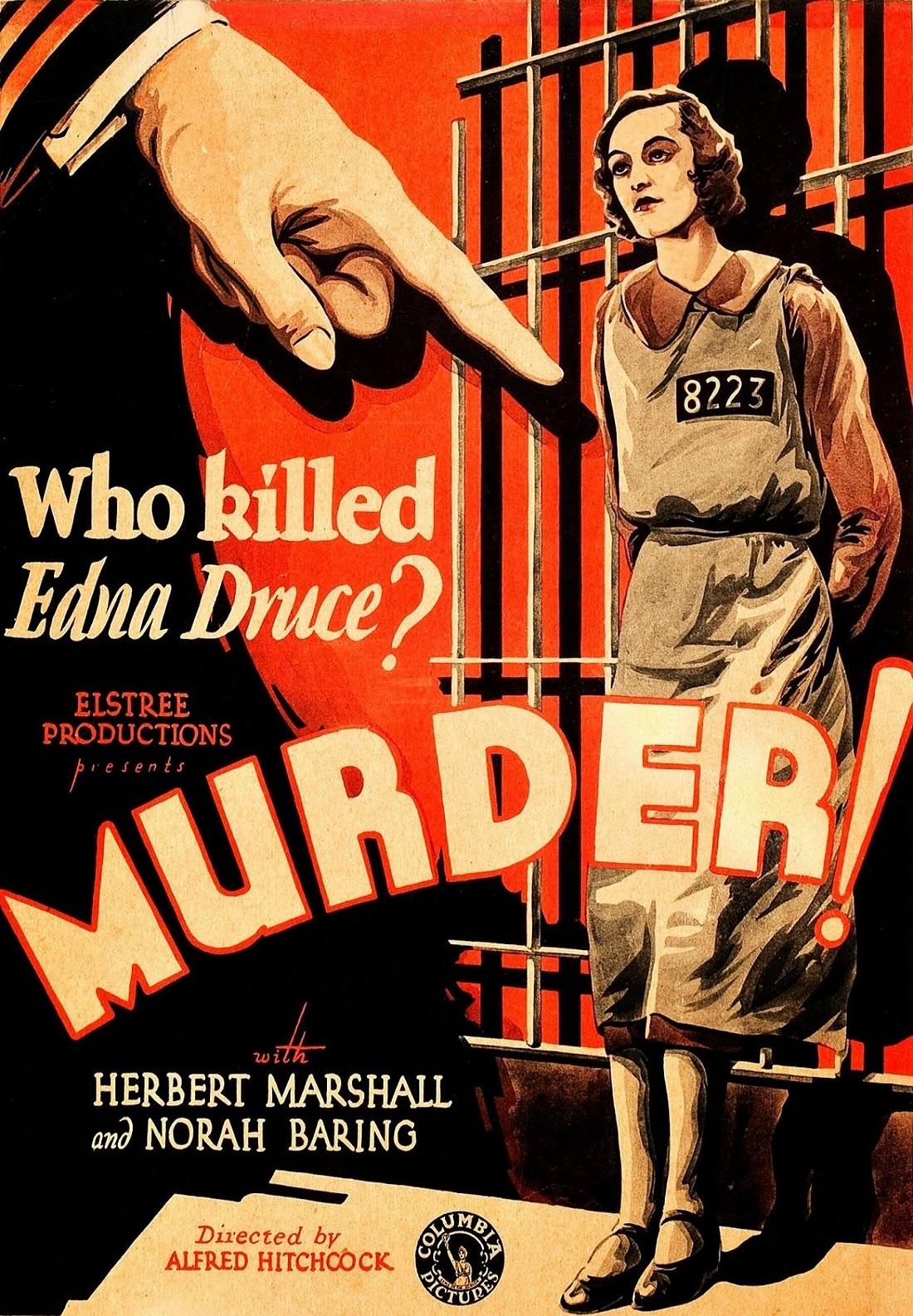
A juror in a murder trial, after voting to convict, has second thoughts and begins to investigate on his own before the execution.
Trailer
Cast
Alfred Hitchcock
Director
Herbert Marshall
Sir John Menier
Norah Baring
Diana Baring
Phyllis Konstam
Doucie Markham
Edward Chapman
Ted Markham
Miles Mander
Gordon Druce
Esme Percy
Handel Fane
Donald Calthrop
Ion Stewart
Esme V. Chaplin
Prosecuting Counsel
Amy Brandon Thomas
Defending Counsel
Joynson Powell
Judge
S.J. Warmington
Bennett
Marie Wright
Miss Mitcham
Hannah Jones
Mrs. Didsome
Una O'Connor
Mrs. Grogram
R.E. Jeffrey
Foreman of the Jury
Alan Stainer
Member of the Jury
Kenneth Kove
Member of the Jury
Guy Pelham Boulton
Member of the Jury
Clemence Dane
Writer
Helen Simpson
Writer
Alfred Hitchcock
Writer
Walter C. Mycroft
Writer
Alma Reville
Writer
You Might Also Like
Out of the Blue
Sweet Revenge: A Hannah Swensen Mystery
Hot Milk
Wrath of Man
The Night Manager
Bodyguard
Get Even
The Stranger
American Gigolo
Stranger
The Truth
All the Queen's Men
The Missing
London Kills
Young Wallander
Death in Paradise
Shetland
The Mallorca Files
Crime
Criminal: UK
Father Brown
Bang
Gone
Dalgliesh
Comments
10 Comments
source: Enter Sir John
This early Hitchcock is really forgettable. It just isn't that good. At first I thought it was a courtroom drama, which would have probably been better. But the court stuff doesn't last long. The movie then focuses on this juror trying to find the real killer. From here on out it's pretty standard and boring. Boring is probably the wrong word. It just wasn't interesting. The highlight of the film comes at the end when the real killer hangs himself in the middle of a circus. And it is a good scene, but it was really the only one. Now I'm not saying that Hitchcock didn't do a good job directing. Once again (as I stated in my "Champagne" review) we see Hitchcock's greatness shine through in certain shots. But overall nothing special. I would have gave this movie a 3, but the final scene saved it so I gave it a 4. I only recommend this if your a Hitchcock fan. The rest should avoid.
For 1930, Hitchcock gives us a sexual suspense flick that gives the audience something to blush about. Like Blackmail and the 39 Steps yet to come, MURDER has a great deal of sexual moments. Said to be one of the slowest narrative films in early Hitchcock cinema, the only thing that keeps the film moving is the sex! Hitchcock loves to play with the emotions of his audience. Murder is an excellent example of this.
This is a brilliant early work by Alfred Hitchcock, a film full of ingenuity and originality, and showing unmistakable signs of Hitchcock's developing genius. It stars Herbert Marshall, in one of his finest performances as the conscience-stricken character Sir John Menier, a famous stage actor who serves as a juror for the trial of a woman named Diana Baring, who is accused of murder. Strangely enough, Diana Baring is played by a well-known British actress of the time called Norah Baring. Despite being a double-Baring, she does not bare anything but her own polite doubts and hesitancies, being so highly bred that she dare not even be so presumptuous as to try to defend herself. Norah Baring has that high wavering voice, exceedingly thin figure, and shy, saintly manner of the born victim. Such women were fashionable in England in the 1930s. They spoke like overgrown children, with the most perfect diction. Considering how over-mannered and feeble most English men were at that time, perhaps such victim-women were all they could cope with. When the story begins, Baring is found sitting in a kind of trance in front of a fire where a girl who was her friend lies dead, with a poker beside her covered in blood. She continues to sit there looking straight ahead of her in a daze while the police come in and investigate the crime scene in an oafish and clumsy manner, getting their own fingerprints all over everything and acting like the proverbial Mr. Plod. They ask her what happened and she says she cannot remember anything. So this is an excellent start to a jolly good Hitchcock drama. Baring is convicted of murder and due to hang. Marshall had held out against a bullying jury until he finally caved in and agreed to a guilty verdict. But then he had juror's remorse and set about actively trying to prove her innocence before she could be executed. His investigations become more and more complicated, and Baring is unwilling to help him, and in any case genuinely cannot remember what happened. Apparently, Baring thinks it is only good manners to submit to the verdict. If she ever had an ego, it had certainly drained out of her long ago, like rainwater going down a street culvert. Can Marshall possibly accomplish anything against all these odds? He is determined and indomitable. A most fascinating understated and inspired performance is given by Esme Percy, as the ambiguous character Handel Fane, who is both an actor and a trapeze artist who likes to dress in drag. In an understated performance laden with unspoken implications, Percy gives the character all the poignant underpinnings of a man tormented by his own contradictory impulses, and weighed down by the loneliness of his cross-dressing compulsion. It is an amazing psychological study of an extreme character type. Percy certainly was underrated in his career and his excellent interpretation of this difficult character helps make the entire film a true classic.
From my comments you will immediately recognize I am not an expert on Alfred Hitchcook or film in general. My positive reactions to this this movie are based on the fact that I felt it held my interest and that it is technically better than most talkies made in the period of 1929 to 1931, even though I think that Herbert Marshall was hampered by a script that was fine for the level of the other actors but inferior for Marshall's talent. I feel that he was out of place in this movie because of the supporting actors. It was still a good movie and you could see hints of Hitchcock future genius in the direction of the plot. I think it took courage to include some of the longer scenes in this movie, especially for a movie made in 1930. That being said I think these longer scenes were mostly effective. I think this film is watch-worthy for any film student and anyone who is a fan of Hitchcock or early talkies. In my opinion if this film were made only 4 years later with the same cast it would have been a superior film because of the massive evolution in film making in the period between 1930 and 1934.
Enjoyed viewing this great Hitchock Classic which was created in London, England in the early talkie films and the sound and production was very poor but Herbert Marshall, (Sir John Menier) gave an outstanding performance along with Norah Baring, (Diana Baring). Sir John Menier had to serve on a jury and make a very serious decision in a murder case concerning actors and a murder that occurred behind the scenes. Sir John was persuaded by his other jurors to convict Diana Baring of this crime which he did not really feel committed this murder. Diana is sentenced to prison and possibly death, but Sir John has a deep concern that she is innocent and decides to start his own investigation into this murder case in order to obtain Diana an appeal. This story goes very deep into this investigation and there are many suspects involved which adds greatly to this very secret murder mystery. Enjoy.
This movie is quite interesting. A rare Hitchcock film in which we only find out who the murderer is in the end. Herbert Marshall is excellent here, as always, and the cast supports him well. The film has some memorable scenes, as when Marshall goes to prison to talk to the prisoner and when the jury decides about the verdict of the accused. The end is completely unpredictable.
Now don't get me wrong. I adore Hitchcock, I think he gave respectability & sheen to the thriller genre, he is intelligent, has a wicked sense of humour, & finally, made some movies which are a delight to watch. Unfortunately 'Murder' isn't one of them. 'Murder' is a filmed play with all the theatrical gestures & conventions intact. The plot is rudimentary (pretty girl on a murder charge) & there are enough holes to fill up Albert Hall (the trial doesn't fill you with much respect for the British judicial system). In its defence I can say that making the movie overly theatrical is supposed to reflect its mileu - a theatre company. The movie also has a pretty strong gay subtext & for many of the major characters we don't know where they stand, & whether that has anything to do with the motives. The best touch of the movie is its ending where the murderer is uncovered. A brilliant touch which, alas, can't redeem the previous 90 minutes.