
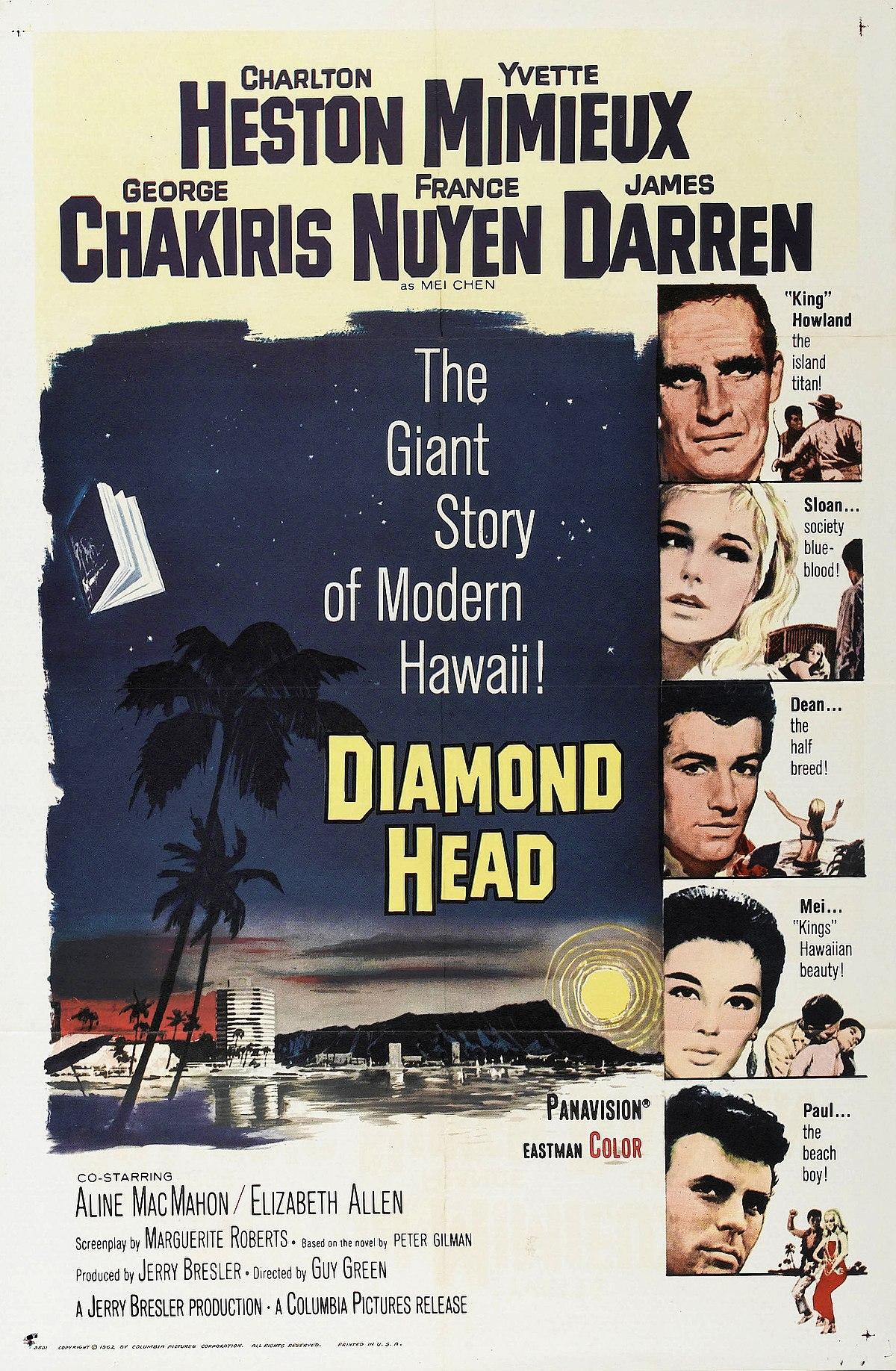
In 1950's Hawaii, a bigoted and ruthless land baron, with political ambitions, bans his sister from marrying a native Hawaiian even though he himself has secretly impregnated an Asian woman.
Trailer
Cast
Guy Green
Director
Charlton Heston
King Howland
Yvette Mimieux
Sloane Howland
George Chakiris
Dr. Dean Kahana
France Nuyen
Mai Chen
James Darren
Paul Kahana
Aline MacMahon
Kapiolani Kahana
Elizabeth Allen
Laura Beckett
Vaughn Taylor
Judge James Blanding
Marc Marno
Bobby Chen
Philip Ahn
Mr. Immacona
Harold Fong
Koyama
Edward Mallory
Robert Parsons
Yankee Chang
Newspaper Man
David Chow
Police Officer
Leo Ezell
Pianist
Seagi Faumunina
Blue Goose
Kam Fong
Loe Kim Lee
Lou Gonsalves
Mario
Marguerite Roberts
Writer
Peter Gilman
Writer
You Might Also Like
American Kamasutra
The Babysitters
Dream Boy
TAKE OVER
Outrageous
The Summer I Turned Pretty
If Loving You Is Wrong
Every Year After
Hit the Floor
Ash
Loke Moon Rob Ter
Cat for Cash
Class Crush Crisis
Gossip Girl
Masters of Sex
From Scratch
The Nature of Us
Dallas
Paris Is Always A Good Idea
Hidden Love
Pursuit of Jade
Lighter & Princess
Maxton Hall - The World Between Us
The Best Thing
Comments
10 Comments
The first thing that hit me about this movie was an appreciation of the wide screens and bright colours that prevailed in movies of that era. Hawaii looks great here. On a large screen, that alone would have been worth the price of admission. As for that other stuff, cast, acting, directing, story, dialogue, etc. Well, this is a soap opera and don't expect too much more except that the plot angles focus on race, ethnic relations and class and this gives them a bit more substance than some other soap operas such "The Picnic" or "Portrait in Black". At the time, it probably skated the line between being edgy enough to intrigue the audience but not so controversial to be scandalous. Today, it comes across as pretty mild although the issues themselves have certainly not disappeared. Nothing and no one is either brilliant or terrible although Philip Ahn's small part is excellent and produces a strong moment. Heston has his huge screen presence but this is not one of his classic roles. There is not enough there for it to possibly become that. Mimieux looks great and her role is as essential as Heston's and is a soap opera archetype. Nuyen also looks great and, as usual for her in the 60s, melancholy.
source: Diamond Head
MGM had a group of young stars Richard Chamberlain, George Peppard, Paula Prentiss, Jim Hutton, George Hamilton, and beautiful Yvette Mimieux. Charlton Heston is very fine in this drama with great colors photography. The film made a lot of Hawaii as being admitted to the USA. MGM loaned Yvette Mimieux to Columbia for above the title star billing. Columbia's contract player James Darren also is cast. Columbia had its own contract roster: Mr. Darren, along with Michael Callan, Deborah Walley, Cindi Carol Yvette Mimieux and Charlton Heston would re unite back at MGM years later in Skyjacked.
The people are pretty. The scenery is spectacular. What more do you want?
Richard 'King' Howland and his sister Sloane (Heston and Mimieux) live on an island, the only wonderful place that gets bigger every time they saw it from the sky Sloane has just returned from California graduated but she despises waiting She has something on her mind to tell her brother about Paul (James Darren). So she asks her brother how did he feel about Paul Kahana? The whole film is about racial intolerance and it sends a strong message, which kept the story interesting Trade with them, be friends with them, even sleep with them, but don't marry them This is Hawaii It can happen here, and it does all the time For Laura Beckett (Elizabeth Allen), King's sister-in-law, it happens, but not to people of their class For King, if Sloane marries Paul, her children will inherit Manoalani one day, and all that goes with it Paul is pure Hawaiian Their families have been in these islands over a hundred years They have never mixed their blood Charlton Heston plays a rich narrow-minded pineapple grower, obstinately and intolerantly devoted to his own beliefs, even though he himself having an affair with Mai Chen (France Nuyen), the woman who doesn't ask questions Mai knows that most women can make the world go away for a while, but none can make it stay away Richard Knows that he's in danger of becoming an uncle His sister and himself are the last of their line Her son will own Manoalani one day and he has to be the right kid of son Obviously he could have a child He might even have a son But he has no intention of marrying again But Mai Chen thinks differently He should have his own son But King had a son His name was Richard Howland III He was 3 years old that day A tidal wave, 40-foot crest smashed into Hilo and killed him and his mother and 120 others So he doesn't want another son Yvette Mimieux achieved stardom in "Where the Boys Are" (1960) and here, she is incredibly fresh, innocent and beautiful Filmed in Color and Wide Screen, the photography is too beautiful presenting a tropical paradise of turquoise waters, white sandy beaches, waving palm trees, lush tropical vegetation and gentle sunshine
Diamond Head was a so so to reasonable film about power and mixed marriage, but nothing special. I did not care for any character in this film. Richard's suppose to be unlikable, but Sloane isn't much better, she will basically have anyone who will jump into the water with her. Jumping from one brother to the next. Sloane: Feel? That's just it, I don't feel. Anything. Paul must of loved me and all I felt was a blank. I don't know how to love. Then she gets with Dean after telling him this. This is a romance?? There was no chemistry between anyone. It was an interesting and engaging enough film though.
This is a big film -- the kind of film made from big novels about big ideas about big people, like Charlton Heston's character (originally written for Clark Gable) "The King." In fact, it reminds me of Edna Ferber's "Giant", or James Michener's "Hawaii." The themes of racism and family strife that motivate the film might have been daring in the early 60s but aren't compelling enough at this point to power the film's entire running length. The big revelation in the film, for me, was (3rd billed) George Chakiris' performance. I never really thought of him as much of an actor, but he definitely nailed this role. He's not a man who is unlikable, but rather a man who doesn't want to be liked (or, perhaps, who doesn't want to need to be appreciated, only respected). At first, his pride and resentment seem simply racially motivated and come off as jealousy; eventually, we begin to see Heston's "King" the same way Chakiris' character does. James Darren is attractive and serviceable, and Heston approaches the role with his usual sincerity and self-sacrifice (he's not afraid to gradually turn this respectable powerful man into a heel). Yvette Mimieux has a bit too much of a baby face for the role.... at times it feels like a Gidget movie with her and Darren running around on the beach. But her performance is OK. There's just nothing really compelling or moving about any of these characters. Overblown, novelistic dialog doesn't help. The film feels a travelogue with melodrama thrown in, like a 20s/30s MGM movie (with Clark Gable, of course!) by Victor Fleming or Woody Van Dyke movie, but cinematographer turned director Guy Green is no Victor Fleming. There are some awesome compositions, but they sort of fly by in the midst of the relatively trite plot directions. The characters take their situations so seriously that one is reminded of Douglas Sirk, sans irony.
From the beginning of the film when manly Chuck Heston majestically rides his horse through the sprawling pineapple fields, to the triumphant swelling of a young John Williams' score, the viewer knows that this movie is BIG. Well, it is big in the sense that it's one of those big soap operas that were popular in the mid-50's to the mid-60's, trademarks of producer Ross Hunter (not the maker of this one, though). The plot is rather simple: plantation owner (Heston) has a little sister (Yvette Mimieux) that's carrying on with a native boy (James Darren), much to the displeasure of Heston, who himself is having a fling with a native girl (France Nuyen, looking appealing as ever). Thus, all things come out in the open, though tragically, and the hypocritical Heston finds himself a wealthy man, abandoned and alone.
Unless I missed it, there's not a single reference to Diamond Head in this Hawaii-set soap opera. Nevertheless, the meaningless title is not the most perplexing thing about the film. What's astounding is how seriously Charlton Heston, Yvette Mimieux, James Darren & George Chakiris take this melodrama. Heston is Richard "King" Howland, a modern day ruler of a plantation where nothing transpires without his input. Mimieux is his extraordinarily younger sister, bent on marrying islander Darren. A lot of lurid nonsense ensues as Heston's hypocrisy is revealed. There's no action, some fairly lousy acting and some rather dull direction by Guy Green. Heston says "damn" a lot, Mimieux gets drunk a lot and France Nuyen (as Heston's kept woman) espouses a lot of common sense advice to virtually everyone. Frankly, the film is so boring, an eruption by ANY volcano would have been most welcome.
The title sounds like some James Bond-type adventure but it's typical melodrama circa 1959 in Hawaii (Heston would return to the locale in an earlier century in "The Hawaiians" in '70). Heston's character hearkens back to his rich landowner of "The Naked Jungle"(54), so it's as if the same character is a decade older. The theme of race relations (white vs. brown here) is played over the plot in a ham-handed manner, though a couple of characters get to voice an almost-profound observation regarding no 'pure-bred' people existing in some future generation. Heston's character, though predictably arrogant & stubborn, starts out as a fairly liberal easygoing chap for a powerful rich white man of the time but quickly learns he can't apply those nice attitudes when it hits close to home: his sister (Mimieux) plans to marry a Hawaiian (Darren) and Heston won't have it. There follows a hint of incestuous undertones and, at some point, it almost looks like Heston plans to marry his sister himself to keep things 'all in the family' - an obsession he reveals as the story progresses. But this is over 40 years ago and nothing goes beyond just some cheap suggestion and titillating the dirty minds of some audience members. By the end, we realize it's the often-used saying of 'money can't buy happiness' which prevails over the sometimes maudlin scenery-chewing. Speaking of scenery, though, the landscapes of Hawaii are very nice here, especially on a widescreen DVD version. And Heston shows why he's a bigger star than the rest of the cast, but the story itself is pretty much forgettable and uninspired.