
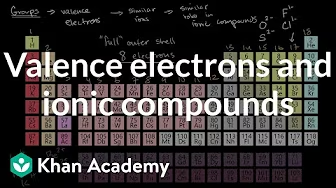
High school chemistry | Unit 3 Start learning now! https://www.khanacademy.org/science/hs-chemistry/x2613d8165d88df5e:chemical-bonding
आपको ये भी पसंद आ सकते हैं
Organic Chemistry
Electricity and magnetism | Physics | Khan Academy
Kids Songs by CoComelon
Primary 1 English
Alphabet (ABC) Songs by CoComelon
ABC Songs for Kids - CoComelon Nursery Rhymes
Halloween Songs For Kids - CoComelon
ABCs, 123s, and MORE with Sesame Street and The Children's Kingdom Nursery Rhymes
Summer Songs for Babies! CoComelon Summertime
IELTS Listening and Speaking Sections Skills Mastery
🎃🕯️🧛♀️ HALLOWEEN STORIES 2025 🕷️🧹👻
Popular Kids Songs & Nursery Rhymes Compilations - by BabyBus
Kids Songs by CoComelon & Blippi - Nursery Rhymes
Exams and revision
ABCs Learn the Alphabet
ABC Alphabet for Kids - Read Along with StoryBots! | Netflix Jr
SEAS Videos
Bingo Songs! CoComelon Nursery Rhymes Mix
Letters and Letter Sounds
English Learning Videos!
Princess Power | Netflix Jr
Gabby's Dollhouse | Netflix Jr
BabyBus | Nursery Rhymes Collections
Nastya and papa
टिप्पणियाँ
10 टिप्पणियाँ
Courses on Khan Academy are always 100% free. Start practicing—and saving your progress—now! https://www.khanacademy.org/science/a... One way to predict the type of bond that forms between two elements is to consider whether each element is a metal or nonmetal. In general, covalent bonds form between nonmetals, ionic bonds form between metals and nonmetals, and metallic bonds form between metals. Khan Academy is a nonprofit organization with the mission of providing a free, world-class education for anyone, anywhere. We offer quizzes, questions, instructional videos, and articles on a range of academic subjects, including math, biology, chemistry, physics, history, economics, finance, grammar, preschool learning, and more. We provide teachers with tools and data so they can help their students develop the skills, habits, and mindsets for success in school and beyond. Khan Academy has been translated into dozens of languages, and 15 million people around the globe learn on Khan A
Courses on Khan Academy are always 100% free. Start practicing—and saving your progress—now! https://www.khanacademy.org/science/a... Metallic bonds result from the electrostatic attraction between metal cations and delocalized electrons. The nature of metallic bonding accounts for many of the physical properties of metals, such as conductivity and malleability. Khan Academy is a nonprofit organization with the mission of providing a free, world-class education for anyone, anywhere. We offer quizzes, questions, instructional videos, and articles on a range of academic subjects, including math, biology, chemistry, physics, history, economics, finance, grammar, preschool learning, and more. We provide teachers with tools and data so they can help their students develop the skills, habits, and mindsets for success in school and beyond. Khan Academy has been translated into dozens of languages, and 15 million people around the globe learn on Khan Academy every month. As a 501(c)(3) n
Courses on Khan Academy are always 100% free. Start practicing—and saving your progress—now! https://www.khanacademy.org/science/h... Lewis diagrams (or Lewis structures) are models that show how atoms are bonded together in a molecule and the arrangement of valence electrons around the atoms in that molecule. They provide a visual representation that helps us understand molecular bonding, visualize molecular shapes, and predict chemical reactivity. Sections: 00:00 - What are valence electrons? 01:39 - Lewis structure of H2 03:08 - Lewis structure of O2 06:08 - Lewis structure of N2 08:32 - Lewis structure of H2O 10:35 - Lewis structure of NH3 12:00 - Lewis structure of CO2 Khan Academy is a nonprofit organization with the mission of providing a free, world-class education for anyone, anywhere. We offer quizzes, questions, instructional videos, and articles on a range of academic subjects, including math, biology, chemistry, physics, history, economics, finance, grammar, presc
Courses on Khan Academy are always 100% free. Start practicing—and saving your progress—now! https://www.khanacademy.org/science/a... Covalent bonds involve the sharing of electron pairs between atoms. Electron pairs shared between atoms of equal or very similar electronegativity constitute a nonpolar covalent bond (e.g., H–H or C–H), while electrons shared between atoms of unequal electronegativity constitute a polar covalent bond (e.g., H–O). Khan Academy is a nonprofit organization with the mission of providing a free, world-class education for anyone, anywhere. We offer quizzes, questions, instructional videos, and articles on a range of academic subjects, including math, biology, chemistry, physics, history, economics, finance, grammar, preschool learning, and more. We provide teachers with tools and data so they can help their students develop the skills, habits, and mindsets for success in school and beyond. Khan Academy has been translated into dozens of languages,
Courses on Khan Academy are always 100% free. Start practicing—and saving your progress—now: https://www.khanacademy.org/science/c... Naming ionic compounds that contain polyvalent ions, using example of cobalt (III) sulfide. View more lessons or practice this subject at https://www.khanacademy.org/science/c... Khan Academy is a nonprofit organization with the mission of providing a free, world-class education for anyone, anywhere. We offer quizzes, questions, instructional videos, and articles on a range of academic subjects, including math, biology, chemistry, physics, history, economics, finance, grammar, preschool learning, and more. We provide teachers with tools and data so they can help their students develop the skills, habits, and mindsets for success in school and beyond. Khan Academy has been translated into dozens of languages, and 15 million people around the globe learn on Khan Academy every month. As a 501(c)(3) nonprofit organization, we would love your help! Do
Courses on Khan Academy are always 100% free. Start practicing—and saving your progress—now: https://www.khanacademy.org/science/c... Ionic compounds are neutral compounds made up of positively charged ions called cations and negatively charged ions called anions. For binary ionic compounds (ionic compounds that contain only two types of elements), the compounds are named by writing the name of the cation first followed by the name of the anion. For example, KCl, an ionic compound that contains K⁺ and Cl⁻ ions, is named potassium chloride. View more lessons or practice this subject at https://www.khanacademy.org/science/c... Khan Academy is a nonprofit organization with the mission of providing a free, world-class education for anyone, anywhere. We offer quizzes, questions, instructional videos, and articles on a range of academic subjects, including math, biology, chemistry, physics, history, economics, finance, grammar, preschool learning, and more. We provide teachers wi
Courses on Khan Academy are always 100% free. Start practicing—and saving your progress—now! https://www.khanacademy.org/science/a... The cations and anions in an ionic solid are arranged in a lattice structure that maximizes the attractive forces between opposite charges and minimizes the repulsive forces between like charges. In this video, we'll learn how to represent the structure of an ionic solid using a particulate model. Khan Academy is a nonprofit organization with the mission of providing a free, world-class education for anyone, anywhere. We offer quizzes, questions, instructional videos, and articles on a range of academic subjects, including math, biology, chemistry, physics, history, economics, finance, grammar, preschool learning, and more. We provide teachers with tools and data so they can help their students develop the skills, habits, and mindsets for success in school and beyond. Khan Academy has been translated into dozens of languages, and 15 million people
Courses on Khan Academy are always 100% free. Start practicing—and saving your progress—now! https://www.khanacademy.org/science/a... Ionic bonds result from the electrostatic attraction between oppositely charged ions, which form when valence electrons are transferred from one atom to another. Khan Academy is a nonprofit organization with the mission of providing a free, world-class education for anyone, anywhere. We offer quizzes, questions, instructional videos, and articles on a range of academic subjects, including math, biology, chemistry, physics, history, economics, finance, grammar, preschool learning, and more. We provide teachers with tools and data so they can help their students develop the skills, habits, and mindsets for success in school and beyond. Khan Academy has been translated into dozens of languages, and 15 million people around the globe learn on Khan Academy every month. As a 501(c)(3) nonprofit organization, we would love your help! Donate or volunteer
Courses on Khan Academy are always 100% free. Start practicing—and saving your progress—now! https://www.khanacademy.org/science/a... When forming ions, elements typically gain or lose the minimum number of electrons necessary to achieve a full octet. For example, fluorine has seven valence electrons, so it is most likely to gain one electron to form an ion with a 1- charge. We can use this method to predict the charges of ions in ionic compounds. Khan Academy is a nonprofit organization with the mission of providing a free, world-class education for anyone, anywhere. We offer quizzes, questions, instructional videos, and articles on a range of academic subjects, including math, biology, chemistry, physics, history, economics, finance, grammar, preschool learning, and more. We provide teachers with tools and data so they can help their students develop the skills, habits, and mindsets for success in school and beyond. Khan Academy has been translated into dozens of languages, and