
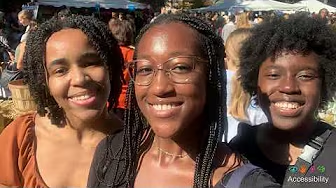
"Accessibility at Yale" is a series highlighting the university's ongoing efforts to create an inclusive and accessible campus. It features resources, initiatives, and personal accounts on supporting accessibility for students, faculty, and staff with diverse needs." To learn more about accessibility at Yale University, please visit accessibility.yale.edu.
Vous aimerez aussi
English learning videos for kids - Lingokids
CoComelon Lane! Brand New Netflix Kids Show!
Halloween Songs For Kids - CoComelon
Year7 German
Learn English With Disney Movies
Test Your English with TV Series and Movies
Educational Cartoons for Kids | Learn with Sheriff Labrador
🎃🕯️🧛♀️ HALLOWEEN STORIES 2025 🕷️🧹👻
CoComelon #shorts
All New Akili & Me
Sheriff Labrador New Episodes
Charlie and Lola Full Episodes
English with TV Series (Kids Appropriate)
Understanding the World
Year5 Music
African
SS 1 Biology
SS 3 Biology
BabyBus | Learning Vehicles Song | Car Songs | Cars for Kids | Nursery Rhymes | Baby Cartoon
Kids Songs & Cartoons of Kitten Family | Kids Cartoon for Kids | BabyBus
Pinkfong! 👻NEW👻 Halloween Songs & Stories (Zombie Sharks, Monsters, Vampires)
Year6 Music
Emanuella And Success Comedy
SSS10 Other
Commentaires
4 commentaires
Most students feel disoriented and anxious when first starting college, and Olivia Schlaepfer was no exception. Yet until she was diagnosed with autism and ADHD as a sophomore, she couldn’t understand why it was especially challenging for her to make the social and academic transition into college life. Learning about neurodiversity and campus resources helped Olivia identify ways of thriving at Yale. Learn more about accessibility at Yale: accessibility.yale.edu.
Heather Klemann, a Yale faculty member in the Dept. of English, discusses why and how she incorporates accessibility into her teaching — an approach that benefits all students and herself as the instructor. Professor Klemann is a longtime advocate of resources available through Yale’s Poorvu Center, including digital education technology and the flexible teaching spaces shown here. Learn more about accessibility at Yale: accessibility.yale.edu
This video features Olivia Schlaepfer, a former student, and Dr. John Wargo, Tweedy-Ordway Professor of Environmental Health and Politics at Yale School of the Environment. Together they discuss the importance of accessible teaching for students with disabilities. Olivia, who is autistic and has ADHD, shares how Professor Wargo's openness to adapting his teaching methods positively impacted her academic experience. Professor Wargo reflects on how accommodating students' diverse needs has made him a more thoughtful educator. Together, they emphasize the value of forming human connections in education and advocate for accessibility as a pathway to equity and inclusivity in the classroom. Learn more about accessibility at Yale: accessibility.yale.edu
When Chisom Ofomata started at Yale University, she found herself trying to navigate various challenges when seeking accommodations as a Deaf student. Through building connections and a sense of community, Chisom was able to not only overcome barriers but also become a leader and advocate for disabled students. She provides tangible recommendations on how faculty can better support d/Deaf students based on her personal experiences. Learn more about accessibility at Yale: accessibility.yale.edu