
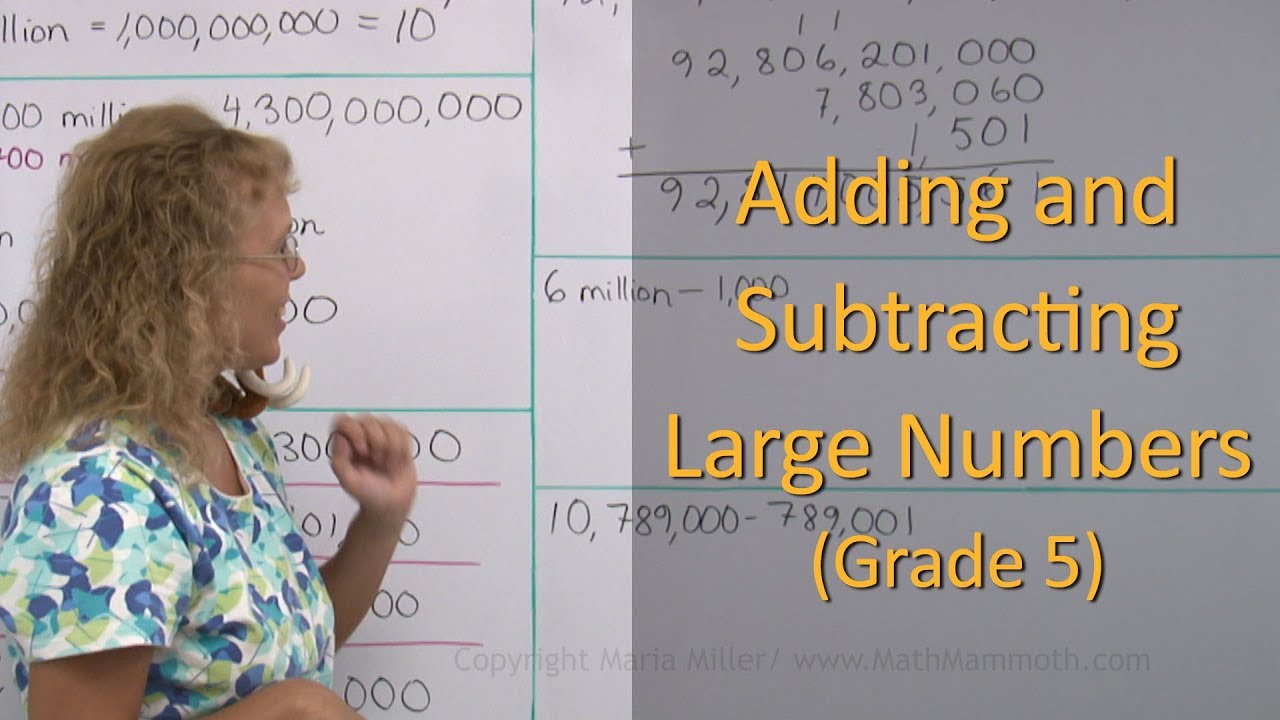
In this lesson, we add and subtract large numbers (with up to 9 digits, or with billions), both using mental math and in columns (one number under the other). The main principle to keep in mind is that the different places in the number need to be aligned: ones with ones, tens with tens, hundreds with hundreds, etc. all the way to hundred billions. Other than that, there's not really anything new to learn: the basic addition and subtraction algorithms (including regrouping) work the same way as with smaller numbers.
قد يعجبك أيضًا
Year 10 Math
Year3 Maths
CoComelon
Alphabet (ABC) Songs by CoComelon
PrePrimary Maths
Year1 Maths
Year 11 Math
Year2 Maths
Year6 Maths
Year4 Maths
3rd Grade Math
How to Play Chess
Trigonometry | High School Math | Khan Academy
First Grade Curriculum
Seconde - Fonction de référence
دوال BAC 2021
Year5 Maths
Maths
Year 9 Math
3rd Grade Fractions
Numberblocks Special Moments ✨
Kids Songs by CoComelon
Learn Colors with CoComelon!
Year1 English
التعليقات
10 تعليق
We look at two example math word problems where a calculator is useful. The first one has to do with average speed. The second one asks us the average miles per capita (per person) driven in the United States in one year, and also in one day. I feel 5th grade is a good time to teach students how to use a calculator. These examples can help students understand when to use a calculator. However, I don't recommend a calculator to be used for simple calculations that can be done mentally. See also this video: How to use a calculator to find powers of 7
We look at two example math word problems where a calculator is useful. The first one has to do with average speed. The second one asks us the average miles per capita (per person) driven in the United States in one year, and also in one day. I feel 5th grade is a good time to teach students how to use a calculator. These examples can help students understand when to use a calculator. However, I don't recommend a calculator to be used for simple calculations that can be done mentally. See also this video: How to use a calculator to find powers of 7
In this example, we find which exact power of seven is more than one million, using a calculator. This is a simple exercise helping students to learn to use the calculator. Once you punch 7 x 7 = with a calculator, and get 49, you can just keep pushing the equals button, which will multiply your previous result by 7. And thus, you can get a sequence of numbers that are powers of 7... 7 to the third power, 7 to the fourth power, 7 to the fifth power (exponent is 5) and so on. See more 5th grade math videos at
In this example, we find which exact power of seven is more than one million, using a calculator. This is a simple exercise helping students to learn to use the calculator. Once you punch 7 x 7 = with a calculator, and get 49, you can just keep pushing the equals button, which will multiply your previous result by 7. And thus, you can get a sequence of numbers that are powers of 7... 7 to the third power, 7 to the fourth power, 7 to the fifth power (exponent is 5) and so on. See more 5th grade math videos at
Some basic practice with rounding large numbers (with millions) to any place, including numbers with lots of nines. We also look at two word problems.
Some basic practice with rounding large numbers (with millions) to any place, including numbers with lots of nines. We also look at two word problems.
This is an introduction to powers of ten and to exponents, as studied in 5th grade math. A power of ten means that ten is multiplied by itself, a certain number of times. For example, ten to the 6th power means 10 x 10 x 10 x 10 x 10 x 10, or one million. In this lesson, we also look at multiplying other numbers by powers of ten, such as 41 x 10^4 or similar expressions. Lastly we consider some large numbers from astronomy, and how powers of ten (exponents) really help us write those numbers!
This is an introduction to powers of ten and to exponents, as studied in 5th grade math. A power of ten means that ten is multiplied by itself, a certain number of times. For example, ten to the 6th power means 10 x 10 x 10 x 10 x 10 x 10, or one million. In this lesson, we also look at multiplying other numbers by powers of ten, such as 41 x 10^4 or similar expressions. Lastly we consider some large numbers from astronomy, and how powers of ten (exponents) really help us write those numbers!
In this lesson, we add and subtract large numbers (with up to 9 digits, or with billions), both using mental math and in columns (one number under the other). The main principle to keep in mind is that the different places in the number need to be aligned: ones with ones, tens with tens, hundreds with hundreds, etc. all the way to hundred billions. Other than that, there's not really anything new to learn: the basic addition and subtraction algorithms (including regrouping) work the same way as with smaller numbers.
In this lesson, we add and subtract large numbers (with up to 9 digits, or with billions), both using mental math and in columns (one number under the other). The main principle to keep in mind is that the different places in the number need to be aligned: ones with ones, tens with tens, hundreds with hundreds, etc. all the way to hundred billions. Other than that, there's not really anything new to learn: the basic addition and subtraction algorithms (including regrouping) work the same way as with smaller numbers.