
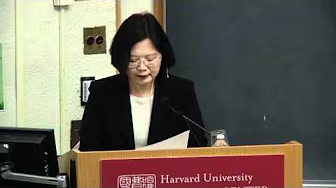
Lecture videos from Harvard University's Fairbank Center for Chinese Studies
قد يعجبك أيضًا
English learning videos for kids - Lingokids
CoComelon Lane! Brand New Netflix Kids Show!
Halloween Songs For Kids - CoComelon
Year7 German
Kids Songs by CoComelon
CoComelon
Alphabet (ABC) Songs by CoComelon
CocoMelon | Little Baby Bum | Blippi - Nursery Rhymes & Kids TV Shows
SEAS Videos
SEAS Campaign Videos
SEAS Undergraduate Videos
SEAS Graduate Students
Seventh IECO-RCC International Colloquium at Harvard University
SS 2 Physics
Nursery Rhymes & Kids Cartoon (All!!) | Kiki and Miumiu | Baby Shark | Fire Truck | Top Playlist - Nursery Rhymes & Kids Songs by BabyBus
SS 1 Business & Finance
JS 2 Mathematics
Learn English Alphabet for Kids
Bingo Songs! CoComelon Nursery Rhymes Mix
Nina and JJ! CoComelon Friends
Numbers for Kids - Learn to Count with StoryBots! | Netflix Jr
Songs & Music Videos for Kids 🎶 Netflix Jr
Basic Learning Songs for Kids
D Billions Family
التعليقات
10 تعليق
Chair: Xiaofei Tian All ten artists, Yin Jinan, Ah Cheng, Gao Minglu This symposium is organized by the East Asian Art History Program, Harvard University, in conjunction with the exhibition Fresh Ink: Ten Takes on Chinese Tradition at the Museum of Fine Arts, Boston. It is sponsored by the Rockefeller Fund for East Asian Art of the Department of History of Art and Architecture, the Fairbank Center for Chinese Studies, the Harvard-Yenching Institute, and the Museum of Fine Arts, Boston. December 4, 2010
Chair: Melissa McCormick Panel: Eugene Wang, Liu Dan, Zeng Xiaojun, Qin Feng This symposium is organized by the East Asian Art History Program, Harvard University, in conjunction with the exhibition Fresh Ink: Ten Takes on Chinese Tradition at the Museum of Fine Arts, Boston. It is sponsored by the Rockefeller Fund for East Asian Art of the Department of History of Art and Architecture, the Fairbank Center for Chinese Studies, the Harvard-Yenching Institute, and the Museum of Fine Arts, Boston. December 4, 2010
Chair: Jane Portal Panel: Hao Sheng, Li Jin, Liu Xiaodong, Yu Hong This symposium is organized by the East Asian Art History Program, Harvard University, in conjunction with the exhibition Fresh Ink: Ten Takes on Chinese Tradition at the Museum of Fine Arts, Boston. It is sponsored by the Rockefeller Fund for East Asian Art of the Department of History of Art and Architecture, the Fairbank Center for Chinese Studies, the Harvard-Yenching Institute, and the Museum of Fine Arts, Boston. December 4, 2010
Chair: Carma Hinton Panel: Yukio Lippit, Arnold Chang, Li Huayi, Qiu Ting This symposium is organized by the East Asian Art History Program, Harvard University, in conjunction with the exhibition Fresh Ink: Ten Takes on Chinese Tradition at the Museum of Fine Arts, Boston. It is sponsored by the Rockefeller Fund for East Asian Art of the Department of History of Art and Architecture, the Fairbank Center for Chinese Studies, the Harvard-Yenching Institute, and the Museum of Fine Arts, Boston.
Welcoming remarks Eugene Wang Introduction to Fresh Ink Hao Sheng "Questions of Ink" Eugene Wang This symposium is organized by the East Asian Art History Program, Harvard University, in conjunction with the exhibition Fresh Ink: Ten Takes on Chinese Tradition at the Museum of Fine Arts, Boston. It is sponsored by the Rockefeller Fund for East Asian Art of the Department of History of Art and Architecture, the Fairbank Center for Chinese Studies, the Harvard-Yenching Institute, and the Museum of Fine Arts, Boston. December 4, 2010
From Harvard University's Fairbank Center for Chinese Studies watch Dr. Lobsang Sangay will share his personal experience as a candidate in the Tibetan election campaign in diaspora. He won landslide victory in the preliminary round for the post of Kalon Tripa (prime minister of the Tibetan government in exile) and is considered by most media as the frontrunner in the final round. The results will be announced on April 27th. The post gained added significance with the recent announcement by the Dalai Lama to devolve his political authority to the elected Kalon Tripa. Lobsang Sangay received his SJD from Harvard University. He was born in Darjeeling, India. After secondary education at a Tibetan refugee high school, he earned his bachelor degrees at University of Delhi. He arrived in the United States in 1995 and completed doctoral studies at Harvard Law School. He has been a senior research fellow of the East Asian Legal Studies program and has organized conferences and special events
The 2011 Edwin O. Reischauer Lectures Undoing/Redoing Modern Sino-Japanese Cultural and Intellectual History, Benjamin A. Elman, Princeton University From Harvard University's Fairbank Center for Chinese Studies watch Elman reintegrate the history of "traditional Chinese medicine" with other themes associated with the intellectual history of classical learning in East Asia from 1600 to 1800 mentioned in the second lecture. This was a time when classical learning enabled rising social statuses for the classically literate. Normally these fields are studied separately as "Confucianism" (儒學) or "medicine" (醫學), with little effort to integrate them thematically in light of the history of ideas or according to the cultural geography of classical learning in East Asia. Doctors, mathematicians, and philologists shared the same classical texts known in East Asia as the Confucian "classics," mathematical "classics," and medical "classics." Physicians and mathematicians throughout East Asia were
The 2011 Edwin O. Reischauer Lectures Undoing/Redoing Modern Sino-Japanese Cultural and Intellectual History, Benjamin A. Elman, Princeton University From Harvard University's Fairbank Center for Chinese Studies watch as Professor Elman will build on his critique of the historiography of modern Japan and China to try to reopen a new, if fractured, historiographical path back to the vibrancy of pre-1894 Sino-Japanese intellectual exchanges. He will present the unprecedented cultural authority and linguistic prestige that Kanbun scholarship imparted to Japanese scholars, physicians, and urbanites in the eighteenth and early nineteenth centuries. In particular he will address the Japanese discovery in the 1740s of a native manuscript version of the medieval Chinese Huang Kan's 皇侃 (488-545) subcommentary known in Japan as the Rongo giso 論語義疏 (C: Lunyu yishu; "Subcommentary for the meanings in the Analects"), its Tokugawa publication, and transmission to late Qianlong China. Collated and pu
The 2011 Edwin O. Reischauer Lectures Undoing/Redoing Modern Sino-Japanese Cultural and Intellectual History, Benjamin A. Elman, Princeton University From Harvard University's Fairbank Center for Chinese Studies watch a lecture on the "rise of Japan" and the "fall of China" in the late nineteenth century are story lines that dominated Sinology and Japanology in the twentieth century. In the first lecture, Benjamin Elman will use a 2006 website controversy concerning Japan's victory in the Sino-Japanese War of 1894-95 to indicate that in the twenty-first century we are entering new historical terrain vis-à-vis "modern" China and Japan. Wars and cultural history are inseparable. The competing/complementary narratives constructed by the victors and the losers of wars on the ground and at sea enshroud the past in a thick ideological fog. Seeing through the fog created by the "First" (or was it the "Second"? the "Third"?) Sino-Japanese War in 1894-95 allows us to place Sino-Japanese cultura
Taiwan: Policy Challenges, Choices, and Leadership in the Next Decade Tsai Ing-wen, chairperson of the Democratic Progressive Party in Taiwan and candidate for president in the 2012 election Dr. Tsai Ing-wen, the first female leader of a major political party and also the first female presidential candidate in Taiwan, is challenging the current President, Ma Ying-jeou, in the 2012 election. Under her leadership, the DPP has won several recent local elections and is striving toward the goal of again becoming Taiwan's ruling party. In her speech, Dr. Tsai will address the challenges facing Taiwan's future generations, including domestic issues as well as international and cross-strait relations. Dr. Tsai Ing-wen is the chairperson of the Democratic Progressive Party (DPP), the main opposition party in Taiwan. Before entering public service, Dr. Tsai was a lawyer and university professor. During the 1990s she was one of the key negotiators for Taiwan's accession to the World Trade Organiz