
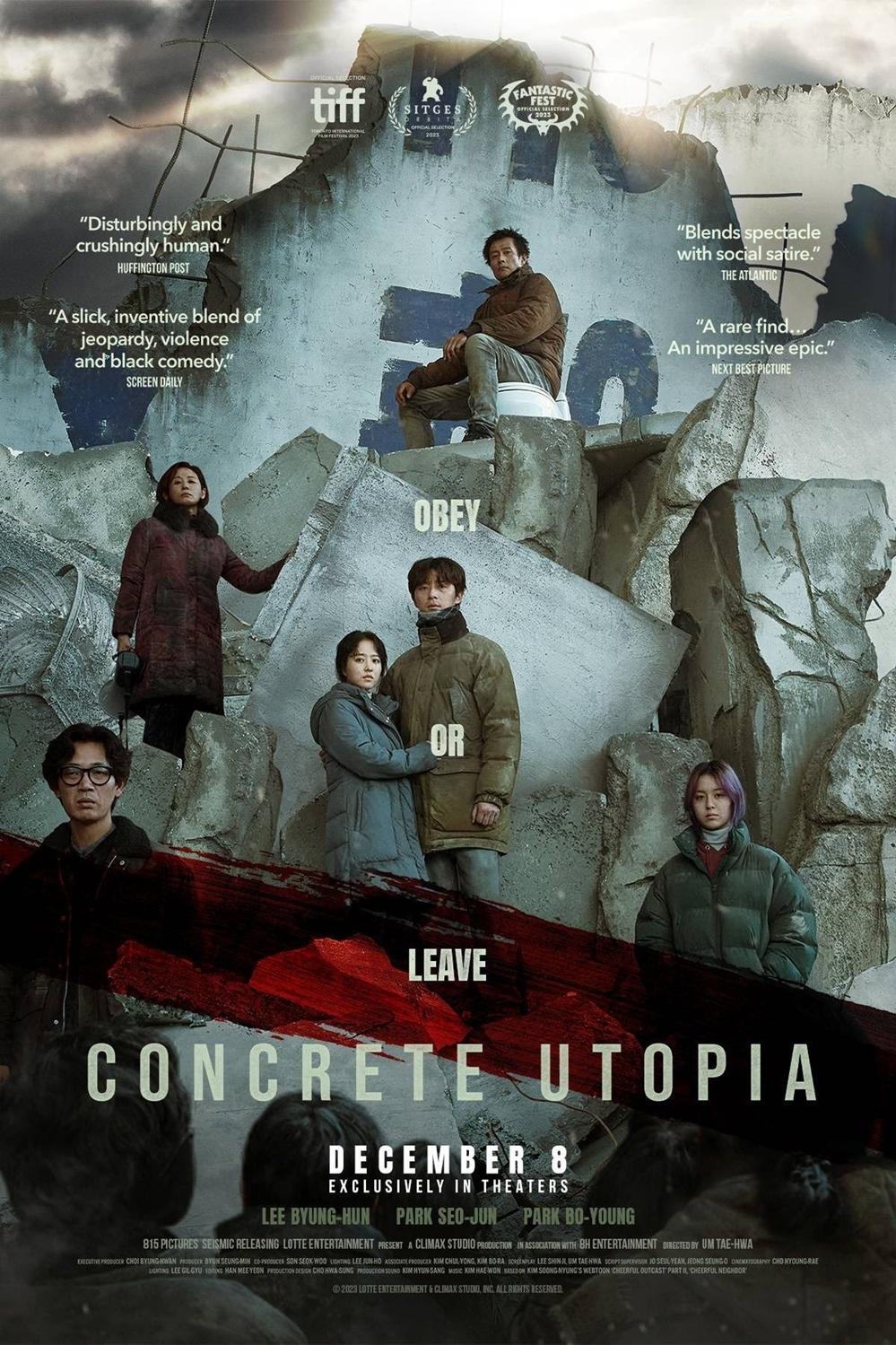
Survivors from a massive earthquake struggle for a new life in Seoul.
الإعلان الترويجي
طاقم العمل
Lee Byung-hun
Yeong-tak
Park Seo-joon
Min-sung
Park Bo-young
Myung-hwa
Park Ji-hu
Hye-won
Kim Sun-young
Keum-ae
Kang Ae-shim
Yeong-tak's mother
Tae-goo Eom
Homeless #1
Na Chul
Suit man
Hee-Jun Oh
Homeless #3
Jeon Young
Medical team leader
Joo In-Young
Kim Po-daek
Kim Do-yoon
Do-gyoon
Joon-bae Kim
Homeless #4
Kim Hak-sun
Member of the National Assembly
Jong-hwan Park
Real Kim Yeong-tak
Tae-joon Kim
Hidden resident #3
Kim Hee-sang
Resident #307
Kim Ye-eun
Cohab woman
قد يعجبك أيضًا
صيادو الأراضي القاحلة
The Assassin
War of the Arrows
Island
The First Responders
سيد الخواتم: خواتم القوة
The War Between the Land and the Sea
ظل وعظم
سوباسيل
دماء الشباب
Fate: The Winx Saga
ماركو بولو
شرلوك الشاب
سقوط الفارس
نعومي
Kung Fu
Encantadia
Love Beyond the Grave
Martial Universe
Cloak & Dagger
The Land of Warriors
The Eternaut
ستار تريك: أكاديمية ستار فليت
The Company
التعليقات
10 تعليق
Greetings again from the darkness. Dropping ordinary people into extraordinary circumstances is sure to generate some interesting cinematic results, and that's what writer-director Tae-Hwa Eom and co-writer Lee Shin-ji do in South Korea's official submission to this year's Academy Award for Best International Feature Film. The film opens with a devastatingly powerful earthquake in 2020 Seoul. When the dust settles, the Hwang Gung Apartment building is still standing. This is in stark contrast to the surrounding rubble as far as the eye can see. The city lies in ruins, at least in this section of the heart of town. Initially things go as you'd hope with neighbors helping neighbors and families re-grouping and embracing. However, with temperatures dropping and other shelter impossible to find, the residents of the Hwang Gung Apartments become concerned about the influx of 'outsiders'. As everyone becomes anxious about resources and supplies, the building residents begin to organize, and have soon voted to evict the outsiders, while naming one man, Yeong-tak (Lee Byung-hun) as the Delegate (leader) of their cause. This, after he is seen courageously sacrificing his own safety to put out a fire in an apartment. The initial neighborly courtesies transition to self-preservation and protection of family. Much of the story focuses on one young couple, Min-sung (Park Seo-jun) and his wife, altruistic nurse Myung-hwa (Park Bo-young), who shows concern about human nature exposing the dark side for many of the fellow tenants. The apocalyptic or dystopian environment brings out the worst of many who seem unwilling to consider the proverbial 'shoe on the other foot'. The residents organize into factions: anti-crime, rations, medical, maintenance, and waste management. The organization provides not just a way to occupy minds and keep residents alive, but also an 'us against them' mentality. When Hye-won (Park Ji-hu), a Hwang Gung resident who was not there when the quake hit, makes her way back home, the tone shifts and the organization is exposed. She brings information about the Delegate, implying that he may not be the hero they presume him to be. This segment brings some flashbacks to just before the quake hit, allowing context that helps us understand more. Her arrival makes the third act even more emotional and frantic. The politics of South Korea living spaces is touched upon in the opening, but director Eom is much more focused on exploring human nature ... those ordinary folks in an extraordinary situation. Desperation leads to irrational thought and survival mode overrides all logic. Normal people become more militant, more unforgiving, and less charitable. What the apartment residents did not consider is that those "outsiders" (or "roaches", as they are called) become even more desperate and their aggressiveness is certain to rise along with their will to survive. Those living in South Korea will surely have an appreciation for the political aspects of the film, and everyone will recognize the warning signs of human nature when things go sideways - as they seem to quite frequently these days. Whether it's political commentary or a precautionary tale, filmmaker Eom makes the points effectively. Opening in NYC and LA on December 8, 2023 and nationwide on December 15, 2023.
The impressive South Korean production «Concrete Utopia", at first glance, seems like a simple show based on Kim Soong-Nyung's webtoon «Pleasant Outcast - Part II». However, it is an ambitious story that addresses the three classic themes of art (love, life and death), and deals with a concept that is always present, at stake: private property. The idea of personalized possession versus the common good has always been in the debates of coexistence on Earth: it is not an issue that communists made fashionable, but this type of property is often at the heart of joy and dramas that can reach tragic levels. Since we are aware that there is a history of humanity, nature and our own human condition question it: from the earthquakes that ends states or nations, to the fragmentation of inheritances because of greed. In fact there is no problem with us wanting to have our private property, but rather with hoarding, territorialism and extreme nationalism, all root cause of so much misery in the world. «Concrete Utopia» is film with vast panoramas, spectacular visual effects and intestine struggles, but its plot is simple: during a cold winter, an earthquake shakes and destroys a metropolis of hundreds of high-rises, condominiums, horizontal properties, housing building glued to each other. However, an apartment complex remains standing, and victims arrive at that "surviving" concrete mass. Residents give them inn at first, but then, in defense of their exclusive property, they deny them shelter, throw them out and many die of hunger and cold. The residents organize, appoint a leader, go "hunting" (such as cavemen), and return with canned food. Soon they realize that they are surrounded by the thousands of victims of the catastrophe, the internal complaints grow and the situation explodes. The movie is long (130 minutes) and the plot has sections in which there are no shocks or bombastic physical actions. The first act is fierce and dynamic and concludes with the ruthless expulsion of the homeless victims. The second act is more leisurely, showing the construction of the surviving community, in which personalities change and false identities are discovered. The brief and violent third act includes external attack and the setting of scores. Fueled by the excellent performances of Lee Byung-Hun as the leader with mud feet, that of Park Bo-Young as the sweet nurse who becomes his antagonist (both winners of the Grand Bell for Best Actor and Supporting Actress) and that of Park Seo-Joon as a young warrior, «Concrete Utopia» is a drama full of irony and sarcasm about the struggle of humans to defend their little parcels, in a framework of visual splendor for all audiences.
A film that tells the story of humanity's survival from a terrible disaster. But the disaster that really threatens them is actually human nature itself. This film depicts humanity at its worst. I love how the film opens with a documentary about the development of apartments and their importance in upgrading modern lifestyle and providing convenience. Throughout the film, the apartment becomes a symbol of protection and not just a place for them to live. Right after that, we get to see the terrible disaster that seemed funny and absurd to me. They said it was an earthquake, but what I saw feels like Godzilla is coming out from surface of the earth. No reason prior to it, no news from the government, no presence of military powers. There is a scene that discusses whether to accept the outsiders (non-resident) or to evict them. Since food resources have become scarce with the increase of people, they need to make an important decision which will be voted according to the majority of the original residents. I felt like this scene should've been more intense and more dramatic because it questions the moral of humanity. Accepting and helping them will result in reducing food resources while casting them out means letting them to die with no protection. Doesn't this count as a 'Collective Act of Murder'? But the scene felt light and less serious and the decision they chose also seemed easy to make without any strong objections from others. Maybe it's the director's vision to show the selfish nature of human greed when they feel threatened. To be honest, there is not a single character in this movie that I like. The lack of character development makes it difficult for me to connect with them. Overall, this movie is quite good and fun to watch especially for fans of disaster movies and survival movies.
You get just enough character backstory to understand what's going on. No over-the-top heroism, no hysterics and no lingering on the terror such a situation would inevitably bring. No do-or-die situations and no narrow escapes, just grinding reality, scene after scene. No fight between good and evil resulting in a victor, just everyone making the best choices they can in that moment. Remarkably, the opening scene is mundane; a man getting out of bed. We wonder why he's wearing a puffy vest and why his face and hands are scarred. We're left to imagine the cataclysmic event with only one short flashback scene coming later in the film. But only to explain the actor's scars, not to visualize the cataclysm. Clearly, we're meant to see that human nature is the horror, not the event that brought out the worst - and the best in people. The excellent leading trio share the screen well and all get equal time. The supporting cast is sublime; not a character out of place, not a discordant voice. I don't normally enjoy dystopian thrillers; mainly because of all the elements listed above that are lacking in this film. Maybe 'enjoy' is too strong a word; it's hard to enjoy seeing the worst in humanity laid bare. Still, this was so well done and so engaging, it deserves every one of those 10 stars.
It is kinda like "Lord of the Flies", meets "I Am Alive: Surviving the Andes Plane Crash", meets a disaster movie. Firstly, the effects are pretty good, and it is hard to tell what is practical and what is CGI for most part. There's not many studios out side Hollywood who can pull off these types of effects movies, and South Korea is certainly competing and catching up with them. It is a psychological study of people in a crisis situation, and how you would react and what depths they would stoop to to survive. It is well crafted, but there are some areas which you could only describe as major loop holes. I mean South Korea is a technically advanced nation, so where is the government within all this and the rescue operation. Even if the whole country was affected by the quake, there would be international aid. There is no explanation to why they are still in exactly the same position 2 months later. Still, if you can put that aside, its an enjoyable disaster movie with plenty psychological twists.
Some evaluate this as a dystopian thriller, but I think that is the wrong category. This film is not really a thriller like 2012, The Day After Tomorrow, etc... The dystopia background is just incidental and not really relevant to the plot. The film is an examination of humanity both during time of crisis and just in general. The people of the "utopia" were misguided in thinking they were chosen and above the rest. This led them to be heartless and egotistical. As the time goes by, they became more and more resentful of the outsiders, calling them roaches. Towards the end, there was clearly a reference to North Korea's isolation in the scene when they were punishing the residents who kept refugees. One may mistaken their reluctance to exile the perpetrators as compassion, but it was all about control. This is why they humiliated them by forcing them to recite "We were wrong" 200 times publicly. This is a tactic of oppressive control quite familiar in North Korea and even communism China. The rise and fall of the utopia was inevitable due to human nature of selfishness, victimhood, and pushing blame. You may notice that when the delegate was exposed, everyone blamed him for exiling the outsiders when it was clearly an landslide resident vote. The mother of the woman's association also blamed the delegate for her son's death even though she was aware of the risks of going outside. Overall the ending nailed it when the main character's wife said, "They were just ordinary people." The people of the Utopia were neither good or bad persay, but just normal people with human flaws. Even the delegate himself was rather a tragic character, who was scammed, then lost his family, and was voted into position he didn't ask for and ultimately scapegoated for their failures. The ending also draws attention to the contrast of character. The group of survivors in the end were more understanding, compassionate, etc.. because the were a gathering of survivors, those who had gone through the hardship. In contrast, the apartment survivors were all from the same building that went unscathed. This is why they were out of touch with what was happening out there in the real world. Definite a 10/10 for the story, the acting, and the special effects.
The idea is undeniably intriguing, taking quite a unique approach within the realm of post apocalyptic features. However, the execution falls short of doing it complete justice, as the presentation leaves much to be desired. Followers of Korean cinema, in particular, would likely agree that this film does not live up to the exceptional quality they are usually known for producing. The main issue is the tonal inconsistency of the writing. At times, the story takes on a serious tone as expected in typical dystopian stories, but then it abruptly tries to incorporate elements of dark comedy, culminating in a jarring blend that felt out of place and unnecessary.
When everything falls apart, it's hard to know what will happen, especially in relations between survivors. Will mankind pull together to promote the uncertain continuation of the species, or is it a case of every man for himself? In this South Korean disaster film about what happens when a massive (and unexplained, not to mention highly improbable) earthquake destroys all of Seoul (and beyond apparently), except for one high-rise apartment building whose residents must decide whether to save only themselves or attempt to help displaced outsiders, despite a crucial lack of resources. What follows is essentially an apocalyptic retelling of The Lord of the Flies, with occasional back story flashes in the vein of television's Lost. However, the film's modestly engaging psychological thriller aspects aside, much of the narrative consists of a string of predictable (and not especially original) episodic incidents, most of which consist of various factions battling one another to become the prevailing alpha dogs. It's not something we haven't already seen many times before. What's more, there's precious little in the script to make viewers want to care about these people, primarily because of its tepid character development and an overreliance on recurring conflict (yawn). Add to that obvious and heavy-handed stabs at metaphorical geopolitical symbolism, erratic shifts in overall tone (particularly in the film's first half), and a handful of feeble attempts at comic relief, and you've got a picture in need of serious retooling. It's indeed puzzling to see the many accolades that have been so generously lavished on writer-director Tae-hwa Eom's third feature outing in light of the project's pervasive failings. But, beyond its imposing special effects and an impressive production design, there's not much here to write home about. Wait for this one to come to home media if you're really interested in sitting through this overlong slog.
An average apocalyptic film about how human nature can change in a dystopian world after a global earthquake disaster, or more precisely, what human beings can do. In the words of the film; in such an environment, a new life where the priest and the thief, the bottom and the top are now equal. If I'm not mistaken, a professor said, "After the Istanbul earthquake, they will neither be able to get in nor get out." The film prompts us to think about this. Yes, we live with ideals while living an ordinary life, but will we be able to stay close to our ideals as the conditions get harder? It is a good film, but it is overlong and has fictional problems. Especially the earthquake scenes are something strange like a tsunami. I think a planet should hit the earth for such an earthquake. It would be a better film if another disaster was chosen instead of an earthquake.